

College costs have jumped 170 percent since 1980, easily outrunning paychecks. In Sarasota, every glossy campus brochure is a reminder.
A 529 plan lets money grow—and come out—federal-tax-free for tuition. Because Florida has no state income tax, there’s no deduction to chase, so strategy, not ZIP code, makes the difference.
Enter the specialist. A fiduciary advisor compares plans, syncs savings with retirement, and applies new rules like the 2024 option to roll up to $35,000 of leftover 529 dollars into a Roth IRA.
We sifted filings, reviews, and credentials to spotlight seven Sarasota firms that turn dense 529 rules into clear action steps. By the end, you’ll know exactly who to call and what to ask.
How to choose a college-savings advisor in Florida
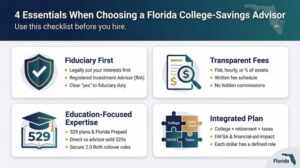
To choose the right college-savings advisor in Florida, confirm four essentials upfront: fiduciary duty, transparent fees, education-specific expertise, and full-plan integration.
First, verify fiduciary status. A fiduciary must put your interests first, delivering advice instead of a sales pitch. Most independent Registered Investment Advisors qualify; many brokers do not. Ask directly and expect a clear “yes.”
Second, check fee clarity. Top planners spell out costs before you sign anything. Whether they charge a flat project fee, hourly rate, or asset-based percentage, you should see the schedule in writing and understand exactly how they are paid.
Third, insist on college-focused knowledge. A qualified advisor speaks fluently about Florida Prepaid contracts, direct-sold versus advisor-sold 529 plans, and the 2024 Roth rollover rule. If those phrases cause a pause, keep looking.
Fourth, demand integration. College savings touches retirement, taxes, and estate goals, so your advisor should connect every 529 contribution to the bigger picture of your life and timeline. When each dollar has a role, you have found your partner.
The 7 best 529 plan advisors in Sarasota, FL
1. Signature Financial Solutions: Personalized plans that connect college, insurance, and taxes
Signature Financial Solutions sits just east of I-75, yet it serves families across Sarasota who want every dollar working in sync.

Signature Financial Solutions Sarasota website homepage screenshot
Michael Reich and his team hold credentials usually seen on Fortune 500 benefit sheets—LUTCF for insurance expertise and ChFC for advanced strategy. They act as fiduciaries when providing investment advice, so conversations stay focused on your goals, not sales quotas.
Integration is their hallmark. Open a 529 and they show how the contribution lines up with your term-life coverage and annual gift-tax limits. Considering Florida Prepaid? They run side-by-side projections so you see which mix lowers risk and raises flexibility.
The firm also teaches. Its online guide,Building a Child’s College Fund, breaks complex rules into friendly checklists, then invites you to a no-pressure meeting to refine the numbers. Parents leave with one unified plan and the relief that nothing slipped through the cracks.
2. SRQ Wealth: Fee-only fiduciaries who weave college goals into a bigger life plan
Walk into SRQ Wealth’s downtown office and the first question is not how much you have saved; it is why the money matters to you.

SRQ Wealth Sarasota fee-only advisory firm website screenshot
Steve Martin, CFP®, and his colleagues run a fee-only practice, so their pay rises only when your wealth grows. No commissions and no product quotas mean straight advice.
Education funding fits naturally beside retirement, taxes, and legacy wishes. The team models scenarios for University of Florida, New College, or a private out-of-state dream school, then shows how each path changes long-term cash flow. They also explain Florida Prepaid quirks and judge whether an out-of-state 529 beats the home plan’s low fees.
Clients praise the clarity. After a few meetings, you leave with a concise roadmap that keeps every goal moving in step.
3. Yaegers Financial Services: A family firm laser-focused on education funding
At Yaegers Financial, college planning is not a footnote; it is the headline.

Yaegers Financial Services Sarasota family firm website screenshot
The Sarasota-based father-and-son team has spent two decades guiding parents through 529 plans, Coverdell ESAs, UTMAs, and Florida Prepaid contracts. Their website reads like a crash course in education funding, complete with plain-language comparisons that strip away jargon.
Meetings feel just as approachable. You bring tuition dreams and a rough budget; they return a step-by-step savings map that blends monthly contributions, expected scholarships, and realistic market returns. If you worry about overfunding, they model the new Roth rollover rules so you see how extra dollars can shift into your child’s retirement.
Fees stay simple—flat planning engagements or an hourly rate when you only need a quick checkup. That flexibility attracts young professionals who want sharp advice without committing to full-service wealth management.
4. Kennon Financial: Straight-talking, ETF-driven strategies that keep costs low and clarity high
Kennon Financial opened in 2019 and quickly topped a quarter-billion dollars under management. The formula is simple: low-cost index ETFs, plain language, and a firm refusal to upsell.
Founder David Kennon learned to help retirees draw steady income; that educator’s instinct now benefits young parents, too. Sit down for a college-fund session and you get a quick primer on 529 basics followed by a data-driven plan—no fluff, no acronyms left unexplained.
Because the firm is fee-only, your 529 lands in a direct-sold plan with rock-bottom expenses. Kennon’s team monitors the allocation like any portfolio slice, dialing risk down as freshman year nears. They also map out Secure 2.0 rollover options so you see how leftover dollars become a retirement boost for your child.
Clients praise the sense of control. Instead of chasing stock tips, they follow a rules-based roadmap that keeps fees tiny and expectations realistic—two factors research shows drive most of the return you actually keep.
5. Ranch Capital Advisors: Hourly and flat-fee guidance built for young families who want flexibility
Newer does not mean untested. Ranch Capital Advisors launched in 2019 with a mission to strip complexity out of wealth planning for professionals in their 30s and 40s. Gregory Pacitti, CFP®, leads the charge, pairing Wall Street research with Main Street service.
The firm’s standout feature is choice. Need only a college-fund blueprint? Pay a one-time flat fee and walk away with a granular action plan: recommended 529, monthly target, anticipated FAFSA impact, plus a backup Roth-rollover strategy if your child wins scholarships. Prefer ongoing help? Choose an asset-based relationship where the team monitors every account—including the 529—and tweaks risk as college nears.
Interactive planning tools make the numbers tangible. Move a slider to raise contributions by fifty dollars and watch the projected shortfall disappear. Lower it and see exactly when you fall behind.
Because Ranch Capital charges no commissions, every recommendation rests on one test: does it serve your goal? That clarity resonates with parents juggling mortgages, daycare, and the relentless tick of the tuition clock.
6. LPF Financial Advisors: Four decades of perspective that keep college dreams and retirement on track together
LPF Financial Advisors has guided Sarasota families since VHS tapes were new. Longevity brings pattern recognition, and that shows in their education-funding playbook.
The firm, founded in 1989, blends multigeneration case studies with today’s analytics. Advisors remember clients who under-saved, those who over-saved, and the sweet spot where tuition gets paid without raiding 401(k)s. That history informs each 529 recommendation, whether you have toddlers or teens.
LPF runs a fee-based model—mostly asset-management charges, with separate planning fees when useful. Up-front disclosures spell out costs, so the process never feels murky.
Talk college and they ask about everything else: retirement timeline, potential Bright Futures scholarships, even whether grandparents plan to lump-sum gift under the five-year election. Then they stack those pieces into a timeline that shows when cash must appear and where it will come from.
Parents leave knowing a diploma will not derail their own retirement celebration.
7. Cumberland Advisors: Institutional-grade management for families with larger, multigoal balances
Cumberland Advisors manages billions for foundations and endowments, yet its headquarters sits unassumingly on Ringling Boulevard. Affluent Sarasota families tap that same research bench to power their own goals, college included.

Cumberland Advisors institutional-grade Sarasota wealth management website screenshot
The firm is purely fee-only. Your 529 slots into the same disciplined process that guides municipal-bond ladders and global equity sleeves for institutions. Analysts watch interest rates, inflation, and policy shifts daily, then adjust portfolios with care.
What does that look like for a college fund? A newborn’s account may tilt toward equities for growth, then glide into high-grade bonds as senior year nears. If markets wobble, Cumberland’s fixed-income expertise cushions the landing so tuition money stays on schedule.
Minimums run high—think seven figures across all assets—so Cumberland fits families who already treat wealth as a multigeneration enterprise. For those clients, the appeal is simple: one elite team shepherds every dollar, whether it funds next semester’s dorm deposit or a grandchild’s future inheritance.
FAQs about 529 plans and working with an advisor
Do I really need an advisor, or can I open a 529 myself?
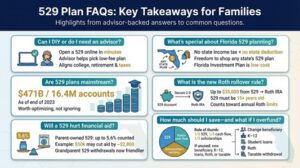
You can open a 529 online in about ten minutes, but an advisor helps you pick the lowest-fee plan, set the right monthly contribution, and navigate Secure 2.0’s Roth rollover rules. They also align college savings with retirement, tax, and estate goals, so every account works together.
What makes Florida different?
Because Florida has no state income tax, there is no deduction for 529 contributions. That freedom lets you shop nationally for the best plan. Many parents still use Florida’s low-cost Investment Plan, yet a skilled advisor compares options from Utah, Michigan, and other states to trim costs further.
How big is the 529 market?
At the end of 2023, American families held $471 billion across 16.4 million accounts. The scale shows these plans are mainstream—and worth optimizing.
What is the new rollover rule everyone mentions?
Secure 2.0 allows up to $35,000 of unused 529 money to move into a Roth IRA for the beneficiary starting in 2024. The 529 must be at least 15 years old, and rollovers count toward annual Roth limits, but the rule removes the old fear of overfunding.
Will a 529 hurt my child’s financial-aid chances?
Parent-owned 529 balances count as up to 5.6 percent of parent assets on the FAFSA, so a $50,000 account may reduce aid eligibility by about $2,800. Grandparent-owned accounts are even friendlier under the new FAFSA because withdrawals no longer count as student income.
How much should I save?
Start with today’s sticker price for your target school, add realistic inflation, then decide what share you intend to cover. Many advisors aim for one-third from the 529, one-third from future cash flow, and one-third from scholarships or student earnings. Software can model the exact monthly amount that fits your budget.
What if my child skips college?
You have options:
- Change the beneficiary to another relative.
- Spend up to $10,000 on K-12 tuition or student loans.
- Roll up to $35,000 into a Roth IRA under Secure 2.0.
- Withdraw for non-education use; you will owe income tax and a 10 percent penalty only on the earnings.
With these escape hatches, many advisors now view overfunding as a benefit, not a risk.
Conclusion
A 529 plan is a versatile, federally tax-favored account. The right advisor turns that raw tool into a tailored strategy, letting you focus on commencement, not calculations.