
https://unsplash.com/photos/tower-bridge-in-london-at-sunset-W8WYh5XmJpc?utm_source=unsplash&utm_medium=referral&utm_content=creditShareLink
Western Europe is often described as a balance between preservation and progress, but that framing suggests a tension that rarely exists on the ground. In reality, historic streets and modern skylines operate less as opposites and more as parallel systems. Old routes continue to guide movement. New structures rise without demanding erasure. The result is a landscape where time layers rather than replaces itself.
Travelling across the region makes this continuity visible. Cities do not reset as borders are crossed; they adjust. Stone gives way to glass gradually. Density shifts. Pace recalibrates. What feels historic in one place informs what feels contemporary in the next.
Layered Permanence in London
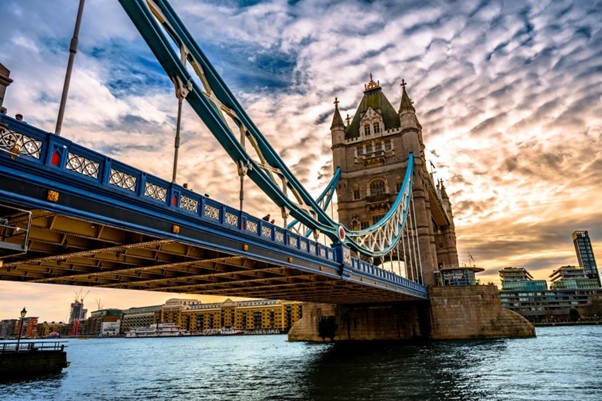
London rarely presents history as a complete picture. It appears in fragments — a medieval street folding into a financial district, a centuries-old market operating beneath steel and concrete. The city’s scale allows eras to coexist without resolving their differences.
Movement here is guided by inheritance. Roads follow older paths. Neighbourhoods retain their logic even as their functions change. Modern towers rise, but they rarely dominate the way people navigate the city at street level.
London’s skyline signals ambition, but its streets retain memory. Daily life unfolds in the space between the two.
Crossing the Channel Without Breaking the Rhythm
Leaving London does not feel like stepping away from its story. It feels like extending it outward. The train from London to Paris allows this shift to happen with minimal disruption.
As the landscape changes, density tightens. Fields compress into towns. The sense of continuity remains intact. Arrival feels prepared rather than abrupt, as though the transition had already begun before the train slowed.
Travel here functions as a hinge, not a divide.
Formality and Focus in Paris
Paris approaches history with intention. Where London accumulates, Paris arranges. Streets align. Sightlines extend. Space behaves predictably.
The city’s historic core feels ordered rather than compressed. Monuments anchor movement. Modern buildings appear, but they respect proportion and hierarchy. Even contemporary additions feel folded into a larger plan.
Paris’s skyline does not compete with its streets. It reinforces them, maintaining a visual logic that prioritises continuity over disruption.

Northward Flow and Changing Scale
Movement through Western Europe often mirrors shifts in cultural tone. Travel north from Paris introduces looseness without losing structure.
Taking the London to Amsterdam by train (via Paris or Brussels) reveals this recalibration clearly. Urban density relaxes. Water begins to organise space. Streets widen, then narrow again with different intent.
The journey doesn’t erase what came before. It reframes it.
Transparency and Confidence in Amsterdam
Amsterdam’s relationship with history is notably pragmatic. Canals dictate layout. Buildings adapt rather than assert. Height remains restrained, allowing the skyline to feel open even as modern architecture integrates quietly.
Glass and steel appear without apology, but they do not overpower the city’s scale. Modern design here emphasises transparency — visual and social. Movement remains human-sized. Streets stay legible.
Amsterdam demonstrates how innovation can coexist with preservation when neither seeks dominance.
Streets That Remember Their Purpose
Across Western Europe, historic streets continue to perform their original roles. Markets remain markets. Squares remain gathering points. Thoroughfares retain their directional logic.
This persistence grounds modern development. New skylines rise in response to need rather than novelty. When old routes remain active, cities avoid fragmentation.
Heritage here survives not through isolation, but through continued use.
Skylines as Signals, Not Replacements
Modern skylines in Western Europe tend to signal economic focus rather than redefine identity. Financial districts cluster. Innovation zones emerge. Yet they rarely erase the older city beneath them.
This restraint allows cities to grow without losing coherence. Glass towers mark function, not dominance. They exist as layers, not substitutes.
The skyline becomes a reference point, not a replacement for street-level life.
Movement as a Form of Understanding
Rail travel across the region reinforces this layered experience. Distances shrink without flattening context. Each city retains its rhythm while remaining connected to others.
Trains allow observation without interruption. Landscapes transition gradually. Cultural differences register subtly rather than dramatically.
Understanding builds through motion rather than contrast.
Why Western Europe Feels Continuous
What connects London, Paris, Amsterdam, and countless cities between them is not similarity, but compatibility. Each has learned how to absorb change without surrendering structure.
Historic streets remain active. Modern skylines rise with intent. Neither demands priority. Instead, they inform each other, creating urban environments that feel both grounded and forward-looking.
Cities That Carry Time Side by Side
Western Europe does not ask visitors to choose between past and present. It allows both to remain visible, functional, and relevant.
Between medieval lanes and glass towers, meaning accumulates quietly. Streets remember. Skylines respond. Life continues without needing resolution.
And it is this ability to carry time side by side — without erasure, without nostalgia — that gives Western Europe its distinctive sense of depth: cities that do not replace themselves, but evolve in full view of where they have already been.