
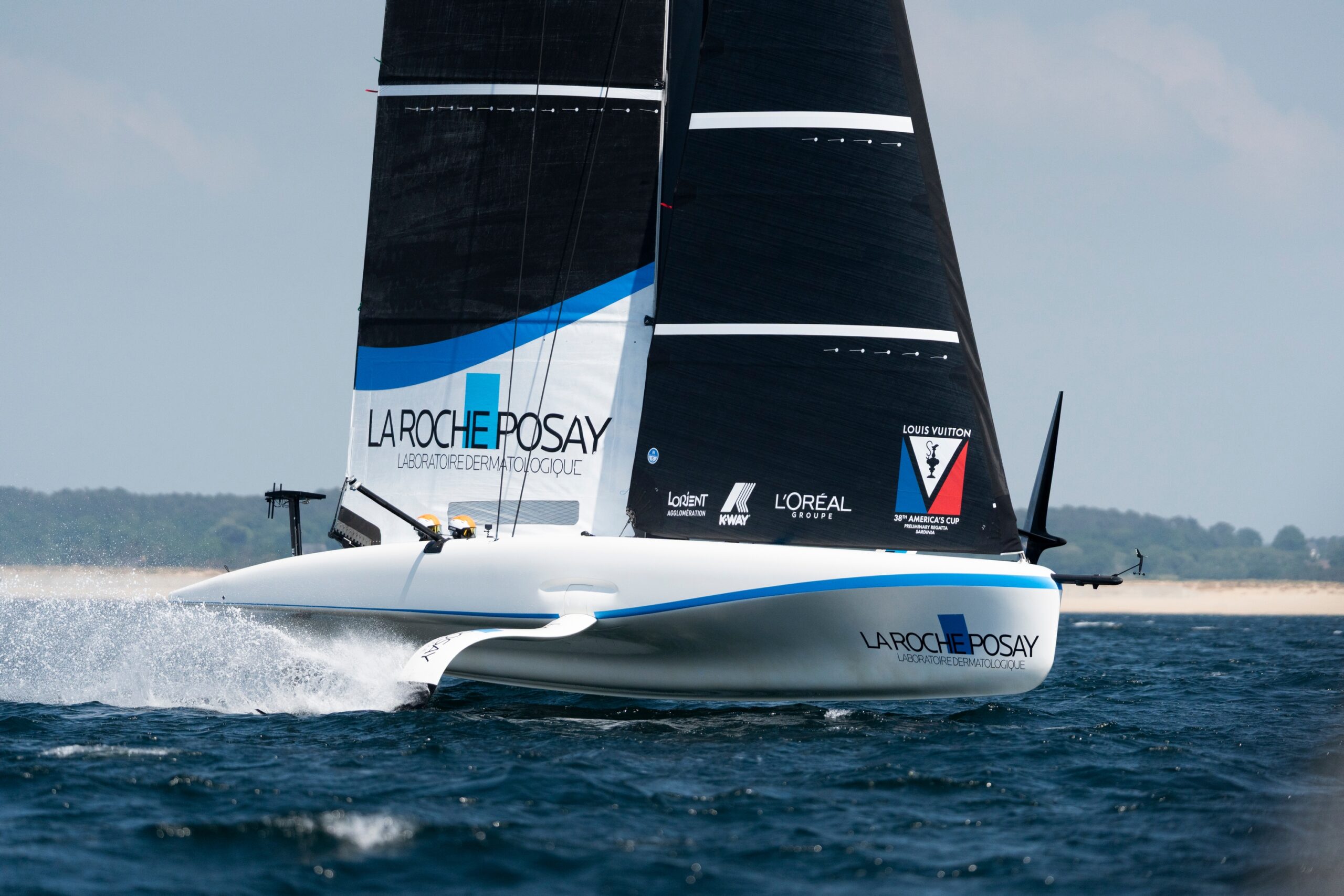
There is a particular kind of tension that exists the day before competition begins. Training is over. The preparation phase disappears. What remains is execution, pressure, instinct, and the reality of lining up against the best in the world.
That atmosphere now surrounds the La Roche-Posay Racing Team as the French challenger prepares for the Louis Vuitton 38th America’s Cup Preliminary Regatta in Sardinia, the team’s first real confrontation against the international fleet ahead of the 2027 America’s Cup in Naples.
And honestly, what makes this moment compelling is not simply the competition itself. It is the feeling that this regatta represents a transition, from isolated preparation to public evaluation, from controlled training to unpredictable racing.
For the French team, Cagliari is where theory finally meets reality.
The Beginning of a New America’s Cup Chapter
Beginning May 21 on the Gulf of Angels in Cagliari, eight AC40 boats will compete in the opening preliminary regatta of the 38th America’s Cup cycle.
The format is intentionally intense: one official training day followed by three days of fleet racing and a match-race final between the top two crews. While the event itself will not contribute points toward Naples 2027, everyone involved understands its deeper significance.
This is not about trophies yet. It is about measurement.
For months, La Roche-Posay Racing Team has been preparing away from public attention in Lorient, France, focusing on manoeuvres, timing, communication systems, and understanding the extremely reactive AC40 platform.
Now, for the first time, those systems will be tested against traffic, pressure, split-second decisions, and direct competition from the world’s strongest sailing teams.
A Team Built Around Precision and Chemistry
What stood out to me throughout the team’s statements is how often they speak about coordination rather than individual talent.
America’s Cup racing has always existed at the intersection of athleticism, engineering, and instinct, but modern foiling boats elevate that complexity dramatically. At these speeds, every movement becomes interconnected.
The French team will field Quentin Delapierre and Diego Botín as helmsmen, alongside trimmers Jason Saunders and Florian Trittel.
It is an intriguing combination of continuity and fresh talent.
Delapierre and Saunders bring experience from previous America’s Cup campaigns, while Botín and Trittel arrive as Olympic champions adapting to the AC40 environment for the first time. That balance between familiarity and evolution appears central to the team’s current philosophy.
According to sporting director Philippe Presti, the focus has been on building reference points quickly and creating stability within onboard roles due to limited sailing time.
And honestly, that emphasis on communication feels just as important as raw speed.
The Mediterranean as Both Playground and Threat
One thing longtime sailing fans understand is that racecourses themselves often become characters in the story.
The Gulf of Angels may appear visually calm, but conditions in Sardinia can change rapidly. The Mediterranean is notoriously difficult to read, particularly with shifting wind patterns and sea state conditions that directly affect high-performance foiling boats like the AC40.
The regatta is expected to feature crowded starting phases, close crossings, and limited room for error with eight boats sharing the same race area.
That matters because the AC40 is not forgiving.
These boats are capable of extraordinary speed, but they demand absolute precision in transitions, manoeuvres, and flight control. Rougher water conditions only amplify those demands.
The French team has already experienced the unpredictability of Sardinia’s conditions during practice sessions leading into the regatta, facing heavy winds before finally finding lighter breeze conditions for several days of sailing.
It is exactly the kind of environment where chemistry and adaptability become as important as outright pace.
Quentin Delapierre Understands What This Moment Means
Perhaps the most revealing quote from the team came from skipper Quentin Delapierre himself.
Describing training in Lorient, he admitted the team had become “kings of the track” while sailing alone, but emphasized that Cagliari would provide the “reality check” they now need.
That level of honesty feels refreshing.
There is confidence within the team, certainly, but there is also realism. Some competing syndicates have accumulated more sailing days and even trained with multiple boats, giving them additional experience in race scenarios and close-quarter tactics.
La Roche-Posay Racing Team has taken a different route, prioritizing internal development, boat feel, and systems refinement rather than early direct competition.
Now they finally get to discover how that preparation compares against the fleet.
More Than a Regatta
What makes America’s Cup preparation fascinating is that every event serves multiple purposes simultaneously.
Yes, teams want strong results. But preliminary regattas also function as live laboratories. Every manoeuvre, mistake, tactical decision, and systems issue becomes data that shapes future development.
Philippe Presti described the event as one of the rare opportunities to “put everyone into real confrontation.”
That phrase captures the essence of this stage perfectly.
Because in the America’s Cup world, pressure itself is part of the testing process.
How does the organization respond under stress? How quickly can sailors adapt during unpredictable situations? How effectively can communication systems function when races become chaotic?
Those answers matter just as much as finishing positions.
France’s Growing Presence in Modern America’s Cup Racing
Another interesting aspect of this campaign is how clearly the French team has evolved organizationally compared to previous cycles.
Delapierre himself acknowledged that the arrival of figures like Philippe Presti, Philippe Mourniac, Lucas Delcourt, Diego Botín, and Florian Trittel has significantly strengthened the project.
The team now appears far more structured in terms of performance analysis, systems development, and long-term strategic preparation.
That evolution reflects a broader reality of modern America’s Cup racing. These campaigns are no longer simply sailing teams, they are highly specialized technology and performance organizations operating at elite international standards.
And France clearly intends to compete seriously within that environment.
Final Thoughts
There is something uniquely cinematic about the America’s Cup.
The boats seem almost unreal at speed, skimming above the water with astonishing precision while teams make split-second decisions that can completely reshape a race within moments.
But beneath the spectacle lies something more human: preparation, trust, pressure, and the constant pursuit of improvement.
For La Roche-Posay Racing Team, the Sardinia preliminary regatta represents far more than an early-season event. It is the first opportunity to discover who they truly are when the pressure becomes real.
And sometimes, those first tests reveal more than victories ever could.
For more info, visit here.