
Luxury travel is the fastest-moving corner of the global travel economy. This page collects the market sizes, growth rates, and spending figures that matter, every one from a named, linked source. Writers and journalists are welcome to cite these numbers with a link back to this page.
Luxury Travel Market Size and Growth
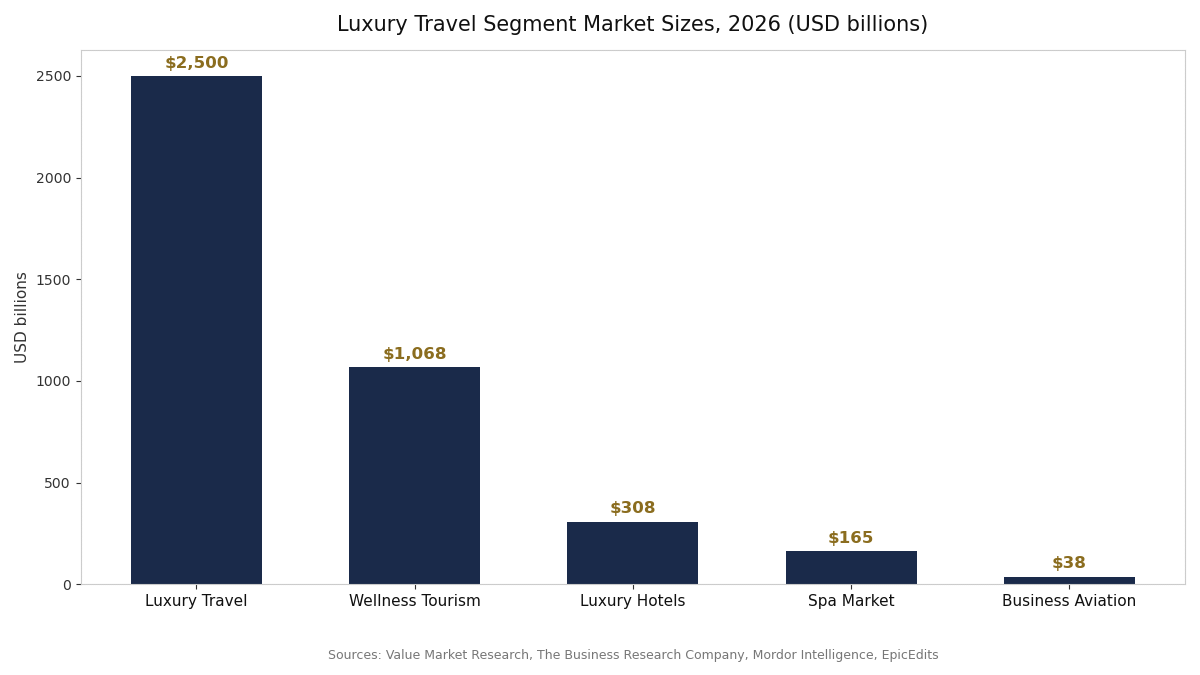
The global luxury travel market is valued at an estimated $2.50 trillion in 2026, up from $2.30 trillion in 2025, and is projected to reach $4.81 trillion by 2034 at an 8.53% compound annual growth rate (valuemarketresearch.com).
Market.us puts the 2026 figure at $1.828 trillion, growing at 7.8% annually (news.market.us). The definitions differ between research firms, but the direction is identical: strong, sustained growth.
The United States is the largest luxury travel market in the world. The US luxury travel market was estimated at $428.48 billion in 2025 and is projected to reach $783.06 billion by 2033, growing at 7.8% annually (giiresearch.com).
Spending confidence among affluent travelers is high. According to the 2025 Luxury Travel Report by Preferred Hotels and Resorts, about 68% of luxury travelers intend to take one to three leisure trips during 2025, and about 55% expect to increase their travel spending versus the prior year.
Los Angeles Tourism by the Numbers
Los Angeles remains one of the most visited destinations in the United States, and its tourism numbers anchor the luxury story on the West Coast.
- Los Angeles welcomed 49.5 million visitors in 2025, generating $42.6 billion in local business sales, about $118 million of economic activity a day (roadgenius.com).
- The visitor industry supported more than 530,000 jobs across Los Angeles County and produced $3.4 billion in state and local tax revenue (smdp.com).
- International visitation totaled 6.4 million in 2025, down 3% from 2024, with Mexico, China, Canada, Japan, the United Kingdom, Australia, and South Korea as the top source markets.
- The average Los Angeles hotel rate in 2025 was $196.06, the lowest among the major US comparison markets tracked by Travel and Tour World, which makes LA a relative value play at the luxury tier (travelandtourworld.com).
2025 was LA’s weakest tourism year since the post-pandemic recovery, driven by January wildfire disruptions and declining international visitation. The rebound story for 2026 and 2027, with a historic run of global sporting events on the way, is one to watch.
Luxury Hotels and Spa Spending
Luxury hotels are the backbone of luxury travel spending. The global luxury hotels market was valued at $288.52 billion in 2025 and is projected to grow from $307.77 billion in 2026 to $515.89 billion by 2034, at a 6.67% annual growth rate. North America dominates with a 36.84% market share (valuemarketresearch.com).
Wellness is the fastest-growing line item inside the luxury hotel stay:
- The global wellness tourism market will grow from $974.57 billion in 2025 to $1.067 trillion in 2026, a 9.6% annual rate, on its way to $1.545 trillion by 2030 (giiresearch.com).
- The global spa market is expected to grow from $159.15 billion in 2025 to $164.66 billion in 2026, reaching $221.02 billion by 2031 (mordorintelligence.com).
- International wellness tourists spend 41% more than the average international tourist, according to Global Wellness Institute data cited by GMI Insights (gminsights.com).
Hotels increasingly treat spa and wellness facilities as revenue centers rather than amenity costs, with destination resort spas running 40 to 60% profit margins.
Private Aviation
Private aviation has moved from niche luxury to serious industry. The global business aviation market closed 2025 at $34.0 billion and is forecast to clear $38.2 billion in 2026, with 24,850 active aircraft and 5.4 million annual movements (epicedits.co.uk).
- Worldwide business jet departures hit 1.95 million in the first half of 2026, up 4% year over year (WINGX via sherpareport.com).
- Fractional ownership departures reached approximately 300,000 in 2025, a 75% increase since 2019, with fractional fleets at roughly 1,300 aircraft in service (magellanjets.com).
- Honeywell’s Business Aviation Outlook forecasts 8,500 new business jet deliveries worth $283 billion over the next decade, the highest projection in the forecast’s 34-year history.
North America accounts for nearly 72% of all business jet departures, with 1.4 million departures in the first half of 2026. The private jet charter services market alone is valued at $16.38 billion in 2025, growing to $17.67 billion in 2026 (researchandmarkets.com).
Experiences Over Things
The engine under all of this is a durable consumer shift: spending on experiences instead of possessions.
- According to the Mastercard Economics Institute, consumers’ share of spending on experiences excluding travel rose to 20.4% in 2025, up from 19.9% in 2024 (businessnewsthisweek.com).
- Mastercard’s 2026 research found 59% of Europeans say they value experiences more than ever, while 46% are willing to spend less on technology, gadgets, or streaming to afford more leisure activities.
- 60% of millennials prefer spending on experiences such as travel, dining, and events rather than on physical goods (accio.com).
- Among US consumers, 58% prioritize experiential spending over goods (accio.com).
Travelers no longer want just a hotel room. They want the heritage property, the local food experience, the wellness retreat, the thing they can feel and remember. That is the demand curve luxury travel is riding.
The Buyers: High-Net-Worth Growth
Luxury travel runs on a growing base of wealthy buyers. The global ultra-high-net-worth population surpassed 625,000 people in 2025, controlling assets of $30 trillion and expanding 4% a year, according to Research and Markets (researchandmarkets.com).
Rising affluence in China and India is strengthening Asia’s contribution to the luxury market, while younger high-net-worth travelers increasingly prioritize immersive experiences over material goods. Corporate executives use point-to-point private connectivity to reconcile intense schedules with lifestyle choices, turning private aviation into a productivity tool rather than a status symbol.
The demographic shift toward diversified wealth centers is creating fresh demand in Southeast Asia and the Middle East. For luxury travel brands, the takeaway is geographic: the next decade’s growth comes as much from where new wealth is created as from how much is spent.
Chart: Luxury Travel Segment Market Sizes, 2026
Explore Luxury Travel With David’s Guide
Numbers describe the market. David’s Guide covers it on the ground. Start with our look at the Leading Hotels of the World, then explore the luxury hotels category for the openings, tastings, and experiences shaping 2026.
Sources
- Value Market Research: Luxury Travel Market Size, Share, Growth, Trends, Forecast, 2034
- market.us: Luxury Travel Statistics and Facts (2026)
- GII Research: U.S. Luxury Travel Market Size, Share and Trends Analysis Report, 2026-2033
- Value Market Research: Luxury Hotels Market Size, Share, Growth, Trends, Forecast, 2034
- RoadGenius: Los Angeles Tourism Statistics
- Santa Monica Daily Press: Los Angeles Tourism 2025: $42.6B Economic Impact
- Travel and Tour World article
- The Business Research Company via GII Research: Wellness Tourism Global Market Report 2026
- Mordor Intelligence: Spa Market Size Statistics and Industry Analysis 2031
- GMI Insights: Wellness Tourism Market Size and Share, Statistics Report 2035
- EpicEdits: Private Jet Industry Statistics 2026
- SherpaReport: Continued Growth in Private Jet Flights in 2026
- Magellan Jets: Fractional Ownership vs Jet Card: 2026 Solutions Guide
- Research and Markets: Private Jet Charter Services Market 2026-2031
- Business News This Week: Experience Economy: Why Consumers Are Spending More on Experiences in 2026
- Accio: Millennial Spending Trends 2025
- Accio: Shift and Trend 2025
