
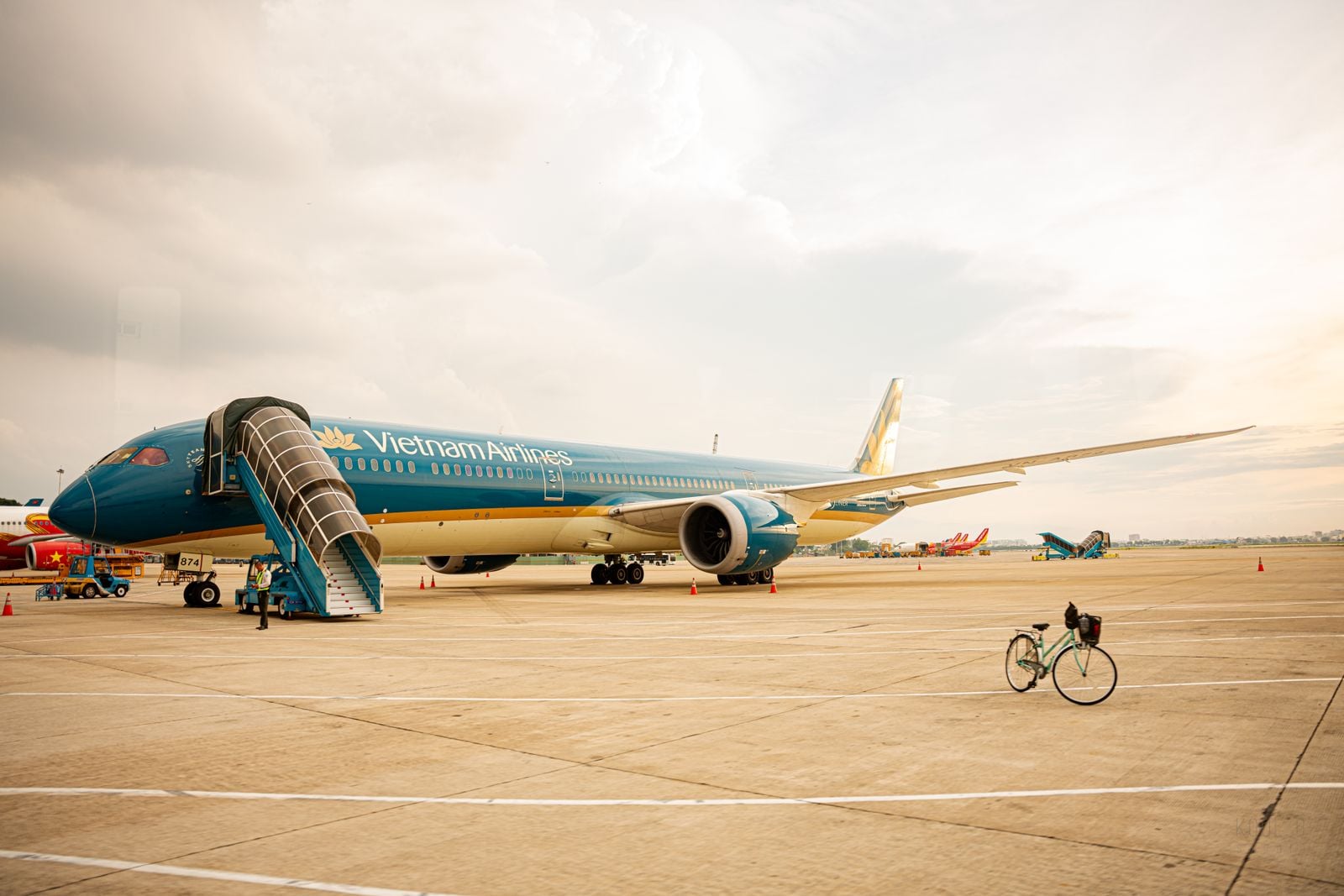
Flying with a bike in 2027 costs $45 to $50 each way on most US airlines, because the bike now counts as an ordinary checked bag. That covers a packed bike up to 50 pounds and 115 linear inches. The exceptions are the budget airlines, where a flat bike fee still applies, and JetBlue, where a size cap can refuse your case outright.
The old advice is out of date. A few years ago the standard answer was a $150 flat bike fee, and plenty of pages still say that. I compiled the fees for 8 airlines from published fee guides updated in October and November 2026 into one table below. Every figure is a published range, not a live quote.
What Does It Cost to Fly With a Bike in 2027?
Flying with a bike in 2027 costs $45 to $50 each way on American, Delta, United, Southwest, and Alaska, because all five treat a packed bicycle as a standard checked bag. There is no separate bike fee on any of them. A round trip adds up to $90 to $100 for the bike, assuming the packed case stays under 50 pounds.
The price is not the same on every fare. American charges $45 if you pay online and $50 at the airport, and Basic Economy costs $5 more per bag. United is the same split. Delta, Southwest, and Alaska charge a flat $45 for the first bag. The bike counts as that first bag if you have no other checked bag.
The number that matters most is the packed weight. A road bike in a hard case with wheels, tools, and padding lands close to 50 pounds fast. Keep the case under 50 pounds and the bike costs the same as a suitcase. Let it drift to 52 or 55 pounds and you can owe another $100 each way.
The Bike Fees I Compiled Across 8 Airlines
I compiled the bike fees for 8 airlines from published fee guides checked in October and November 2026. The table shows the first bag fee, any separate bike fee, oversize treatment, and overweight charges. These are published ranges, not live quotes.
| Airline | First bag each way | Separate bike fee | Oversize on a bike case | Over 50 lb |
|---|---|---|---|---|
| American | $45 online, $50 at airport | None | Waived | $30 from 51 to 53 lb, then $100 to 70 lb |
| Delta | $45 | None | Not stated as waived | $100 to 70 lb, $200 to 99 lb |
| United | $45 prepaid, $50 at airport | None | Waived | $100 to 70 lb, $200 to 100 lb |
| Southwest | $45 | None | Waived | $100 to 70 lb, $200 to 100 lb |
| Alaska | $45 | None | Waived | Waived to 70 lb, then $100 to $200 |
| JetBlue | $45 off peak, $49 peak | $100 fee still listed in some schedules | 80 linear inch cap | $150 from 51 to 99 lb |
| Frontier | $100 flat bike fee | Yes, $100 each way | Refused over 109 inches | Included in the $100 fee |
| British Airways | No fee, counts as a checked bag | None | Waived | Heavy bag charge over 23 kg |
In 2027, flying with a bike on a major US airline costs $45 to $50 each way, the price of one checked bag, with no separate bike fee as long as the packed case stays under 50 pounds and 115 linear inches.
Three things jump out. First, the five big US carriers cluster in a $5 band, so the airline barely changes the bike price. Second, Alaska is the most forgiving on weight. It waives the overweight fee up to 70 pounds, so a 60 pound bike box costs $45 each way there and $145 on Delta, United, or Southwest. Third, JetBlue is the one to avoid for a full size bike. Its 80 inch cap rules out most full size hard cases, and a $100 bike fee still appears in some of its fee schedules.
The sources are published fee guides that read the airline pages directly. Veloescapes read the five big US carriers in October 2026. Flightfare read eight airlines on October 5, 2026 and rechecked European fees on November 11, 2026. Gearbiking read airline pages on October 3, 2026.
Why Is There No Separate Bike Fee Anymore?
There is no separate bike fee on the big US airlines anymore because they moved bicycles into standard checked baggage. The old $150 fee was an oversize charge in disguise. A bike case is big, so it tripped the oversize limit. Once the airlines waived oversize fees for properly packed bikes, the bike fee had nothing left to charge for. American removed oversize fees for sports equipment including bicycles. United waives oversized fees on properly packed bicycles. Southwest and Alaska waive oversize up to 115 linear inches.
Delta is the one carrier to watch. It handles a bike as standard checked baggage and refuses anything over 115 linear inches or at 100 pounds or more, but its page does not state that oversize is waived. That is a gap in the published policy, not a fee, but confirm at the counter before you assume the $45 rate holds. The 2026 bag increases finished the shift. Delta raised its first bag to $45 effective April 8, 2026, and United and Alaska followed the same month.
How Do I Pack a Bike for a Flight?
You pack a bike for a flight in a hard case or a soft bag, with the pedals removed, the handlebars turned sideways, and the tires slightly deflated. United asks that the bike be padded and enclosed in a hard or soft case, with pedals removed and tires slightly deflated, and it is not liable for damage to bikes packed any other way.
A hard case protects the frame and the derailleur best, and it is the only packing JetBlue accepts without argument. A soft bag is lighter, which helps you stay under 50 pounds, and it folds flat at the destination. The tradeoff is protection, so a soft bag needs more padding around the frame, the fork, and the rear derailleur. A cardboard bike box from a bike shop is the cheapest option and it works, but measure it first. The 115 linear inch cap is the sum of length plus width plus height, and padding can push a box over the line.
Weigh the packed box on a bathroom scale before you leave home. That one check is the difference between $45 and $145 each way. Remove the pedals and bag them inside the case. Turn the handlebars sideways and secure them so they cannot swing. Deflate the tires slightly, not fully. Protect the fork ends and the rear derailleur. Put tools, a pump, and spares in the case only if the weight allows it, and take a photo of the packed bike before you close the case.
What Happens If My Bike Box Is Over 50 Pounds?
If your bike box is over 50 pounds, you pay an overweight charge on top of the bag fee, and the total can reach $145 to $200 each way. On American, a 52 pound box costs $45 plus $30, or $75 each way, and a 54 to 70 pound box costs $45 plus $100, or $145 each way. On Delta, a box over 50 pounds costs $145 each way up to 70 pounds and $245 each way from 71 to 99 pounds. On United and Southwest, the same math gives $145 each way to 70 pounds and $245 to $250 each way above that.
The weight limit is a hard refusal on some carriers, not just a fee. Delta will not accept a bike at 100 pounds or more. Southwest will not take a bike over 100 pounds or 115 inches. JetBlue will not accept anything over 99 pounds. Weigh the packed case at home and leave a margin. The cheapest fix is to move weight into your carry on. Tools, a pump, pedals, and a lock can travel in a backpack, and a second checked bag at $55 to $60 each way can be cheaper than a $100 overweight charge.
Can I Fly With a Bike on a Budget Airline?
You can fly with a bike on a budget airline, but the bike fee is flat and separate, and on a short hop it can cost more than your seat. Frontier charges a flat $100 each way for a bike, whatever the fare, and refuses anything over 109 inches or 99.9 pounds. That is simple to price, but $200 round trip for the bike is the price, with no way to reduce it by packing light.
The European budget carriers charge per flight, not per bag. Ryanair charges about $65 at booking and about $85 later, per flight, for a bike. easyJet charges about $75 online and about $80 at the airport. Flightfare priced a London to Mallorca trip and found the Ryanair or easyJet bike fee cost more than the seat in five of six cases. Price the bike before you price the ticket. Add the bike fee to the fare and compare the total against a legacy carrier, because a $45 bag fee on American can beat a $100 bike fee on Frontier once the ticket prices are close. Our domestic flight costs guide helps you see the full fare picture before you commit.
What About Flying With a Bike Internationally?
Flying with a bike internationally costs the same bag fee on most routes, but the weight limits get stricter. British Airways is the simplest case. A bike counts as one of your checked bags as long as it fits within 190 by 95 by 65 centimeters and 23 kilograms, about 50 pounds, with no sports surcharge. On a long haul or premium economy ticket with generous baggage included, the bike often travels for free. British Airways asks you to notify them at least 72 hours before the flight so they can plan hold space, so do not skip that step.
Delta does not accept bags over 70 pounds on flights to, from, or through Europe, which is a lower ceiling than the 100 pound domestic limit. Keep the international case light and put the extras in a second bag or your carry on. The rule that catches people is the return flight. The airline that takes your bike out may not be the airline that brings it home, and the partner carrier can have a different fee, size cap, and weight limit. Check both directions and the operating carrier before you book. Give yourself extra time at the airport, since the bike goes to oversize baggage. Read our guide to how early to get to the airport before you set your departure time.
What I Learned Flying Camera Gear Out of LAX
I have flown out of LAX with camera gear for 27 years, and the lesson that applies to a bike is the same one that applies to a camera case. The airline does not care what is inside the case. It cares about the weight, the size, and whether you packed it right. I learned to weigh every case at home, to photograph the packed gear before I closed the lid, and to arrive with time to spare.
The second lesson is that the fee is set before you reach the airport. Paying online, packing under the limit, and knowing the policy in advance is what keeps the price at $45 instead of $145. I have watched photographers pay overweight charges they could have avoided by moving a lens into a carry on, and the same mistake with a bike is a pump and a tool roll left in the case. I photograph my packed cases, I keep the baggage receipt, and I check the case before I leave the airport. If a bike arrives damaged, the airline will ask how it was packed, and a photo of a properly packed case is your answer.
FAQ
How much does it cost to fly with a bike in 2027?
Flying with a bike in 2027 costs $45 to $50 each way on most US airlines, because the bike counts as an ordinary checked bag. That covers a packed bike up to 50 pounds and 115 linear inches. Over 50 pounds, add $100 to $200 each way in overweight charges.
Which airlines charge a bike fee in 2027?
No major US airline charges a separate bike fee in 2027. American, Delta, United, Southwest, and Alaska all treat a packed bike as a standard checked bag. Frontier charges a flat $100 each way, and Ryanair and easyJet charge a per flight sports fee. JetBlue is the unclear case, with a $100 fee still listed in some schedules.
What size bike box can I fly with?
A bike case up to 115 linear inches, length plus width plus height, flies at the standard bag rate on American, Delta, United, Southwest, and Alaska. JetBlue caps bags at 80 linear inches, which rules out most full size hard cases. Frontier refuses anything over 109 inches. Measure the packed case before you book.
How much can a packed bike weigh?
A packed bike can weigh up to 50 pounds at the standard bag rate on most US airlines. Alaska waives the overweight fee up to 70 pounds. Over 50 pounds, the overweight charge is $100 to $200 each way depending on the airline and the weight band. Delta refuses bikes at 100 pounds or more, and Southwest refuses bikes over 100 pounds.
Is a bike box or a bike bag better for flying?
A hard case protects the frame and derailleur best and is the only packing JetBlue accepts without argument. A soft bag is lighter, which helps you stay under 50 pounds, and it folds flat at the destination. A cardboard bike box from a bike shop is the cheapest option. Whichever you use, remove the pedals, turn the handlebars sideways, and slightly deflate the tires.
Do I need to tell the airline I am flying with a bike?
British Airways asks you to notify them at least 72 hours before the flight so they can plan hold space. US airlines do not require advance notice for a bike in a case, but you should still check the policy for your exact flight, especially on a codeshare where a partner carrier may set the rules. If you are weighing whether the bike is worth the fee, run the numbers first with our points or cash flight math guide to see what the trip really costs.
