
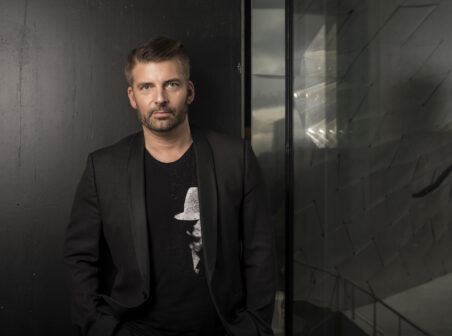
On November 16, 2025, the Walt Disney Concert Hall in Los Angeles came alive for a stirring performance by the Los Angeles Philharmonic under the baton of Matthias Pintscher, in a program aptly titled Mozart, Ravel & Pintscher. The afternoon concert, which formed part of a three-date run (November 13, 14, and 16), wove together the timeless elegance of Mozart, the impressionistic color of Ravel, and the probing modern voice of Pintscher himself.
An Imaginative Opening: Ravel’s “Mother Goose” Suite
The concert began with Maurice Ravel’s Ma mère l’Oye (Mother Goose Suite), a delicate suite that evokes fairy tales, childhood wonder, and magical gardens. Pintscher conducted with an imaginative touch, leading the orchestra through shimmering textures, gentle orchestral colors, and a dreamlike atmosphere. The work’s vignettes—ranging from “Sleeping Beauty” to “Tom Thumb”—were brought to life with a refined sensitivity that married playfulness and nostalgia.
A Premiere of Depth: Pintscher’s neharot
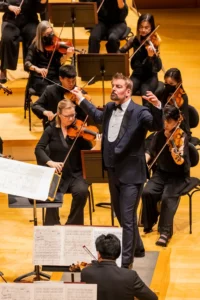
Following Ravel, Pintscher remained on the podium to conduct the Los Angeles premiere of his own work, neharot. Written during a particularly reflective period, neharot was described by the composer in interviews as a “search for light in the midst of troubled times.” The piece carried an emotional weight: moments of darkness and introspection were interspersed with soaring themes, and a trumpet solo soared like a beacon of hope—a poignant tribute, Pintscher said, born from his reflections during the COVID-19 pandemic.
Mozart’s Majesty: Piano Concerto No. 25
In the heart of the program came Mozart’s Piano Concerto No. 25 in C Major, K. 503, with Emanuel Ax as the soloist. This concerto, one of Mozart’s last, combined a sense of classical clarity with a deep emotional undercurrent. Under Pintscher’s guidance, the orchestra supported Ax’s interpretation beautifully: the opening movement carried an air of stately elegance, the slow movement was lyrical and deeply expressive, and the finale brought vivacious energy and technical flair. Ax, in earlier remarks, had called the slow movement “pure magic,” and during this performance, that magic resonated clearly across the hall.
A Climactic Finale: Ravel’s La Valse
To conclude, the program returned to Ravel with the powerful and haunting La Valse. Under Pintscher’s baton, the orchestra navigated the work’s dizzying shifts—from a graceful, elegant waltz to chaotic, almost apocalyptic momentum. The performance highlighted Ravel’s dual vision: the courtly charm of a bygone era, and the disintegrating world of early-20th-century Europe. Critics have long noted that La Valse embodies both elegance and violence, and this afternoon’s rendition did nothing to diminish that profound tension.
Pintscher at the Helm
Matthias Pintscher’s role as both conductor and composer gave the concert a compelling through-line. Known for his expressive conducting and his own compositional voice, Pintscher balanced the classical and the modern with confidence and clarity. In neharot, he drew from personal experience to shape a work of reflection and hope; in the Ravel, he captured impressions of wonder and dread; and with Mozart, he framed a masterwork that is rich in both structure and soul. His leadership brought coherence to a program spanning different eras, and his interpretation allowed each composer’s voice to shine.
Audience and Atmosphere
The Walt Disney Concert Hall, known for its superb acoustics and architectural beauty, provided an ideal setting for this program. Throughout the performance, the audience responded with attentive silence, clearly absorbed by the emotional journey of the music. The November afternoon light, filtering through the hall’s distinctive design, seemed to complement the concert’s themes of light and transformation.
Reports following the concert suggested that many felt deeply moved by Pintscher’s neharot, finding its emotional arc particularly resonant in today’s world. The juxtaposition of fairy-tale Ravel, introspective modernism, and classical formality created a balanced and thought-provoking experience.
Reflections on the Program
The Mozart, Ravel & Pintscher concert was, in many ways, a meditation on memory, time, and change. Ravel’s Mother Goose evoked childhood and innocence, while La Valse confronted history’s darker sweeps. Mozart’s concerto, placed in between, acted as a bridge—a piece rooted in classical elegance, but with emotional depth that nodded toward more modern sensibilities. Neharot, Pintscher’s own offering, stood as both a personal testament and a universal lament, a piece that looked inward even as it reached outward.
Pintscher has spoken before about wanting his audiences to find something personal in his music: not just to hear, but to feel, to reflect, and to discover new meaning. On this afternoon, that desire seemed well fulfilled.
Closing Thoughts
The November 16 concert of Mozart, Ravel & Pintscher was a vivid reminder of the Los Angeles Philharmonic’s commitment to programming that is both deeply respectful of tradition and daringly forward-looking. Through Pintscher’s dual role, the performance tied together different musical worlds in a way that felt cohesive, meaningful, and emotionally alive.
By the end of the concert, the audience seemed not only to have experienced a succession of masterworks but also to have been invited on a journey: from fairy-tale landscapes to the inner world of grief and introspection—and finally, into a waltz that reflected the collapse and reinvention of an entire epoch.
More info, please visit here.