
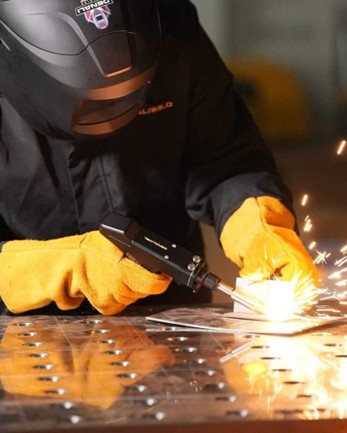
Choosing a Laser Welder: Key Differences Between Entry-Level and Industrial Models
With more laser welders for sale today than ever before, buyers face a critical decision: whether to invest in an entry-level laser welder or upgrade to an industrial-grade system. Each type serves different needs in terms of power, workload capacity, material compatibility, and long-term value. The challenge is simple but important—matching your welding requirements (material thickness, precision, production volume) with the correct machine.
Choosing the wrong type of laser welders for sale can lead to wasted resources, production delays, or welders that fail to meet your application demands. This guide breaks down the key differences so you can make an informed decision before investing.
What Is a Laser Welder — Common Ground
Regardless of size or price, all laser welders operate on the same core principle: a high-energy, focused laser beam melts and fuses metal parts together. This produces:
- Deep, narrow welds
- Minimal heat-affected zones
- Very low distortion
- Clean, precise seams
These advantages make laser welding ideal for applications requiring accuracy, repeatability, and minimal post-processing. This level of performance is especially valuable in modern manufacturing, where efficiency and precision directly impact overall productivity.
Entry-Level vs. Industrial Laser Welders: Core Definitions
Entry-level models are designed for:
- Small shops and fabrication studios
- Jewelry and electronics work
- Light metal repair
- Prototyping or hobby use
Characteristics of compact systems include:
- Lower power output suitable for thin to medium metal sheets
- Simpler components and maintenance
- More affordable pricing for new users or small operations
- Portable or desktop design for limited workspace
They are excellent for users who do not require continuous, heavy-duty welding.

Industrial Laser Welders
Industrial systems are engineered for:
- High-volume production environments
- Thick or highly conductive materials
- Long duty cycles
- Robotic or automated integration
Key traits include:
- High power output for deeper penetration
- Advanced cooling systems for continuous operation
- Superior build quality and stability
- Automation-ready designs for CNC or robotic lines
- Higher upfront cost but greater long-term ROI
These machines meet the demands of industries such as automotive, aerospace, heavy machinery, and large-scale fabrication.
Key Differences in Capability & Application
Material Thickness & Workpiece Size
Entry-Level:
- Best for thin sheets, decorative work, electronics components, or small assemblies.
- Limited penetration depth restricts use on thicker materials.
Industrial:
- Handles thick plates and large structural components.
- Delivers stable welds even on demanding metals like aluminum or copper.
Production Volume & Duty Cycle
Entry-Level:
- Ideal for occasional use, low-volume fabrication, and one-off projects.
- Lower duty cycles; prolonged use may cause overheating.
Industrial:
- Engineered for multi-shift, high-volume production.
- Stable performance during long, continuous welding cycles.
Precision, Weld Quality & Process Flexibility
Both machine types share the inherent precision of laser welding. However:
- Industrial welders offer better optics, beam quality, and stability.
- They maintain precision under more extreme workloads or material combinations.
- Entry-level welders produce clean welds but may struggle with highly reflective metals or complex joint geometries.
Automation, Integration & Advanced Features
Entry-Level:
- Typically manual or handheld systems
- Minimal automation options
Industrial:
- Programmable controls
- CNC or robotic arm integration
- Multi-axis movement
- Higher repeatability and consistency
These features are crucial for mass production facilities.
Cost, Investment & Total Cost of Ownership
Entry-Level:
- Lower entry cost
- Low maintenance requirements
- Suitable for startups or workshops with limited budgets
Industrial:
- Higher upfront investment
- Higher cooling, energy, and operational needs
- Greater long-term returns when used for heavy workloads
Before comparing laser welders for sale, be clear on whether your workload justifies industrial-grade spending.
Which Machine Should You Choose?
Use the following guidelines to match machine type to your needs:
Choose Entry-Level If:
- You fabricate thin metals or small custom parts
- Your production volume is low or moderate
- You need a compact, affordable, easy-to-use system
- You work in a small shop, studio, or prototyping environment
Choose Industrial If:
- You weld thick materials or structural components
- Your workflow includes continuous, repetitive production
- You require automation, robotics, or integration features
- Your shop handles demanding industrial projects
Consider Future Growth
If you expect to scale production, move toward thicker materials, or expand into new industries, an industrial system may provide better longevity.
Factors to Evaluate Before Buying Laser Welders for Sale
Here’s a practical checklist to guide your purchase decision:
Technical Requirements
- Materials you weld most often
- Typical thickness ranges
- Required penetration depth
- Precision or seam appearance needs
Operational Requirements
- Production volume and duty cycle
- Type of welds: small, intricate, structural, repetitive
- Workspace size and ventilation
System Requirements
- Cooling method (air-cooled vs. water-cooled)
- Laser type (fiber, CW, pulsed)
- Machine form: desktop, handheld, or industrial platform
- Compatibility with automation
Cost & ROI Considerations
- Upfront budget
- Expected lifespan
- Maintenance needs
- Energy consumption
- Overall productivity gains
If you are comparing different laser welders for sale and need a reliable, well-supported option, systems from Denaliweld offer configurations suited for both small workshops and growing industrial environments. Their selection includes handheld, compact, and high-performance models designed for daily use, backed by stable output, ergonomic design, and user-friendly operation. Always match specifications with your exact workflow to ensure the best long-term value.
Conclusion
Both entry-level and industrial laser welders provide the precision, cleanliness, and efficiency that make laser welding so attractive. However, they differ greatly in power, durability, automation capabilities, and workload capacity. The right choice depends on your materials, production scale, and long-term goals.
For fabricators, technicians, and business owners evaluating laser welders for sale, the key is simple: match machine capabilities to real application demands. With proper assessment—and with support from trusted providers, you can invest confidently in a system that improves productivity, weld quality, and operational efficiency for years to come.