
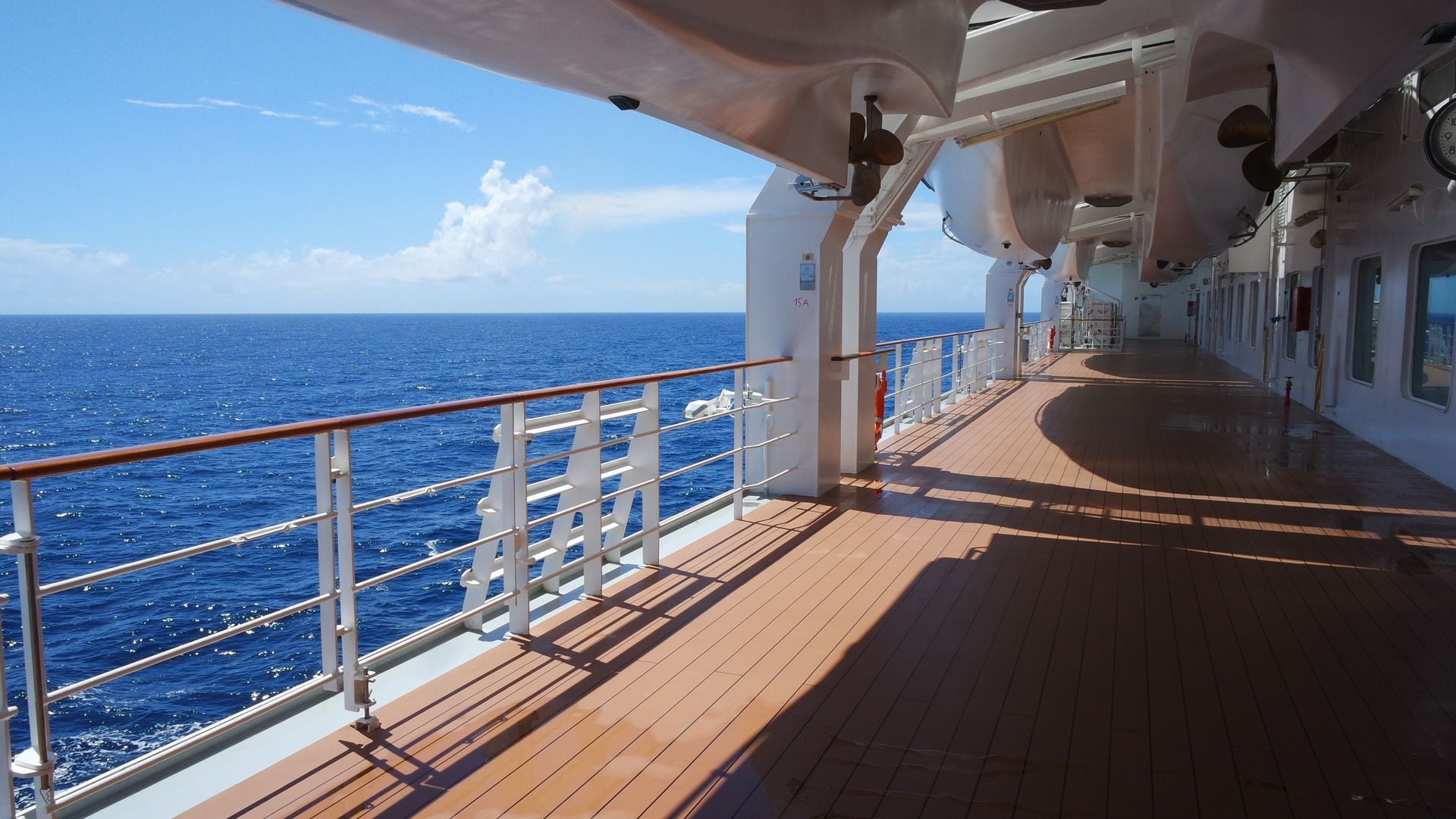
Can you really walk 57,000 steps on a cruise ship in one day?
Yes, and a cruise ship on a sea day might be the easiest place on earth to do it. On Monday, November 9, 2026, in the middle of a seven night Mexican Riviera sailing on Norwegian Encore, I walked 57,000 steps in a single day. That is a personal record for me. My previous best was 47,252. The ship left San Pedro on November 8 and returns November 15, and November 9 was a full sea day, no port, no schedule, nothing between me and the decks except meals. My device sync recorded 54,452 steps and 24.8 miles for the same day, and the reason my own count and the device count differ is part of the story, so I will get to it.
I am David Christopher Lee, Editor in Chief of David’s Guide. I log my steps and my food every day, and I usually walk around 30,000 steps on a high day. A sea day on a ship this size turned a high day into a record day, and I did not set out that morning planning a record. I set out to walk after breakfast. The ship did the rest.
Where do the steps come from on a sea day?
A big cruise ship is a walking city that never asks you to stop. Norwegian Encore is long, wide, and stacked with decks, and a full lap of the ship, end to end and back, is real distance before you have even decided to exercise. On a sea day there is no commute, no car, and no reason to sit in one place for long, so the steps stack up in layers that never feel like a workout.
Here is how the day actually built. I walked the decks in the morning. I walked to breakfast, and then walked after breakfast, because a post meal walk has become a habit I keep on land and at sea. I took stairs instead of elevators, which on a ship with this many decks is a decision you make dozens of times a day, and every one of those decisions is worth a few hundred steps and a flight of climbing. I walked the promenade. I walked to lunch, walked after lunch, and walked the ship end to end in the long, empty stretch of afternoon that a sea day gives you and a port day never does. I also lifted that day, because November 9 fell on a lift day in my every other day training rotation, and I do not move training days just because I am on vacation.
None of that sounds dramatic, and that is the point. There was no single heroic hike. There was a floating resort that rewards movement all day long, and a full day with nowhere else to be.
A big ship makes this possible in a way a smaller ship cannot. For the comparison, see Are Small-Ship Ocean Cruises Worth the Premium? At the luxury end of cruising, the experience looks very different, as Is Aman at Sea Worth It? Amangati Prices, Suites, and What Is Actually Included shows.
Why did I think I had only walked 50,000 steps?
Because my step counter was not registering properly, and I believed it. For most of the day the count I could see was running behind what I was actually doing. I kept walking, partly because the day was built for it and partly because the number I was chasing kept looking further away than it should have. When I finally stopped, I believed I had finished at about 50,000 steps, which would already have been a personal record.
I only learned afterward that the real total was 57,000 steps. The device sync, which recorded 54,452 steps and 24.8 miles, sat between my displayed count and my final reported count, and that spread is honest data, not a problem to hide. At this volume, counters disagree by thousands of steps. I publish all the numbers and say which one each calculation uses. I keep the full logged breakdown, step counts, distances, pace math, and the device comparison, in one place: the complete 57,000 step day, logged. If you want the short version, it is this. I aimed for a record, my counter under reported the day, I walked further than I thought, and the record was bigger than I knew until it was over.
What did I eat to fuel 57,000 steps on a cruise ship?
About 5,225 calories, and the cruise made that possible in a way my kitchen at home never could. My own logged model is simple: maintenance for me is 1,800 calories plus 60 calories per 1,000 steps. Run 57,000 steps through that model and maintenance lands near 5,220 calories, with a lift day target of about 5,620. I ate almost exactly maintenance and still finished about 395 calories under my lift day target. Eating that much real food, while spending most of the day on your feet, is harder than the walking.
The food itself was ordinary cruise food, eaten in ordinary cruise places, and I logged all of it. Breakfast was two chocolate muffins and black coffee. Lunch in the buffet and dining rooms ran long: a baked potato loaded with chili, a side salad, Italian wedding soup, beef moussaka, a white fish cake with tartar sauce, a chicken flauta, braised oxtail, jerk chicken breast with the skin left off, and a celery and cucumber salad. Dinner was cheese ravioli, roasted chicken with mashed potato and broccoli, a bread roll, a slice of no sugar added carrot cake, and then, because the day was not done, a second dinner of sliced turkey breast, shrimp in an Indian curry sauce, a fish fillet, another bread roll, and four small scoops of no sugar added vanilla ice cream. The day totaled 318 grams of protein, 421 grams of carbs, 246 grams of fat, and 47 grams of fiber.
If you want to run your own numbers before a sea day, the calculator I use is the Step Lab, which takes your steps and your weight and shows the distance, time, and calorie math without borrowing my body or my model. The lesson the buffet taught me is not that cruise food is fuel. It is that a 50,000 step day has to be fed on purpose, and a ship, with food available all day in the buffet and the dining rooms, is one of the few places where feeding it is easy.
What was it like doing this while traveling with my parents?
I am sailing this week with my parents, Norman, who is 76, and Jeanne, who is 70, and that matters to how the day worked. A sea day at their pace and a sea day at mine are different days, and both of them happened on the same ship. We ate together. We spent time together. And in the long stretches between, I walked decks they had no reason to walk, and nobody had to choose between family time and movement because the ship holds both at once.
That is an underrated part of cruising with family across generations. On land, a 57,000 step day would mean disappearing for nine hours. At sea, it means being gone for a lap and back for lunch. My parents got a relaxed sea day. I got a record. The ship absorbed the difference.
How can cruise passengers walk more and come home without gaining weight?
Start with the sea days, because they are the opportunity nobody uses. Most passengers treat a sea day as a day off from everything, including movement, and then wonder why a week of excellent food shows up on the scale at home. A sea day is actually the best walking day of the whole cruise: no port schedule, no excursion bus, no tender line, just decks, stairs, and time.
The habits that carried my day are available to any passenger, at any volume. Walk after meals, even ten or fifteen minutes around the deck after breakfast, lunch, and dinner, because those walks add up to thousands of steps nobody notices taking. Take the stairs instead of the elevator whenever the distance is a few decks, and accept that on a big ship that choice alone changes your day. Walk the ship end to end once in the morning and once in the evening instead of crossing it only when you need something. And use the port days that are coming. This sailing still has Cabo San Lucas, Mazatlán, and Puerto Vallarta ahead of it, and port days are walking days in disguise: tenders, marinas, malecóns, old town streets, and markets, all of it on foot if you let it be.
None of this requires 57,000 steps. A passenger who moves from a typical cruise day of a few thousand steps to 15,000 or 20,000 steps on sea days changes the whole math of the trip. The buffet is not the enemy of coming home the same weight. Sitting still for seven days next to the buffet is closer to it. My own logged day is the extreme end of that idea, and I keep the full record, including how far 50,000 steps actually is in miles, on The Walk Daily: 50,000 steps a day, the full logged breakdown.
If you are weighing the overall value of a cruise before you book, read Are Repositioning Cruises Worth the Money?
Should you try to walk 50,000 steps on your cruise?
Not cold, no. My normal high day is 30,000 steps, built up over a long time of logging and walking daily, and 57,000 was a jump even from there. If your normal day is 6,000 steps, a 50,000 step sea day is not a goal, it is an injury plan with a view. The honest way to use a cruise is to double or triple your normal for a day, enjoy how easy the ship makes it, and let the record attempts belong to people whose base already holds them.
What I would tell any passenger is simpler. The ship is already a walking track with restaurants on it. Use the sea days. Take the stairs. Walk after you eat. The steps are there whether you collect them or not.
Was 57,000 steps a new habit?
No, and I want to end on that, because honesty is the whole point of logging this stuff. November 9 was a ceiling test on a day built for it: a sea day, a lift day, a ship that rewards walking, food available all day, and a counter that quietly under counted me into walking further than I planned. The next day, November 10, was a rest day in my rotation, with Cabo ahead and a tender to catch. I am not going to walk 57,000 steps today, or most days, and neither should you read this as a standard to chase.
What it proved is narrower and more useful. A cruise ship, used properly, is one of the best walking environments most people will ever vacation inside. The record was mine. The environment belongs to anyone with a cabin key.
David Christopher Lee
Editor in Chief, David’s Guide
Aboard Norwegian Encore, Mexican Riviera, November 2026
