
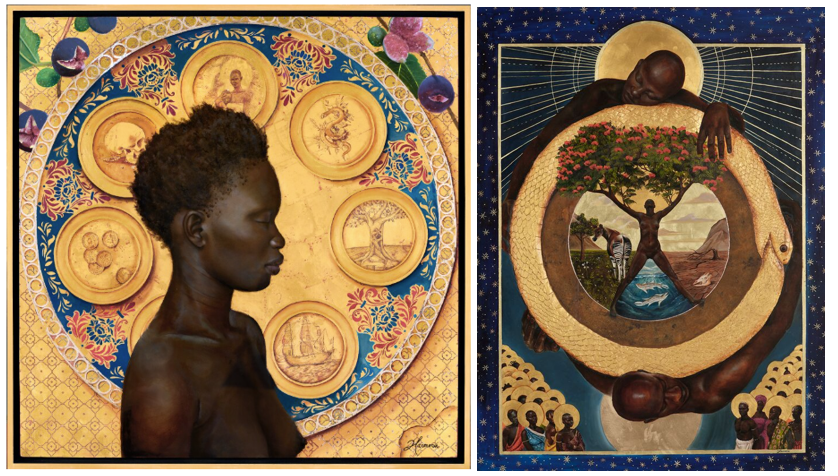
When Beginnings: The Story of Creation in the Middle Ages opens at the Getty Center in Los Angeles on January 27, 2026, it will bring together centuries of visual storytelling in a powerful dialogue between past and present. Among the exhibition’s most significant moments is the inclusion of contemporary artist Harmonia Rosales, whose work will be presented alongside medieval illuminated manuscripts from the Getty’s renowned collection. The pairing marks a pivotal institutional milestone for Rosales and signals a broader rethinking of how creation, divinity, and authorship are visualized across time.
The exhibition examines how the Biblical narrative of Creation was interpreted and transmitted during the medieval period, tracing how images shaped belief, imagination, and spiritual identity. By situating Rosales’s paintings within this historical framework, the Getty expands the exhibition’s scope beyond chronology, inviting viewers to consider whose visions of creation have endured—and whose have been erased.
A Contemporary Voice in a Medieval Conversation
Rosales’s work appears in direct dialogue with medieval manuscripts, including a response to the Getty’s Stammheim Missal, a significant object within the museum’s collection. A highlight of the exhibition is the debut of a new painting created specifically for this context, marking Rosales’s first major collaboration with the Getty. Rather than functioning as a modern counterpoint, her paintings operate as continuations of a long tradition of spiritual inquiry, reframed through a different cosmological lens.
“I approach my paintings as a way to reclaim stories long erased,” Rosales explains, “using Yoruba cosmology to restore strength and presence to figures often left out of history.” In conversation with medieval depictions of Creation, her work bridges epochs, challenging the assumption that Western religious imagery represents a universal narrative.
One of the works featured, Portrait of Eve (2021), exemplifies Rosales’s approach. Rendered in oil with gold and silver leaf on panel, the painting recalls Renaissance techniques while subverting their conventions. Eve is not depicted as a fallen figure or a derivative presence, but as a sovereign, radiant force—reclaiming origin itself as a site of power rather than transgression.
Reimagining Origins Through Yoruba Cosmology
Rosales is known for drawing from Renaissance and Baroque compositional strategies while centering African diasporic histories and West African spiritual traditions. Her practice reconsiders inherited narratives of origin and divinity, asking viewers to imagine creation through lineages that existed long before—and far beyond—the medieval European worldview.
In Beginnings, her paintings expand the exhibition’s inquiry geographically and philosophically. Yoruba cosmology, with its emphasis on interconnectedness, spiritual continuity, and ancestral presence, offers a framework that resonates across cultures while remaining rooted in African knowledge systems. By placing this worldview in dialogue with medieval Christian imagery, the exhibition invites reflection on how belief systems coexist, overlap, and inform one another across centuries.
A Pivotal Moment in a Expanding Career
The Getty exhibition arrives during a landmark period in Rosales’s career, one defined by both institutional recognition and public engagement. In September 2025, she unveiled her first public outdoor monument, Unbound (2025), commissioned by King’s Chapel in Boston. Created in partnership with MASS Design Group, the memorial honors the at least 219 children, women, and men enslaved by past members and ministers of the church.
Installed along the Freedom Trail, Unbound features a bronze figure lifting a birdcage as birds take flight across the courtyard. The imagery speaks to freedom, spiritual release, and transformation, while confronting the church’s historical complicity in slavery. As the cornerstone of King’s Chapel’s Living Memorial initiative, the work invites ongoing reflection, education, and dialogue around racial justice and reconciliation.
Expanding Mythology Through Literature
Rosales’s engagement with origins and storytelling extends beyond visual art into literature. Her debut book, CHRONICLES OF ORI: An African Epic, published in October 2025, reimagines West African myths for a contemporary audience. While the stories of the Orishas have traditionally been passed down orally, Rosales presents them in a narrative, linear framework that weaves ancestral knowledge with modern reflection.
Illustrated with twenty-six luminous paintings, the book honors both the physicality of the human form and the transcendent spiritual realm. The work situates Yoruba mythology within a global context, revealing connections to religious narratives across cultures while affirming the resilience of African spiritual traditions.
Following the book’s release, Rosales embarked on a multi-city tour at major museums and institutions, including Harvard University, the National Gallery in London, Spelman College, and the Pérez Art Museum Miami. The tour continues into 2026, reinforcing her role as both artist and cultural storyteller.
An Artist Reshaping Art History
Born in Chicago and raised in an Afro-Cuban American household, Rosales’s artistic journey began with a deep admiration for Renaissance painting. Yet it was her daughter’s observation—“they don’t look like me”—that exposed the exclusions embedded within that tradition. That moment became a catalyst for Rosales’s practice: reimagining canonical imagery with Black protagonists and restoring spiritual authority to figures historically marginalized in Western art.
Since 2017, Rosales has visualized the Orishas and explored the survival of their stories across the Middle Passage. Her work challenges Eurocentric ideals of beauty and divinity while asserting Black presence as central, not peripheral, to narratives of origin.
With Beginnings: The Story of Creation in the Middle Ages, Harmonia Rosales enters a new chapter—one that places her vision within a centuries-long continuum of image-making and belief. In doing so, the Getty exhibition not only honors her work, but redefines what it means to imagine the beginning of the world.
For more details, please visit here.