
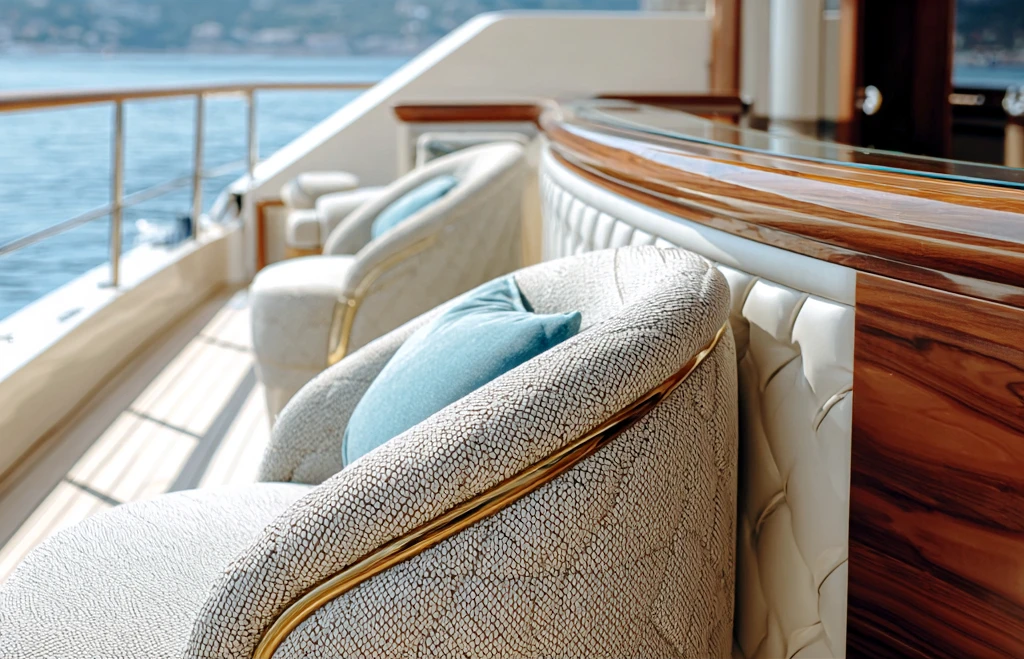
When it comes to yachts worth tens (or hundreds) of millions, the real luxury isn’t only in the engines or the hull design. It’s in the interiors: the bespoke furniture that transforms each vessel into a private floating villa. Beyond the glossy surfaces and panoramic decks, yacht owners and designers are investing in pieces that merge comfort, artistry, and identity.
There is nothing to stop you choosing an Edra Standard sofa for the living areas of your yacht, especially now that they have relaunched it in an outdoor version, but there are perhaps other design brands that are more focused on furnishing luxury boats. Let’s take a look at the purchasing habits of yacht owners and discover the brands most sought after by interior designers when it comes to private boats.
The Design Imperative
It’d be easy to dismiss interiors aboard yachts or jets as “just nice extras” to a magnificent machine. But in truth, they become the emotional glue of the experience. When you fly 40,000 feet above ground or drift in open water, every surface you touch, every curve you see, every shift in light tells a story. That story must feel personal, rich, and seamless. Luxury travelers don’t want to think, “I’m in a jet now”. They want to feel, “I’m in my space”, albeit one that’s adapted for altitude and wave.
We can now reveal the secret that most luxury projects involve Italian design brands, perhaps because Italy’s landscape combines both sea and mountains. From high-end boats to private jets flying over the Alps, there is a general consensus that Italian furniture has something extra that others lack. Giorgetti, Minotti, Bonaldo, and Vismara are just some of the names most in demand by design studios in the last year.
The Private Jet Interior Furniture: Elegance at Altitude
In the confines of a jet’s cabin, every inch counts. Italian heritage leather houses, such as Poltrona Frau’s In Motion division, are leaders in this domain. Poltrona Frau has for years produced custom leather seats, panels, and trim not just for homes, but for high-performance settings: cars, yachts, and yes, private jets. Their deep know-how in hide selection, stitching, and seam layout becomes critical when you’re flying at 500 mph. Each curve of a seat, each panel joint, must be engineered for tolerance, vibration, and accentuated in beauty. To complement those seats, texture is layered via wall panels and overhead liners. Italian textile houses like Loro Piana, known for fabric mastery, venture into yacht and aviation interiors with high-performance, treated fabrics that resist UV, humidity, and abrasion but still feel sumptuous. In a jet cabin, walls clad in velvet-blend surfaces add acoustic softness, while ceiling panels can emulate satin or silk under soft LED lighting. The result: you forget you’re in a machine.
One reason private-jet interiors from Italy stand out is their discipline in combining expressive design with utility. A bar module might fold elegantly out of a side wall, its front veneer wrapping like a small cabinet, concealing crystal holders, a wine cooler, and glassware. A compact desk might slide up, complete with electric charging, hidden USB ports, and a leather-wrapped inset. The challenge is seamless transitions: a panel that slides or pivots without revealing screws or mechanics. Some jets include little gestural touches: ambient lighting that changes color during descent, mirror-finish surfaces that double as screens, or recessed handrails in polished metal mirroring yacht hardware. The design trick is to hide as much as possible, so the eye rests on the beauty and coherence.
Yachts: Floating Palaces With Italian Designer Pieces
Step into a modern Italian yacht salon and you feel more like you’re entering a gallery or boutique hotel than a “boat lounge.” Designers bring an aesthetic language born in Florence into the hull, combining sweeping lines with subtle material transitions. The goal? To fuse form, light, and circulation so that one doesn’t “feel” the transitions between rooms, corridors, and outdoor decks. Walls might shift from glossy ebony wood veneer to backlit onyx. Floors may be marine-rated parquet with inlays of luminous resin or metal striping. Curved sofas (inspired by iconic land-based designs) hug panoramic windows. Sideboards hold wine cabinets behind flush doors; bookshelves appear as sculptural niches when closed. Italian kitchen brand Officine Gullo has redefined what a yacht galley can become with its Nautical Collection.
Rather than being stowed away, the galley becomes a social nucleus. With matte marble counters, built-in wine columns, and stainless steel modules in corrosion-resistant alloys, their pieces are part kitchen, part design centerpiece. On deck, bar islands morph into serving surfaces or cocktail stations integrated into the yacht’s architecture, not just bolted on. The boundary between the interior and the exterior is also merging. Retractable glass walls, sliding roofs, and furniture modules that shift between sheltered and open-air modes allow design continuity across decks. The same leather, wood, or textile cues follow you from the living salon to the aft terrace, always reinterpreted to withstand sun, salt, and splash.
Design Strategies for the Discerning Owner
If you’re an owner, here are strategies to help the design translate into a journey:
- Prioritize flexibility over showiness. Modules that shift, tables that fold, seats that stow: these permit evolving needs and future refits.
- Insist on full environmental modeling. Weight, balance, thermal behavior, vibration, all must be simulated.
- Commission bespoke, signature pieces. A custom chaise, a sculpted console, only you will own it.
- Design the transitions. Entry from gangway, staircase, bridge; how light, material, and scale evolve matters more than the big reveal.
- Harmonize across domains. The jet aesthetic and the yacht aesthetic should speak the same design language if your lifestyle spans both.
Also read: Travel in Style with Private Jet Charter