
Disclaimer: This article is not medical advice. This product is not intended to diagnose, treat, cure, or prevent any disease. Talk to your clinician before starting any supplement, especially if you are pregnant, nursing, taking medication, or managing a health condition. What follows is my personal routine, not a recommendation for you.
My routine is boring on purpose
I am 44. I train every other day. I am on a cut, aiming toward roughly 10 percent body fat, eating around 170 grams of protein a day. My routine is built on things that are not exciting to talk about: sleep, protein, lifting, and showing up again the next day. That is the whole system. There is no secret ingredient, and if someone tries to sell you one, keep your wallet closed.
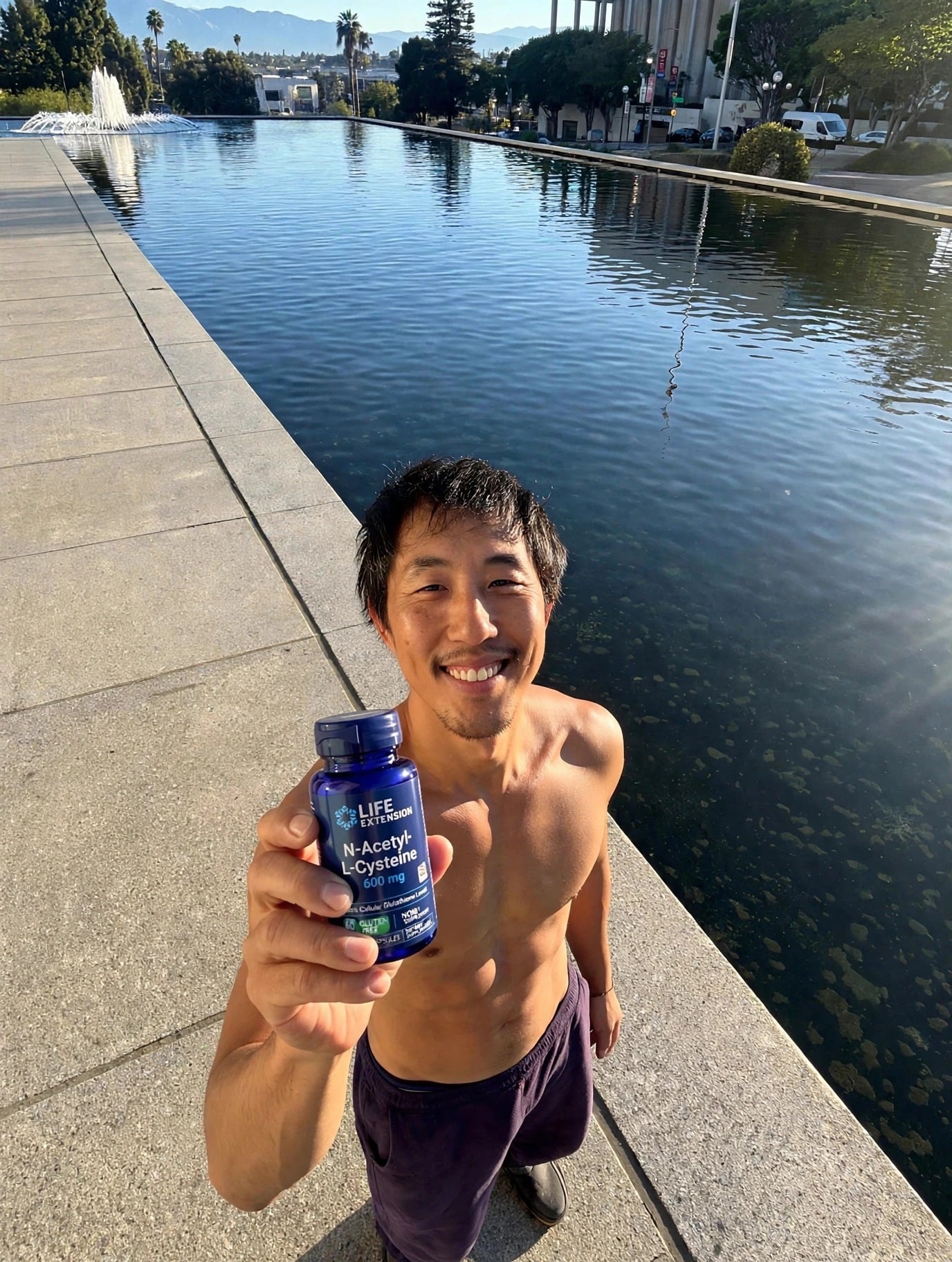
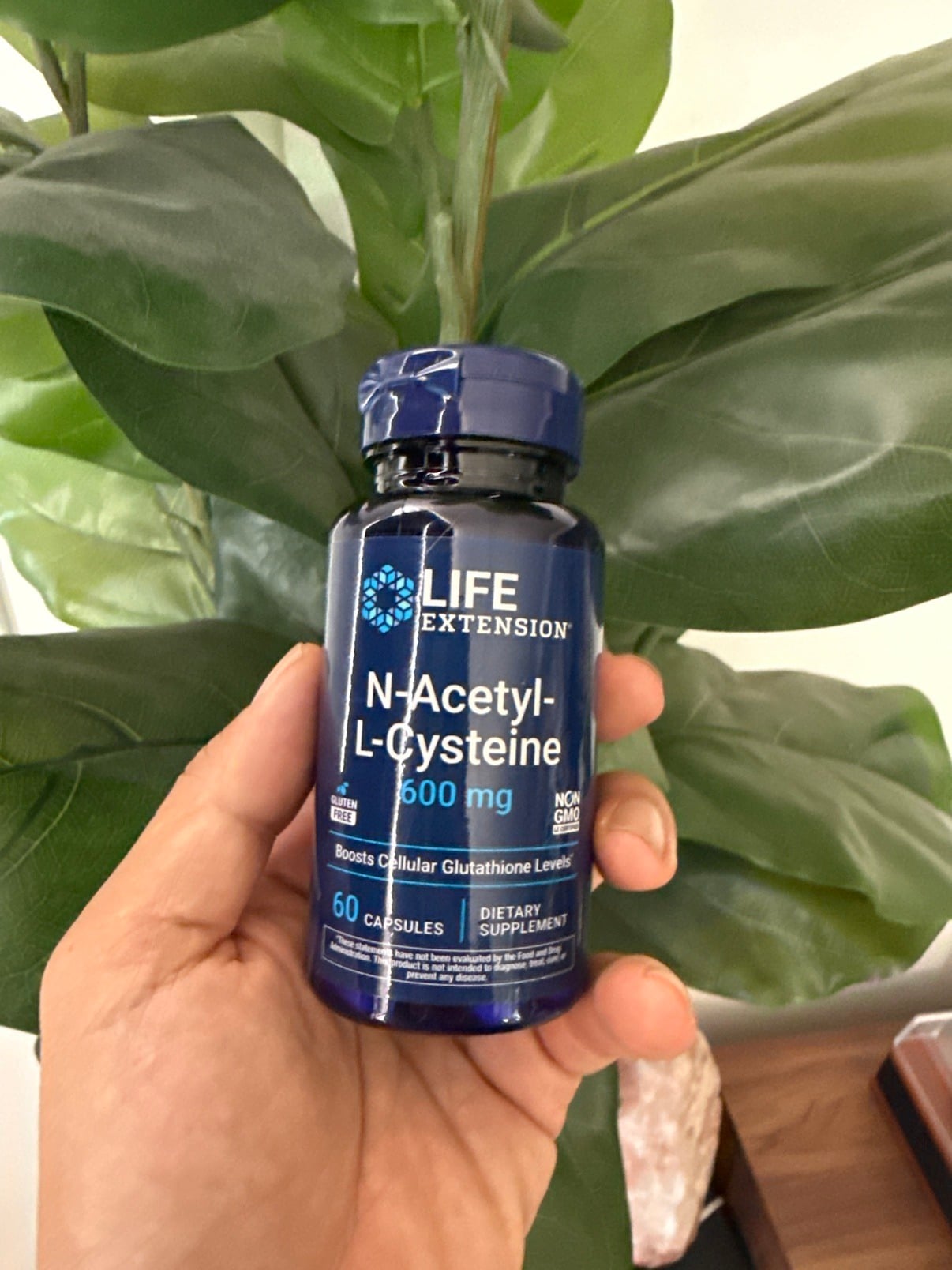
So when I talk about a supplement, I talk about it the same way. NAC, N-Acetyl-L-Cysteine, is not a transformation product. It is a simple, unsexy capsule, and that is exactly why it fits my routine. The bottle in the photograph is the one I have: Life Extension N-Acetyl-L-Cysteine 600 mg, 60 capsules, gluten free, non-GMO, with the words “Boosts Cellular Glutathione Levels” on the label. One ingredient. One clear dose on the label. No proprietary blend, no stimulant, no promise that it will change your life.
The bottle in the photo: Life Extension N-Acetyl-L-Cysteine 600 mg – not sponsored.
I like products that say one thing and do one thing. The supplement world is full of bottles that say twenty things and do none of them well. A bottle that lists a single amino acid derivative at a clear dose is the opposite of that. You know what you are taking. You can look up what it does. You can decide, with your clinician, whether it belongs in your routine at all.
What NAC is, in plain terms
Your body makes an antioxidant called glutathione. It is one of the main ways your cells handle the wear and tear of normal life: training, city air, stress, alcohol, and getting older. Glutathione is built from three amino acids, and one of them, cysteine, is usually the limiting piece. NAC is a stable form of cysteine. It supplies the raw material your body uses to make glutathione. It does not contain glutathione itself, and this article does not claim it will raise your levels by any specific amount, cure anything, or fix any condition. The mechanism is the story, and the mechanism is simple enough to state in one sentence.
Why would a person training and cutting care about that? Because hard training is stress, in the good sense and in the literal sense. You break muscle down, you recover, you get stronger. That process produces oxidative stress as a byproduct. Your body handles it with systems it already has, including glutathione. Supporting that system with adequate protein and, for some people, a cysteine supplement, is a way of taking care of the recovery side of training, not a shortcut around the training itself. No capsule replaces a workout, a meal, or a night of sleep. Anyone who tells you otherwise is selling something.
My protein target matters here too. At 170 grams a day, I am already eating a lot of the amino acids that build glutathione, from eggs, poultry, fish, and whey. Food comes first in my routine, always. A supplement is what it says it is: something added to a foundation that already exists. If your diet is low in protein, the most useful change is food, not a bottle. If your sleep is broken, the most useful change is sleep, not a bottle. I say that because I have watched too many people, including myself in earlier years, try to buy their way out of a missing foundation. It does not work.
Why this bottle, and what I check on any label
I am not sponsored by Life Extension, and this is not an advertisement. I am writing about the bottle in the photograph because it is the bottle I actually have, and because it is a good example of what to look for. First, the form: N-Acetyl-L-Cysteine, not a blend. Second, the dose on the label: 600 mg per capsule. That is the only dose this article discusses, because it is the dose on this label. This article does not tell you how many capsules to take, when to take them, or how long to take them. That is a clinician conversation, and I am not your clinician.
Third, the count: 60 capsules. That lets you work out the cost per capsule, which is the only honest way to compare two bottles. A bottle that looks cheap but contains half the capsules at half the dose is not cheap. Do the math before you buy anything.
Fourth, the quality labels: gluten free and non-GMO, printed right on the front. Those matter to people who need them, and they are a useful signal that the manufacturer is labeling clearly. They do not prove purity on their own. I look for manufacturers with a track record, published quality standards, and third party testing for identity and contaminants. Life Extension has been around a long time, which is a starting point, not a guarantee. Check the testing, not just the brand name.
Fifth, the claim: “Boosts Cellular Glutathione Levels.” Read that as the manufacturer’s statement of purpose, based on the cysteine mechanism described above. It is not a promise about your body, your training, or your results. Individual results vary, and anyone who promises you a specific outcome from a supplement is not being straight with you.
And the fine print on the bottle says what every supplement bottle must say: these statements have not been evaluated by the Food and Drug Administration, and the product is not intended to diagnose, treat, cure, or prevent any disease. I repeat that here because it is true, and because it keeps this article honest. NAC is a nutritional supplement. It is not medicine, and I do not treat it as medicine.
Where it sits in my day
My day, on a training day, looks like this: I eat protein at every meal, aiming for that 170 gram target. I train every other day, with rest days that are actually rest days, not excuses to skip. I protect sleep as much as a working photographer in Los Angeles can, which means I treat late nights as a cost, not a badge of honor. Supplements sit in that routine as a small, consistent habit, taken alongside the food and the other daily staples, not as a separate event.
The reason I keep a routine small is that small routines survive. A routine with fifteen capsules, three powders, and a timing schedule that requires an alarm for each one will not survive a busy week. A routine with a few clear items will. NAC fits that test for me because it is one capsule, one ingredient, one job. If a supplement cannot pass the test of “will I still be doing this in three months,” it does not earn a place, no matter how interesting the research sounds.
That is also why I am writing about it here, on David’s Guide, rather than only on a health site. Los Angeles is full of optimization culture, and much of it is noise. The most useful thing I can share from my own cut, at 44, is not a new compound. It is the discipline of keeping the routine simple: lift, eat protein, sleep, repeat, and let the small, well understood inputs support that, rather than distract from it. NAC is one of those small inputs for me. It is not the story. The story is the routine.
What I would tell a friend who asked
If a friend asked me whether they should take NAC, I would say three things. First, talk to your clinician, especially if you take medication, are pregnant or nursing, have asthma or a history of breathing trouble, or have a liver or kidney condition. Those are not scare tactics. They are the situations where a general article is not enough, and a person who knows your health history should weigh in.
Second, check your foundation first. Are you eating enough protein? Are you sleeping? Are you training consistently? If the answer to any of those is no, fix that before you buy a bottle. The foundation is where the results live.
Third, if you and your clinician decide a cysteine supplement makes sense, buy a transparent product: one ingredient, a clear dose, a manufacturer whose testing you have checked, and a cost per capsule you have calculated. Keep the routine small, keep it consistent, and judge it by whether you actually stick with it, not by whether it feels exciting in the first week.
That is my whole philosophy on supplements, and it is the same philosophy behind my training and my cut. Boring wins. Consistency wins. The flashy thing is usually the thing that does not last. NAC will never be the most exciting bottle on a shelf, and that is precisely why I trust it enough to write about it. It does one job, it says so on the label, and it fits a routine built on sleep, protein, and lifting, which is the only routine that has ever actually worked for me.
Related reading
[BIOHACK ARTICLE URL]NAC and Glutathione: A Clinician’s Plain Language Guide
NAC in My Daily Routine: A Simple, Honest Look at It
