
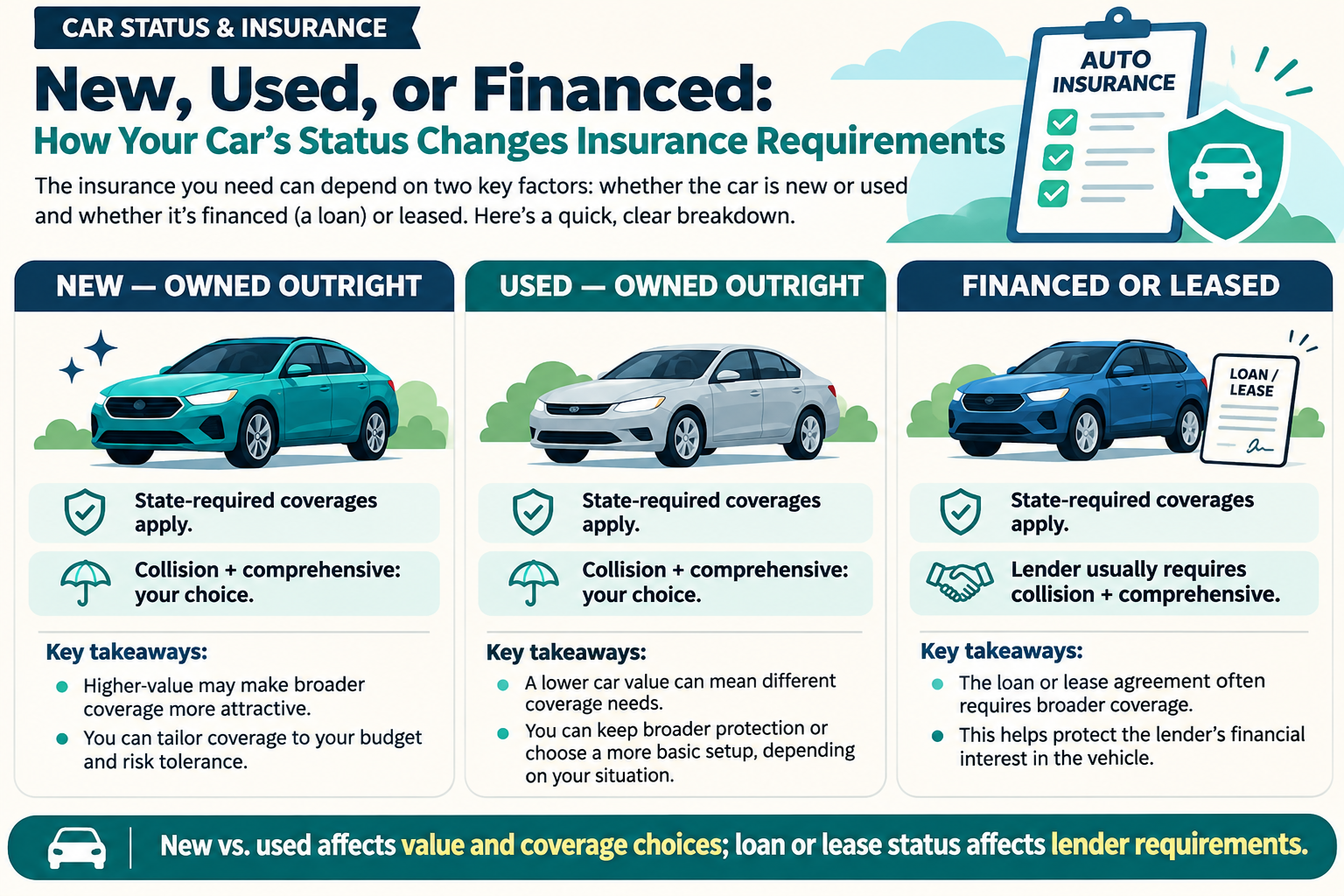
Buying a car changes more than your monthly expenses. It can also change the type of insurance you need, the coverage your lender expects, and how much financial risk you carry.
Consider two drivers purchasing the same $30,000 vehicle. One pays cash, while the other finances the purchase through a bank. Although the vehicles are identical, their insurance obligations may be different.
The distinction matters whether you’re driving a brand-new SUV, purchasing a five-year-old sedan, or making payments on a used truck.
Here’s what changes—and what doesn’t—when your car is new, used, financed, or leased.
First, Understand What Actually Determines Insurance Requirements
Two factors shape your auto insurance obligations:
- State law: Establishes the minimum insurance or financial responsibility requirements for driving legally.
- Ownership and financing: Determines whether a lender or leasing company can require additional protection.
A vehicle’s age doesn’t automatically change the state’s minimum requirements. A ten-year-old car and a new car registered in the same state generally face the same basic liability insurance rules.
Financing, however, introduces another party with a financial interest in the vehicle.
That is why understanding the insurance differences for new vs. used cars can help buyers evaluate coverage before committing to a purchase.
New Cars: Why Broader Coverage Often Makes Sense
A new vehicle usually represents a substantial financial investment. Even without a lender, replacing it after a serious accident could be expensive.
For a new car purchased outright, consider three principal protections.
Liability Insurance
Liability insurance helps pay for injuries or property damage you cause to others in an accident. Most states require minimum liability protection, although specific rules and coverage limits vary.
Collision Coverage
Collision insurance helps pay to repair or replace your vehicle after a covered collision, subject to your deductible and policy terms.
For an expensive new car, this protection may prevent a substantial out-of-pocket expense.
Comprehensive Coverage
Comprehensive insurance generally protects against covered non-collision events, including theft, hail damage, vandalism, fire, and certain natural disasters.
A new vehicle purchased with cash doesn’t automatically require collision or comprehensive coverage by law. However, the financial consequences of losing a valuable vehicle may justify carrying both.
Some insurers also offer new-car replacement coverage. Eligibility, vehicle-age limits, and reimbursement terms vary, so review the details rather than assuming every policy includes it.
Used Cars: Coverage Decisions Depend on Value and Ownership
Buying used doesn’t mean you can ignore insurance. State-required coverage still applies.
What changes is the financial calculation.
Imagine you own a twelve-year-old sedan worth approximately $4,000. If collision and comprehensive insurance cost a substantial amount each year, you might question whether those premiums justify the potential payout.
A driver with enough savings to replace that vehicle might choose to drop optional physical damage coverage.
Another driver who depends on the same car for work may decide that broader protection remains worthwhile.
Before reducing coverage, consider:
- The vehicle’s current market value.
- Your annual collision and comprehensive premiums.
- The deductibles you would pay after a claim.
- Your ability to finance repairs or replacement yourself.
- Local exposure to theft, flooding, hail, or other risks.
An inexpensive used car might not justify extensive physical damage coverage. A lightly used luxury vehicle, however, could still be expensive to repair or replace.
The important distinction: An older vehicle’s lower value may change what coverage makes financial sense, but it does not eliminate legally required insurance.
Financed Cars: Why Your Lender May Require More Insurance
Financing changes the equation.
When you purchase a car through a loan, the lender retains a financial interest in that vehicle until the loan is satisfied.
Consequently, auto lenders usually require borrowers to maintain collision and comprehensive coverage, whether the vehicle is brand-new or used.
These requirements protect the collateral securing the loan.
What Lenders Commonly Expect
Your loan agreement may require:
- Collision and comprehensive coverage throughout the loan term.
- Deductibles that comply with the lender’s maximum permitted amounts.
- The lender to be identified as a lienholder or loss payee where required.
- Continuous insurance without an unauthorized lapse.
- Proof of adequate coverage when purchasing or refinancing the vehicle.
Requirements depend on the lender and the contract.
If you allow required physical damage coverage to lapse, the lender may obtain insurance protecting its interest and charge you for it. This lender-placed coverage can be costly and may offer less protection to you than a policy you purchase yourself.
Is GAP Insurance Required?
Guaranteed Asset Protection, commonly called GAP coverage, addresses a separate problem.
Suppose your financed vehicle is declared a total loss.
- Outstanding loan balance: $27,000
- Vehicle’s actual cash value: $22,000
- Potential difference: $5,000
Your standard collision or comprehensive policy generally pays according to the vehicle’s covered value, not the amount you still owe.
Eligible GAP protection may help cover that difference, subject to the contract’s exclusions, deductible treatment, and other limitations.
GAP is not universally required for financed cars. Some lenders or leasing arrangements may require or include it, while others leave it optional.
It deserves particular attention when you make a small down payment, take out a long-term loan, or finance a vehicle likely to depreciate faster than you reduce the principal.
Leased Vehicles: Similar Coverage, Different Contractual Rules
Leasing resembles financing from an insurance perspective, but the details can differ.
The leasing company generally owns the vehicle during the lease term, which means it can impose its own insurance conditions.
These may include collision and comprehensive insurance, specified deductible limits, and liability limits higher than the state’s minimum.
Some lease agreements incorporate GAP protection, while others offer it separately.
Review the actual lease agreement before buying insurance. A policy satisfying state law may still fail to meet the leasing company’s contractual requirements.
Insurance Requirements Compared: New vs. Used vs. Financed
| Vehicle status | State-required coverage | Collision and comprehensive | Main consideration |
|---|---|---|---|
| New, paid in full | Applies | Generally optional | High replacement cost |
| Used, paid in full | Applies | Generally optional | Vehicle value and affordability |
| New, financed | Applies | Usually required by lender | Loan protection and depreciation |
| Used, financed | Applies | Usually required by lender | Remaining loan balance |
| Leased | Applies | Usually required by lessor | Lease-specific conditions |
Requirements vary by state, insurance company, lender, and lease agreement. This table describes common U.S. arrangements rather than universal rules.
What Happens When You Pay Off Your Car?
Paying off your loan removes the lender’s contractual interest in the vehicle.
Once your lender confirms that the loan has been satisfied and its lien has been released, you can generally reconsider lender-required collision and comprehensive coverage.
You are not required to remove those protections.
For example, if you pay off a relatively new $35,000 vehicle, maintaining broader coverage might still be sensible. If your paid-off car has a modest market value, reducing optional coverage may become more attractive.
Before making changes, confirm that your policy reflects the lien release and that any coverage you remove is no longer required.
How to Choose the Right Policy Without Overpaying
Getting the right insurance is about comparing comparable protections—not simply selecting the lowest advertised premium.
Use this checklist before buying or changing a policy.
1. Confirm Your State’s Requirements
Determine the minimum liability and any additional mandatory coverages in your state.
Some states also require uninsured motorist coverage, personal injury protection, or other protections under particular circumstances.
The National Association of Insurance Commissioners provides consumer information about common auto insurance coverage types.
2. Read Your Financing or Lease Agreement
If the vehicle is financed or leased, check the required physical damage coverage, deductibles, liability limits, and lender information.
Do this before visiting the dealership or accepting delivery.
3. Estimate Your Car’s Replacement Value
For a paid-off vehicle, compare its current value with the cost of insuring it against physical damage.
Don’t base the decision exclusively on the vehicle’s model year.
4. Compare Identical Coverage Limits
A low premium may reflect higher deductibles or lower limits.
When reviewing quotes, use consistent liability limits, collision and comprehensive deductibles, and optional benefits.
Otherwise, you’re comparing different levels of financial protection.
5. Consider Optional Coverage Carefully
Rental reimbursement, roadside assistance, GAP coverage, and replacement-cost options can be useful, but none should be added automatically.
Choose benefits that address risks you cannot comfortably absorb.
6. Compare Offers Before Signing
Insurance prices can differ among providers for the same driver, vehicle, and coverage selection.
You can compare policies at CivilCarCoverage to explore available insurance options based on your location and vehicle information.
CivilCarCoverage is an insurance comparison and referral service rather than an insurer. Availability and final premiums depend on participating providers and individual underwriting, and the service may receive compensation from its partners.
Common Questions About Car Insurance Requirements
Does a brand-new car legally require full coverage?
Not solely because it is new. State laws generally establish minimum insurance requirements regardless of vehicle age. If your new car is financed or leased, the lender or leasing company will usually require collision and comprehensive coverage.
Can I carry liability-only insurance on a financed used car?
Usually not while the loan agreement requires physical damage coverage. Review the contract before attempting to remove collision or comprehensive insurance.
Is full coverage an official insurance policy type?
No. “Full coverage” is an informal term commonly used for a combination of liability, collision, and comprehensive insurance. It does not mean every possible loss is covered.
Does GAP insurance replace collision coverage?
No. GAP addresses an eligible difference between the vehicle’s covered value and the outstanding loan or lease balance after a qualifying total loss. It does not replace the physical damage insurance that responds to the loss.
When should I compare insurance again?
Review your options when purchasing or refinancing a vehicle, paying off a loan, moving to another state, or renewing your policy. Changes in your driving circumstances or the vehicle’s value can also justify a review.
Final Thoughts
The difference between new, used, and financed vehicles is not simply about price or age.
New vehicles often justify broader coverage because replacement costs are higher.
Used vehicles offer greater flexibility when owned outright, particularly as their market value declines.
Financed and leased vehicles generally carry additional contractual insurance requirements because another party retains a financial interest in the car.
The smartest approach is to separate what the law requires, what your financing agreement demands, and what your personal finances can support.
Understand those three factors before purchasing your policy, and you’ll be better equipped to choose coverage that protects both your vehicle and your budget.
Editorial note: This article provides general information about U.S. auto insurance. Coverage availability, legal requirements, and contractual obligations vary. Consult your insurer, a licensed insurance professional, and the applicable loan or lease agreement before making changes.