
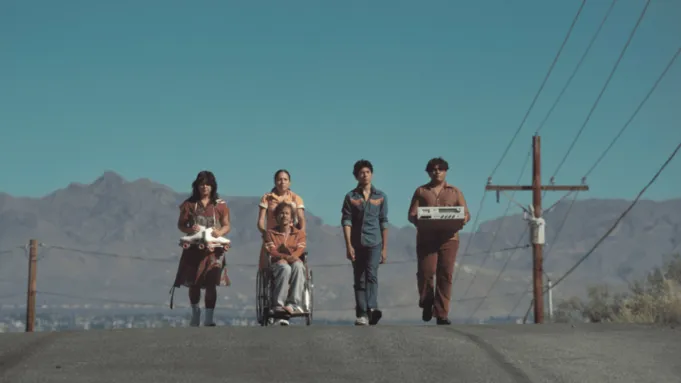
Some coming-of-age films rely on dramatic life-changing events to leave an emotional impact. Others understand that adolescence itself already contains enough confusion, heartbreak, humor, and emotional contradiction to fill an entire world. Olmo feels very much like the second kind of film.
Now acquired by Greenwich Entertainment for North American distribution following an acclaimed international festival run, the latest feature from celebrated Mexican filmmaker Fernando Eimbcke appears poised to become one of the summer’s most emotionally resonant independent releases.
What immediately stands out about Olmo is how deceptively simple the premise sounds at first glance.
A teenager wants to spend time with his best friend and impress a girl he likes, while simultaneously caring for his sick father at home. But within that familiar setup lies something much more layered, a portrait of adolescence shaped not only by desire and rebellion, but also by responsibility, grief, tenderness, and the quiet emotional weight many young people carry long before adulthood officially begins.
And honestly, those are often the coming-of-age stories that stay with audiences the longest.
Fernando Eimbcke Returns to the Emotional Territory He Knows Best
Over the past two decades, Fernando Eimbcke has quietly become one of the most respected filmmakers in contemporary Latin American cinema.
Known for films like Duck Season, Lake Tahoe, and Club Sandwich, Eimbcke has built a filmmaking style centered around stillness, awkwardness, understated humor, and deeply human emotional observation.
His films rarely feel oversized or performative. Instead, they linger in everyday spaces, bedrooms, kitchens, empty streets, uncomfortable silences, where people slowly reveal themselves through behavior rather than dramatic exposition.
That same emotional sensitivity appears central to Olmo.
The film follows its teenage protagonist through a chaotic night of mischief and longing after receiving an invitation from a beautiful neighbor. But underneath the comedy and youthful impulsiveness is a much deeper emotional conflict involving family obligation and emotional escape.
As the night unfolds, Olmo slowly begins confronting the possibility that the home he desperately wants to leave may also be the place most deeply shaping who he is becoming.
That emotional contradiction feels painfully authentic to adolescence itself.
A Coming-of-Age Story Rooted in Real Emotional Experience
One of the most compelling details surrounding Olmo is that Eimbcke co-wrote the screenplay alongside longtime friend Vanesa Garnica, someone he has known since they were both fourteen years old growing up in Mexico. Their shared love of music and classic coming-of-age cinema reportedly became part of the creative foundation for the film.
That personal connection matters because Olmo already sounds emotionally lived-in rather than manufactured.
According to Eimbcke, the writing process was guided by a surprisingly simple rule: if something made them laugh, it stayed. If it made them cry, even better.
That balance between humor and heartbreak has always defined the strongest coming-of-age films. Adolescence is rarely experienced in a single emotional register. One moment feels ridiculous and joyful, the next quietly devastating.
The best filmmakers understand that emotional instability rather than trying to simplify it.
And Eimbcke has consistently excelled at capturing exactly that.
Festival Audiences Have Already Embraced the Film
The film’s growing reputation across the international festival circuit suggests audiences are connecting strongly with its emotional honesty.
After premiering at the Berlin International Film Festival, Olmo continued building momentum through major screenings at the Toronto International Film Festival, San Sebastián International Film Festival, BFI London Film Festival, AFI Fest, and Morelia International Film Festival.
It also received the Jury Prize at the Deauville American Film Festival and the Church of Sweden Youth Film Award at the BUFF Malmö Film Festival.
That kind of broad festival support often signals something important:
a film capable of resonating emotionally across very different audiences and cultures.
And honestly, coming-of-age stories rooted in emotional specificity often become the most universal.
Plan B’s Involvement Adds Significant Creative Weight
The film is produced by Plan B Entertainment, the acclaimed production company led by Brad Pitt, Dede Gardner, and Jeremy Kleiner.
Over the years, Plan B has become associated with emotionally intelligent, filmmaker-driven cinema including Moonlight, Minari, 12 Years a Slave, and Women Talking.
Their involvement with Olmo feels completely aligned with that creative philosophy.
In fact, Gardner and Kleiner described the film as “brilliant, bilingual, personal and deeply universal,” emphasizing its emotional exploration of love, family, and human connection.
That description captures exactly what makes smaller independent films like this so powerful when they work well.
Why Quiet Coming-of-Age Films Still Matter
At a time when mainstream cinema increasingly gravitates toward spectacle, franchise storytelling, and heightened emotional scale, there is something incredibly valuable about films that focus on ordinary human experiences with patience and sincerity.
Coming-of-age films, when done honestly, remind audiences that emotional transformation rarely happens through massive cinematic moments alone.
Sometimes it happens during one strange night.
One conversation.
One moment of embarrassment.
One realization about family.
Those smaller emotional shifts often define people far more permanently than dramatic life-changing events ever could.
That is the emotional territory Fernando Eimbcke seems especially interested in exploring.
A Bilingual Story with Global Emotional Reach
Another aspect that makes Olmo feel especially contemporary is its bilingual and cross-cultural identity.
The film exists comfortably between languages and emotional worlds without feeling the need to simplify itself for broader accessibility. That authenticity likely contributes to why the story feels so personal while still resonating internationally.
Global audiences today increasingly respond to films grounded in cultural specificity rather than generic universality.
And Olmo seems fully confident in its own voice.
Final Thoughts
What makes Olmo so intriguing is not just its festival success or impressive creative pedigree. It is the feeling that the film genuinely understands adolescence in all its contradiction.
The desire to escape while secretly needing home.
The longing for independence while still carrying emotional responsibility.
The humor that exists beside sadness rather than replacing it.
Fernando Eimbcke has spent years crafting deeply human films that observe people with tenderness rather than judgment, and Olmo appears to continue that tradition beautifully.
In a cinematic landscape often obsessed with noise and scale, films like this remind audiences how emotionally powerful smaller stories can still be when they are told honestly.
And honestly, those are often the films audiences remember longest after the credits roll.
For more information, visit here.
She’s All Over the Place Podcast