
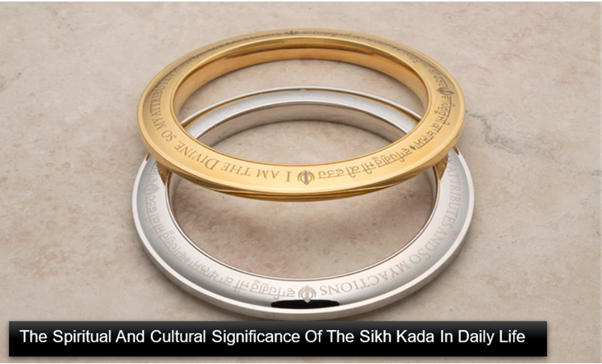
Not every piece of jewelry is just jewelry. For Sikhs around the globe, the Sikh kada is not just a metal circular band worn on one’s wrist. Rather, it is a symbol of life itself, designed as a circle with no beginning or end, like the eternal nature of the divine it symbolizes.
Wearing a kada is not just a question of style or cultural habit. It is an exercise of devotion every day, a declaration of values. Most symbolic objects are relevant only in particular contexts or situations.
However, the kada is not like that. Kada accompanies you through all of life, from the first quiet instant of the morning till the last reflection of the night, never removed, never out of reach. This article explores how the kada appears in the everyday moments of Sikh life and why its significance grows the more closely you look at it.

- Morning Ritual That Sets the Tone for the Day
For many Sikhs, the day truly begins when the Sikh kada rests on the wrist. Putting it on each day is not done hastily or casually. Rather, it is a ritual of equal significance to prayer, performed each morning.
This simple act marks the start of the day with intention. It is a reminder for the wearer that they are committed to the principles of the Khalsa and Waheguru. In a matter of seconds, the bracelet is a moment for reflection before the daily routine begins.
By doing this routine every morning, a connection is made between spirituality and daily life. What is done as an act of faith to follow the articles of faith gradually builds into something much more personal. It allows the mind a moment to reflect before the chaos of the day begins.
- Silent Guide When Decisions Get Difficult
One of the most subtle yet powerful aspects of how the kada functions in daily life is its role as a corrective action on one’s own behavior and decision-making processes. Sikhs often talk about the kada on their wrist as a moment of awareness that comes precisely when they need it most.
When they face frustration, temptation, or indecision, the weight of the kada on their wrist brings their attention back to what the Khalsa lifestyle is really about. This may not be a dramatic or loud moment. One moment of awareness, prompted by the simple sense of touch of the steel on their wrist, may be all that is needed to stop an action, temper a harsh word, or choose a more compassionate response.
- Instant Bond It Creates in Everyday Social Settings
A kada is doing something unique in the world that no other object does. The moment a Sikh sees another human being wearing a kada, they recognize that person instantly without saying a word. This says a lot about who that human being is and what they stand for, despite all the differences in language, nationality, age, and other factors, instantly anywhere in the world.
Also, the kada further represents the idea that one should use one’s hands for the service of humanity, which all Khalsa Sikhs worldwide believe in.
- Turns Everyday Tasks Into Spiritual Practice
One of the most important aspects of the kada is that it is always with the wearer throughout their daily activities. The kada is not taken off for work or any physical activity. Like many things that people remove when their activities become challenging or inconvenient, the kada is always with the wearer.
The presence of the kada gives the bracelet a sense of purpose. True devotion is not only about the times when one is not so busy but also about the times when one is engaged in their activities. The movement of the kada accompanies the movement of the hands. Besides, the presence of the kada reminds the wearer of their Guru’s teachings at all times.
All activities done with one’s hands are done in the presence of the kada. Whether one is making food, writing, building something, or even helping another person, the kada is always with the wearer. The wearer is reminded to be honest, disciplined, and compassionate while doing their activities. The activities done with one’s hands slowly become acts of devotion to the teachings of their Guru.
- Deepens the Evening Reflection Process
As the day comes to a close, the kada may also be a part of a moment of reflection. After a long day of work, conversation, and the demands of the day, the kada on the wrist gently reminds the wearer to reflect on the day that has been.
Throughout the day, the kada is a witness to all actions. When the day comes to a close, it reminds the wearer to reflect on the day that has been. People may reflect on the decisions made, the words spoken, and the actions taken with others.
This is not a time for guilt or for adding to the burden. It is a time for learning and growing. The kada reminds the wearer of how they can learn to be better people and live a life closer to the teachings of the Guru.
Final Thought
The Sikh kada finds its way into daily life not through ceremony or display, but through presence. Besides, the kada helps determine how the day begins, informs what is done when it matters most, forges connections in unexpected places, remains present even through the hardest work, and grounds the mind when the day is done.
For an object that rests on the wrist, the extent to which the Sikh kada touches all aspects of daily life is remarkable, particularly because that was the intent when it was placed among the five most important expressions of Sikhism.