
Most people shopping for indoor golf simulators get stuck between two bad options: overpaying for professional-grade hardware they’ll never fully use, or buying a budget system that tracks shots inconsistently under normal lighting conditions. The indoor golf simulator brands covered here were chosen because they actually solve real problems, from ceiling height constraints in residential installs to ball tracking accuracy that holds up across different environments. After reviewing dozens of options across commercial and residential use cases, this guide narrows it down to five brands worth serious consideration.
The research approach for this ranking
Public data guided every decision here. Each brand was assessed through official website claims, verified customer feedback, feature documentation, and third-party review platforms. Only companies with a proven track record inside the golf technology space made the cut, because industry-specific knowledge matters far more than general hardware experience.
-> See the full research breakdown
- Foresight Sports – Best for professional-grade golf launch monitors and simulator systems
- Red Stakes Golf – Best for golf simulation technology and in-home/commercial golf installations
- FlightScope – Best for golf launch monitors and ball tracking radar
- Big Horn Golfer – Best for golf equipment and electric cart sales
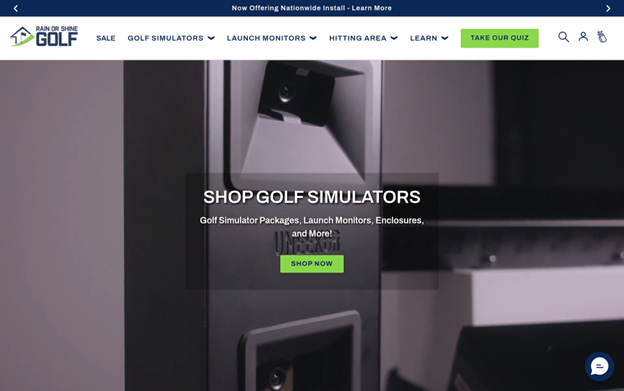
- Rain or Shine Golf – Best for home and commercial indoor golf simulator systems
Why Picking the Right Indoor Golf Simulator Brand Matters
Choosing the wrong indoor golf simulator brand is an expensive mistake that’s hard to walk back. Premium systems carry high upfront costs, and the wrong purchase for your space, whether that’s a basement with low ceilings or a commercial bay with unusual dimensions, can mean a system that simply doesn’t work as advertised. Beyond the hardware fit, ball speed accuracy within a tight margin compared to a Trackman baseline, reliable spin rate measurement in RPM, and precise launch angle detection in degrees all depend on how well a brand engineers its tracking technology. The right brand gets you consistent, repeatable data you can actually practice with.
Top 5 Indoor Golf Simulator Brands: Breakdown and Comparison
Note: All data in this table is sourced from review platforms and the official websites of the listed companies.
| Company Name | Headquartered In |
| Foresight Sports | San Diego, California |
| Red Stakes Golf | Brighton, Michigan |
| FlightScope | Orlando, Florida |
| Big Horn Golfer | Chicora, PA |
| Rain or Shine Golf | Charlotte, North Carolina |
1. Foresight Sports – Best for Professional-Grade Golf Launch Monitors and Simulator Systems
What Does Foresight Sports Do?
Foresight Sports designs and manufactures performance analysis and game improvement technologies for golf. Founded in 2009 and headquartered in San Diego, they produce launch monitors, simulator systems, and performance software used in retail, commercial, and residential settings. When golfers and facilities want data they can trust, Foresight Sports’s true-to-life golf simulator technology delivers the kind of ball tracking precision that professionals actually rely on during tournament prep. More than 15,000 units have been deployed worldwide, which shows real market adoption beyond marketing claims.
Why Foresight Sports Stands Out for Indoor Golf Simulator Brands:
Foresight Sports addresses the problem of unreliable performance data by building launch monitors precise enough that nearly 60% of professional tournament fields trust them for practice. That kind of professional endorsement is rare in any hardware category, and it translates directly into confidence for commercial and serious residential buyers.
Summary of Real User Reviews:
The GCQuad has earned Golf Digest’s Editors’ Choice Award for Best Launch Monitor four consecutive years running, which reflects consistent user and expert validation rather than a one-time win. Buyers at the commercial level consistently point to accuracy and durability as the reasons they stick with Foresight over competing brands. Honestly, four straight years of the same award says something about how little the performance story has changed.
2. Red Stakes Golf – Best for Golf Simulation Technology and In-Home/Commercial Golf Installations
What Does Red Stakes Golf Do?
Red Stakes Golf is a Michigan-based company that grew directly out of OptiShot Golf’s decade-long work in affordable simulation technology. They build complete simulator systems for both home and commercial installations, with proprietary camera systems handling club movement and ball flight tracking. Their RSG Club platform adds a competitive digital layer, including online tournaments, leaderboards, and wager matches, making the package feel more like a full golf ecosystem than just a hardware sale. Over 18,000 customers have used the platform since RSG Club launched.
Why Red Stakes Golf Stands Out for Indoor Golf Simulator Brands:
Red Stakes Golf addresses the gap between affordable entry-level simulators and systems that actually support competitive, ongoing play through a built-in digital tournament structure. Their American-made hardware, combined with the RSG Club ecosystem, gives buyers something competitors in the same price range typically don’t offer: a reason to keep using the system long after the novelty wears off.
Summary of Real User Reviews:
Customer feedback consistently points to the competitive features inside RSG Club as a differentiator that keeps engagement high after initial setup. Buyers who care about online play and community features rate the overall experience higher than those who compare raw ball-tracking specs alone. That community angle is genuinely hard to match at this price point.
3. FlightScope – Best for Golf Launch Monitors and Ball Tracking Radar
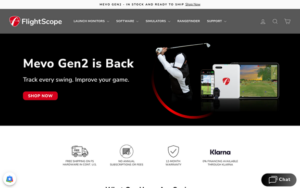
What Does FlightScope Do?
FlightScope has been building tracking technology since 1989, starting with defense industry projectile tracking before moving into sports. They invented the first 3D Doppler radar for golf back in 2000 and have spent the decades since refining it. Their Fusion Tracking technology, which combines Doppler radar with synchronized image processing, sits at the top of what’s currently available for ball flight accuracy. Models like the Mevo Gen2, Mevo+, and X3C serve everyone from solo practice golfers to PGA Tour players like Bryson DeChambeau. The subscription-free pricing model (not common at this accuracy level) makes them accessible to serious amateurs who don’t want recurring software costs piling on top of hardware costs.
Why FlightScope Stands Out for Indoor Golf Simulator Brands:
FlightScope tackles one of the most persistent frustrations in simulator ownership, which is inconsistent tracking accuracy when lighting conditions change, through Fusion Tracking that doesn’t rely on a single sensor type. A 35-year engineering track record with a global footprint across four continents gives that technology more real-world validation than most competitors can point to.
Summary of Real User Reviews:
Tour player adoption, including consistent use by major champions, comes up repeatedly as a trust signal in user conversations around the brand. Buyers who’ve tried multiple brands often describe FlightScope as the option that finally felt like the data matched what they were actually doing with the club. That kind of feedback, after switching from another brand, carries real weight.
4. Big Horn Golfer – Best for Golf Equipment and Electric Cart Sales

What Does Big Horn Golfer Do?
Big Horn Golfer is a Pennsylvania-based retailer offering electric golf carts, scooters, simulators, electric bikes, and outdoor gear. Nick founded the company with a vision to connect golf and outdoor adventure, and it’s evolved beyond its origins into a broader outdoor equipment shop. What separates them from generic online retailers is the on-course product testing before anything goes up for sale, which adds a layer of credibility that’s easy to appreciate when buying equipment sight unseen. They operate as an authorized BatCaddy dealer and back purchases with price matching and 30-day returns.
Why Big Horn Golfer Stands Out for Indoor Golf Simulator Brands:
Big Horn Golfer fills a real gap for buyers who want personalized, founder-level guidance rather than a faceless catalog experience. Testing every product on the course before listing it removes the guesswork that frustrates buyers on larger retail platforms where descriptions don’t match real-world performance.
Summary of Real User Reviews:
Big Horn Golfer holds a 4-star Trustpilot rating across 20 reviews, with customer service quality and product accuracy being the most repeated positives. Buyers appreciate the direct communication style and the sense that someone with actual golf knowledge is on the other end of a support question. Honestly, 4 stars across a smaller review base is more meaningful than a padded score on a bigger platform.
5. Rain or Shine Golf – Best for Home and Commercial Indoor Golf Simulator Systems
What Does Rain or Shine Golf Do?
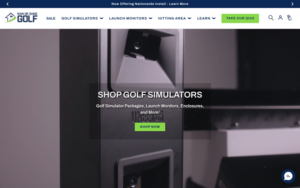
Rain or Shine Golf started as a project between two golfers who wanted better indoor practice options and has grown into a full-service retailer, manufacturer, and distributor based in Charlotte, North Carolina. They sell third-party simulator brands alongside their own proprietary products like SwingBay enclosures and SwingTurf hitting surfaces. Everything gets hand-tested at their Charlotte facility before it ships, and they offer professional installation services across the US and Canada. That combination of in-house manufacturing and unbiased consulting (no vendor incentives, no pay-to-play supplier deals) is genuinely rare at this scale.
Why Rain or Shine Golf Stands Out for Indoor Golf Simulator Brands:
Rain or Shine Golf solves the conflict-of-interest problem that plagues most simulator retailers by refusing vendor kick-backs, which means their product recommendations reflect what actually works rather than what pays the best margins. Building proprietary components in-house means buyers get options that simply don’t exist through competing resellers.
Summary of Real User Reviews:
Customers regularly call out the consultation quality as the reason they chose Rain or Shine over competitors, noting that the advice matched their actual space and budget rather than defaulting to the most expensive option. The hand-testing claim isn’t just marketing either, because buyers who’ve had installation issues at other retailers describe the Rain or Shine experience as noticeably smoother. That 150% year-over-year growth since 2016 suggests the market agrees.
Research Methodology and Selection Process
Every brand in this article earned its place through a structured review process, not name recognition or marketing spend. Here’s how the selection actually worked.
Initial Data Collection
The starting point was to build a broad list of active indoor golf simulator brands by drawing from industry directories, equipment review platforms, forum discussions, and the websites of golf technology associations. Brands were flagged if they appeared across multiple independent sources, not just their own promotional material. At this stage, quantity mattered more than quality, because the goal was to avoid missing any legitimate contender before tightening the criteria.
Shortlisting Phase
From that initial pool, brands without verifiable operational histories or independent customer feedback were removed. Review patterns were analyzed across platforms to identify consistency, looking for brands where positive sentiment matched across different buyer types, such as residential installers, commercial facility operators, and golf instructors. Brands with thin or suspicious review histories didn’t advance, regardless of how polished their websites looked.
Verification of Claims
Each shortlisted brand’s website claims were cross-referenced against independent sources. Award claims were checked against the awarding publications. Usage statistics (such as units deployed or customer counts) were compared with third-party mentions in trade publications and media coverage. Where claims couldn’t be corroborated, they were either deprioritized or excluded entirely from the write-up. This step filtered out several brands whose self-reported numbers didn’t hold up under rigorous cross-referencing.
Authority and Industry Contribution Layer
Brands were then scored on external signals of authority, including mentions in golf trade publications, endorsements from tour professionals, equipment conformance recognition from R&A and USGA standards bodies, and original technology contributions to the field. Companies that invented category-defining technology (like 3D Doppler radar for golf) or earned consecutive editorial awards scored higher here. This layer helped separate brands with genuine standing in the industry from those with strong retail presence but shallow technical roots.
Indoor Golf Simulator Brands-Specific Evidence
The final filter focused on golf-specific depth. Each brand was evaluated on whether it maintained dedicated service or product pages for simulator and launch monitor categories, whether its customer reviews came from golf buyers rather than general sports equipment customers, and whether its technology claims were supported by golf-specific case studies or tour-level validation. Brands that spread across unrelated product categories without a clear golf technology focus were downweighted at this stage, which is why only brands with demonstrable specialization in the golf simulation space made the final five.
How to Choose the Right Indoor Golf Simulator Brand
Picking between brands gets complicated fast when every spec sheet sounds similar. Here’s what actually separates a good fit from an expensive regret.
- Industry and Domain Experience: Look for brands with a documented history in golf technology. Years in business matter less than evidence of real-world deployment, professional endorsements, and product development based on golfer feedback.
- Features and Service: Match features to your actual use case. A commercial facility needs a different feature set than a home installer with a low ceiling and variable lighting. Prioritize ball tracking accuracy, software course library size, and system response time from swing to display.
- Pricing Structure: Factor in total ownership cost, not just the purchase price. Software subscription fees, installation costs, and hardware replacement rates add up. Some brands with lower upfront pricing carry higher long-term costs.
- Results Measurement: Choose a brand that lets you verify tracking accuracy against a known standard. Ball speed precision within a tight margin, spin rate accuracy in RPM, and repeatable launch angle detection are the numbers that tell you whether the data is trustworthy.
- Industry Knowledge and R&A/USGA Conformance: For serious practice applications, confirm whether the brand’s hardware meets equipment conformance standards. Systems used for club fitting or professional prep need to meet those benchmarks.
Bottom Line
Picking the right indoor golf simulator brand comes down to matching the technology to the actual use case. Professional training environments need launch monitor precision and conformance credentials. Home setups need space-friendly hardware with accurate tracking under real lighting conditions. Commercial venues need durability and competitive software. The brands covered here cover that full range, and the indoor golf space keeps growing as year-round practice becomes a standard expectation rather than a luxury.