
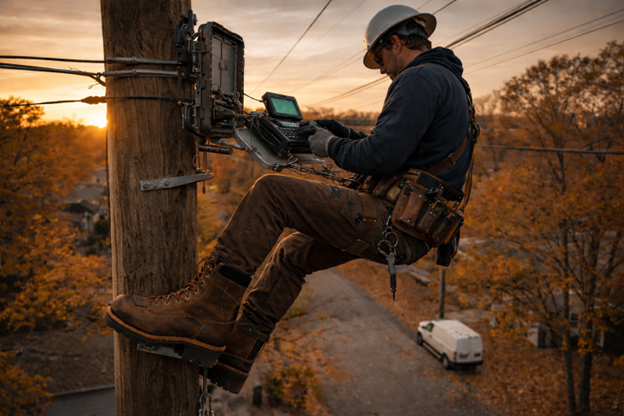
Line work isn’t just “outdoors work” with a tougher title. It’s about working at height, in all weather conditions, on slick surfaces and uneven footing, with constant electrical exposure, often while tired and under time pressure.
Your boots aren’t a style choice. They’re part of your safety system because every step sets up the next move. For workers comparing options, understanding what makes lineman boots different from standard work boots is critical for staying safe on the job.
Stability at Height Starts With the Boot’s Structure
A lineman’s boot handles forces completely differently than a standard work boot. On hooks or gaffs, the boot takes pressure through a narrow contact zone while your body shifts weight and fights rotation. If the boot folds under the arch or twists easily, you lose stability and burn energy faster.
A Defined Heel Is Non-Negotiable for Climbing-Focused Work
A defined heel is essential for climbing compatibility. It creates a controlled interface when your footing is limited to rungs, edges, and positioning points. It also helps when stepping down onto uneven ground, especially in wet conditions where small slips become big problems.
This is why wedge sole boots don’t work for pole climbing. Wedge soles can be great for long days on concrete, but the profile doesn’t match the climbing needs that require a defined heel. That trade-off matters because plenty of good boots are simply built for the wrong job.
Shank Rigidity Is the Backbone of Predictable Footing
Shank support prevents the boot from collapsing around the pole contact point. In practical terms, it stabilizes your foot when weight shifts forward on steps, ladders, and climbing systems. Soft boots might feel comfortable early on, but soft underfoot structure becomes a liability at height.
Why Linemen Burn Through Non-Climbing Boots Faster
Torque and repeated climbing cycles find weak points fast. Shanks fatigue, heels break down, and soles separate when the construction isn’t designed for repeated flex under load plus moisture exposure. A boot can feel fine in week one and still become unstable quickly if it was built mainly for flat ground.
Electrical Hazard Protection Is a Standard, Not a Guarantee
EH-rated lineman boots are often misunderstood. Electrical Hazard footwear is secondary protection, and it’s not a substitute for electrical safety procedures, PPE, and training. The important point isn’t the label. It’s understanding what the rating can and cannot reasonably cover in real conditions.
What the Data Says About Electrical Risk
The Electrical Safety Foundation International (ESFI) reports that, on average, 150 workplace electrical fatalities occur each year. ESFI also highlights overhead power line contact as a major driver, noting that between 2011 and 2018, 38 % of electrically-related workplace fatalities were caused by overhead power lines.
These numbers aren’t here to scare anyone. They’re a reminder that electrical risk is common enough to take seriously, and safety layers matter.
What EH Does and Doesn’t Do
EH-rated footwear is designed and tested to meet specific performance requirements under defined conditions. Dry versus wet conditions matter in the real world. Wet surfaces, conductive grime, cuts in the outsole, and worn tread can quickly change performance. That’s why EH should be treated as one layer in the safety stack, not as a guarantee.
This is you need to take a hard look at your job conditions. If work is routinely wet, waterproofing and maintenance become part of risk control, not just comfort. And if your boots are getting chewed up, the EH benefit can be undermined by wear and tear.
Fatigue Is a Safety Issue, Not a Comfort Complaint
Fatigue changes movement quality. Foot placement gets sloppier. Recovery steps get slower. Grip and balance feel less precise. It’s a predictable human factor that adds risk to an already risky job.
Fatigue Is Common, Not Occasional
The National Safety Council reports that 97 percent of workers have at least one workplace fatigue risk factor, and more than 80 percent have two or more. That reality applies across industries, but it shows up hard in physically demanding work where the margin for error is thin.
What Comfort Should Mean for Linemen
For linemen, comfort means a boot that stays stable and consistent across a long shift. A platform that starts stable and ends mushy is a safety problem, because you finish the day on a less predictable foundation.
Support features matter more than cushion: shank rigidity, a stable heel base, and underfoot structure that supports the arch under load. Moisture control also affects fatigue. Wet feet blister faster and slip more inside the boot. That’s distraction, and distraction is risk. Breathability, liners, and waterproofing were all needed to feed the same goal: keep your foot stable and your mind on the work.
Durability That Matches the Work, What Fails First, and Why
Durability isn’t just thick leather. It’s whether the boot stays structurally sound under torque, weather, and repeated climbing cycles.
The Common Failure Points in Lineman Work
Sole separation often shows up when flex, moisture, and grit combine. Heel breakdown occurs when edges and contact points repeatedly load the heel. Shank fatigue shows up when the boot loses backbone and stability. Upper cracking occurs when leather cycles between wet and dry conditions without proper care.
Build Choices That Translate to Job Value
Welt construction matters because it’s commonly associated with better long-term rebuild potential and resoling options when the upper is still solid. This is also where cost becomes a safety issue, not just a budget issue. The National Safety Council estimates the total cost of work injuries in 2023 was $ 176.5 billion, including wage and productivity losses, medical expenses, and administrative expenses.
That number isn’t a buying guide, but it’s evidence that prevention is cheaper than recovery, and lineman boots are part of prevention when slips, fatigue, and unstable footing are in the risk chain.
What to Check Before Buying Lineman Boots
Match the Boot to Climbing First, Then Everything Else
For pole climbing priority, the defined heel and climbing-compatible profile should be non-negotiable. If a boot is built mainly for flat concrete comfort and lacks heel definition, it’s the wrong tool for the job.
Confirm the Shank and Underfoot Stiffness Are Built for the Work
A boot that flexes too easily forces your foot to do extra work to stay stable on the pole. Look for explicit shank language that signals climbing support, such as a “linesman shank”, and a platform that doesn’t collapse under load.
Use EH Rating as a Layer, Not a Shortcut
If your environment requires it, confirm that the boot is EH-rated and keep expectations realistic. Wet conditions, outsole damage, and contamination can quickly change the picture. EH is helpful when properly managed, but it’s not a replacement for procedures.
Traction and Weather Resistance Should Reflect Real Job Sites
Wet grass, mud, slick pavement, and uneven ground are common. Outsole traction and stability should match those surfaces, not just look aggressive. Waterproofing can be a safety benefit in wet climates by reducing internal slip and blister risk.
Be Honest About Trade-offs
Supportive lineman boots are often heavier and take longer to break in, especially with stiffer shanks and thicker leather. That’s usually the price of structure. Also, not every lineman boot is ideal for all-day ground work. Some climbing-focused designs feel overbuilt on concrete, and that’s a fair trade-off when climbing is the priority.
Conclusion: Boots Should Reduce Risk, Not Add to It
What linemen really need isn’t hype. It’s stability that holds at height, protection that’s standards-based and understood, and durability that stays intact under torque and weather.
The right lineman boot reduces the number of small problems you have to solve all day, like slips, foot collapse, hot spots, and wet foot distraction, so your attention stays on the work that carries the real risk.