
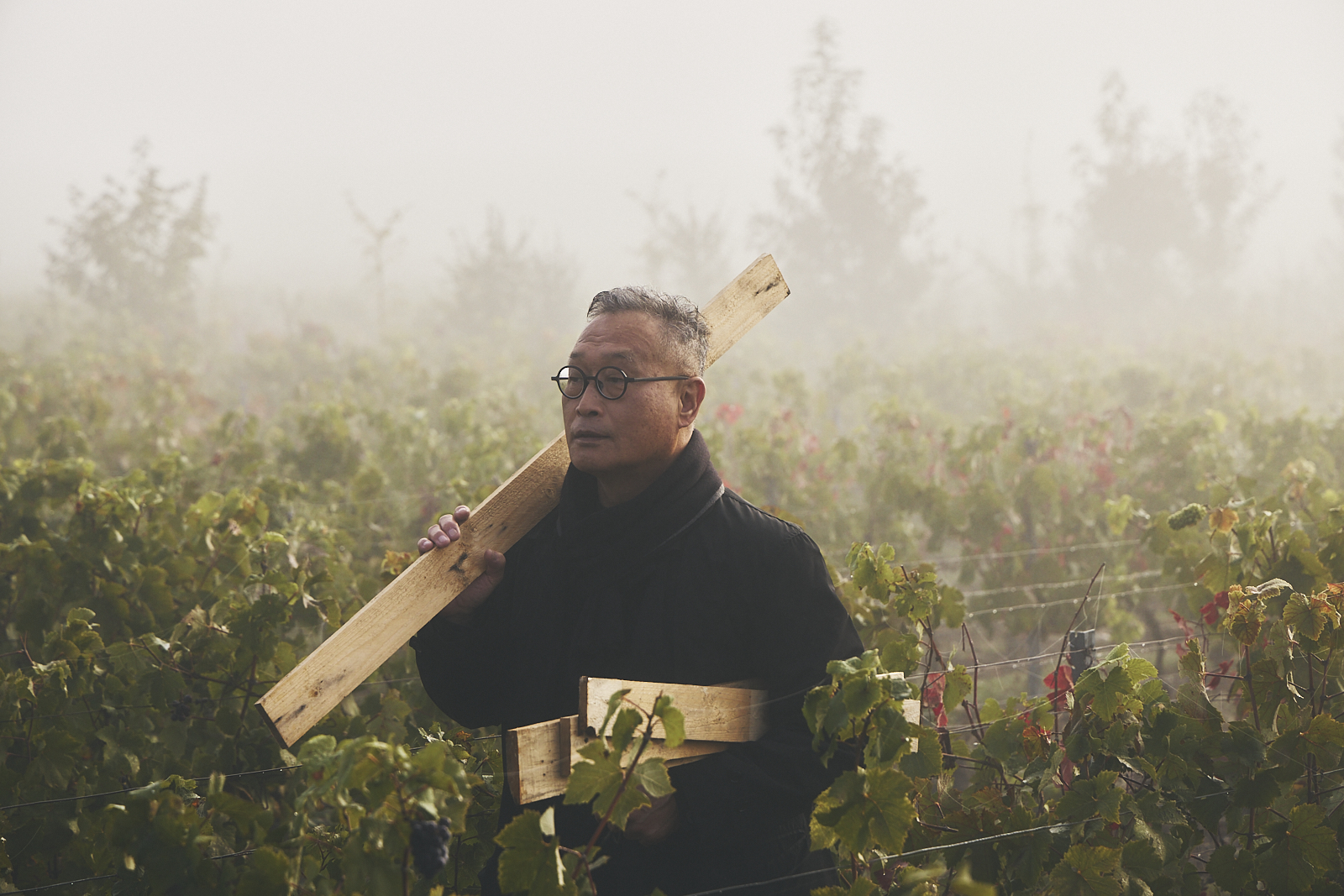
In 2026, Maison Ruinart continues its long-standing dialogue between art and nature by welcoming Japanese artist Tadashi Kawamata into its evolving Conversations with Nature program — a collaboration that feels less like a traditional commission and more like an ongoing exchange between landscape, craftsmanship, and human perception.
Kawamata’s work has always lived somewhere between architecture and emotion. Known for constructing fragile, immersive structures from reclaimed wood and everyday materials, he approaches space not as something fixed, but as something alive — shaped by climate, time, and human interaction. That philosophy finds a natural home at Ruinart, where centuries of champagne savoir-faire have always depended on a deep sensitivity to the environment.
During his first visit to Maison Ruinart in Reims, the artist was struck not by grandeur, but by subtlety: morning mist settling across the vineyards, the warmth of early sunlight, and the quiet presence of birds and insects moving through the landscape. These small, almost invisible rhythms became the starting point for a series of sketches and models — what Kawamata describes as a way of thinking through the hand before building at full scale.
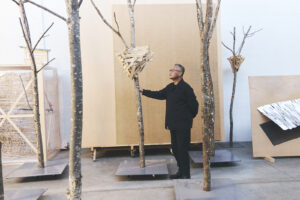
Those early drawings will now evolve into three in-situ installations in the Champagne region — Tree Hut, Nest, and Observatory. Together, they form a unified artistic gesture that invites visitors to slow down and observe the delicate balance that defines both nature and champagne making. Rather than imposing themselves on the environment, the structures respond to it, echoing Ruinart’s belief that craftsmanship and terroir exist in constant conversation.
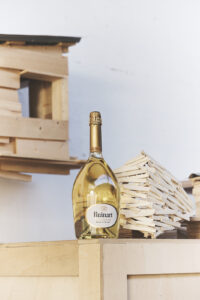
Kawamata’s fascination with scale plays a central role in the project. Small wooden models allow him to test tensions and balances before translating them into monumental shelters. For the artist, miniature objects and large installations are not opposites but complements — each carrying the same spirit rooted in material, gesture, and time. Where an object feels autonomous, an installation remains open, continuously shaped by weather, light, and human presence.
At Ruinart’s historic address, 4 Rue des Crayères, these works will sit within a broader cultural landscape that merges art, architecture, and winemaking. The site, transformed in 2024 with a contemporary pavilion designed by architect Sou Fujimoto, now serves as a living destination where visitors encounter artistic interventions alongside vineyards, gardens, and UNESCO-listed chalk cellars. More than twenty installations already inhabit the grounds, forming an evolving artistic ecosystem inspired by biodiversity and environmental awareness.
Kawamata’s contribution extends a lineage of collaborations that reflect the Maison’s enduring relationship with art. From Alphonse Mucha’s 1896 poster — considered the first advertisement ever created for a champagne house — to recent works by artists such as Tomás Saraceno, NILS-UDO, Eva Jospin, and Marcus Coates, Ruinart has consistently used artistic practice as a way to explore contemporary ecological questions. Each project asks visitors not simply to look, but to reconsider their relationship with the natural world.
Born in Hokkaidō in 1953 and now working between Tokyo and Paris, Kawamata has spent decades challenging ideas of permanence through temporary structures, walkways, shelters, and elevated viewpoints. His installations encourage physical participation, often lifting viewers above ground level to alter perception. As he explains, the world feels different when experienced from a new height — wind sounds change, perspectives shift, and awareness deepens.
That shift in perception lies at the heart of Conversations with Nature. Rather than presenting art as an isolated object, Ruinart frames it as an experience that reconnects people with environment, craftsmanship, and each other. Kawamata’s shelters function almost as imaginary refuges — quiet reminders of nature’s fragility, but also of its extraordinary resilience and ability to adapt over time.
In many ways, the collaboration mirrors champagne itself. Just as Ruinart’s chardonnay expresses balance, luminosity, and patience shaped over centuries, Kawamata’s structures reveal beauty through imperfection, reuse, and transformation. Both practices depend on listening — to materials, to place, and to the slow passage of time.
As visitors move through the gardens, courtyards, and underground cellars of 4 Rue des Crayères, Kawamata’s installations invite a simple yet profound act: to pause, observe, and feel the subtle vibrations of nature that often go unnoticed. And in that quiet attention, art and champagne briefly share the same purpose — helping us reconnect with the world around us.