
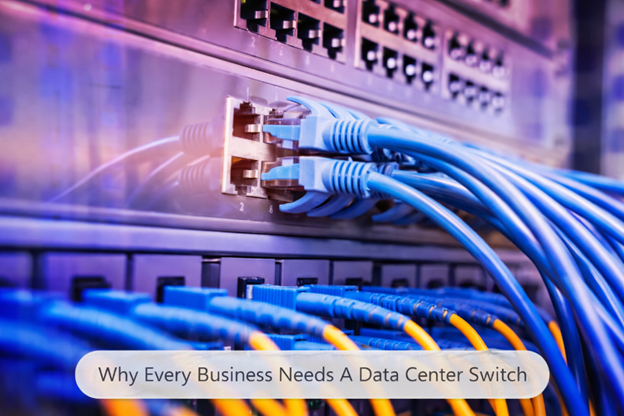
In the digital era, data is often described as the new oil, but for most businesses, the challenge isn’t just “drilling” for it—it’s moving it. The pressure on internal networks has increased as companies adopt AI-powered workloads, cloud-first strategies, and real-time analytics. A basic office switch could handle the simplest internet queries and printing, but it quickly fails under heavy server-to-server traffic.
This is where the data center switch comes in. It is far more than a box with ports; these are high-performance machines that serve as the traffic control for the new enterprise.
Be it a developing mid-sized company or a multinational corporation, here’s why this technology has become an indispensable condition for business stability and expansion.
What is a Data Center Switch?
A data center switch is basically a high-density, low-latency switch tailored to handle data moving back and forth (East-West) between servers, storage arrays, and backup systems in a data center environment.
As opposed to the traditional switches called Campus or Enterprise, which mainly connect end-user devices (such as laptops) with the internet, the switches in data centers support the high-density and consistent communication (needed by the virtualized applications).
They are designed to support high throughput, typically ranging from 100 Gbps to 400 Gbps per port, ensuring that mission-critical information does not encounter bottlenecks.
Reasons Every Business Needs A Data Center Switch
- Handling the Explosion of AI and Big Data
Today, AI is no longer a niche project; it is one of the key drivers of business value. Large language models or the processing of real-time data demand tremendous bandwidth to run. The conventional networking equipment can’t handle these huge data packets quickly enough, thus resulting in latency, the delay that makes applications lag.
A data center switch is designed for low-latency performance. These switches can use lossless Ethernet protocols and specialized hardware (ASICs) to ensure the network can fully support AI training and inference workloads. This means quicker insight and competitiveness in a more automated market, as far as business is concerned.
- Ensuring Business Continuity through Redundancy
For any business in the contemporary world, downtime is not just an inconvenience; it is a catastrophe on the financial front. It is estimated that even several minutes of lost network connection can mean thousands in lost revenue and productivity.
High Availability is a fundamental concept of data center switches. They often feature:
Redundant Power Supplies: When one malfunctions, the other immediately provides backup.
Hot-Swappable Fans: The ability to service the system without shutting it down.
Stacking and MLAG: These technologies enable several switches to operate as a single unit, so that if one physical device fails, there is always a backup route.
This degree of redundant architecture ensures that your servers can still be accessed in the event of hardware or component failure.
- Scalability: Growing Without Growing Pains
Data center switches operate on the Leaf-Spine architecture, enabling a business to scale horizontally. Historically, adding more servers required recabling a hierarchical network, which was difficult task. Modern switching involves merely adding a switch, called a Leaf switch, to the fabric.
This modularity is essential for businesses that experience cyclical peaks or high growth. A small setup can be developed and expanded as you need more bandwidth (without ever requiring a forklift upgrade to your entire network). This is one of the reasons the data center industry is projected to grow at 14% per year until 2030.
- Advanced Security at the Core
Data breaches are becoming more expensive than ever, and lateral movement is less frequent on the outer network. Standard switches provide basic security, whereas data center switches offer granular control.
They support features such as Micro-segmentation and Access Control Lists (ACLs), enabling IT personnel to isolate sensitive data from the rest of the network. If one of the servers is compromised, the switch will help prevent the threat from spreading to your financial database or customer records.
This kind of hardware-level security is critical at a time when data sovereignty and privacy laws and regulations are becoming increasingly stringent.
- Energy Efficiency and Cost Optimization
Although the initial price of a data center switch may be higher than that of a consumer-grade switch, the Total Cost of Ownership (TCO) may be lower. They are intended for deployment in a high-density server rack and rely on airflow management, similar to hot/cold aisle containment.
This precise thermal control reduces the load on your data center’s cooling system, thus lowering electricity bills by a large margin. Also, most current switches can be programmed, enabling automated provisioning and saving person-hours in network management.
Final Thoughts
With the shift to 2027 and inference workloads and distributed regional hubs being the predominant form of network, the network cannot be an afterthought anymore. Your digital services are based on a data center switch.
By investing in dedicated switching equipment, companies will know they can keep up with AI and protect their investments, while ensuring scalability as the market continues to evolve. It is no longer the luxury of tech giants; it is a necessary utility for any business that uses data for survival and prosperity.