

Balancing genuine luxury with real environmental responsibility is harder than it looks. You want the private villa, the curated experiences, the impeccable service. But you also want to know your trip isn’t quietly funding greenwashing or draining a fragile community. A solid sustainable luxury travel checklist does more than remind you to pack a reusable bottle. It gives you a framework for every decision, from choosing your hotel to tipping your guide, so you can travel with both comfort and conviction.
Table of Contents
- Key takeaways
- 1. Your sustainable luxury travel checklist starts with vetting accommodations
- 2. Eco-friendly packing essentials that don’t compromise on style
- 3. Curated sustainable experiences and local immersion
- 4. Comparing your sustainable travel options side by side
- My honest take on sustainable luxury travel
- Plan your next trip with Davidsguide
- FAQ
Key takeaways
| Point | Details |
|---|---|
| Vet every property carefully | Look beyond marketing claims and verify third-party certifications, local hiring rates, and energy practices. |
| Pack with purpose | Choose sustainable luggage, ethical beauty products, and multipurpose clothing to reduce your footprint without sacrificing style. |
| Prioritize local immersion | Book community-led tours and eat at locally owned restaurants to keep money in the destination’s economy. |
| Slow down your itinerary | Spending more time in fewer places cuts transport emissions and creates richer, more memorable experiences. |
| Compare your transport options | Weigh private aviation, hybrid vehicles, and direct flights against each other based on distance and carbon impact. |
1. Your sustainable luxury travel checklist starts with vetting accommodations
The single biggest lever you have as a luxury traveler is where you sleep. A property can look stunning on Instagram and still fail every meaningful sustainability test. 42% of online green claims are potentially deceptive or exaggerated, according to a European Commission study. That means you need a sharper filter than a leaf logo on a booking page.
Start with the Global Sustainable Tourism Council (GSTC) framework, which evaluates properties across four pillars: sustainable management, socio-economic impact, cultural impact, and environmental impact. Ask properties directly about their waste reduction targets, renewable energy adoption, and water conservation programs. If they can’t answer with specifics, that tells you everything.
One metric worth asking about directly: staffing. Boutique properties employing 80% local staff are a strong signal that economic benefits stay within the destination’s community rather than flowing back to distant corporate owners. The ‘halo effect’ of general eco-labels often misleads travelers, so third-party verification and direct inquiries about waste, energy, and equity are what actually separate authentic properties from polished marketing.
Here is what to look for when evaluating any luxury property:
- Third-party certification from recognized bodies (GSTC, Rainforest Alliance, Green Key)
- Documented renewable energy use or carbon offset programs
- On-site composting, water recycling, or zero single-use plastic policies
- Local food sourcing for restaurants and spa products
- Transparent community investment programs
Pro Tip: Ask the property what percentage of their food and beverage comes from local suppliers. Properties serious about sustainability will answer immediately and with pride.
2. Eco-friendly packing essentials that don’t compromise on style
Your bag is a policy statement. What you bring, and what you leave behind, directly shapes your footprint. The good news is that sustainable travel essentials have caught up with luxury expectations. You no longer have to choose between looking good and traveling responsibly.
The foundation of a green luxury packing list starts with reusables:
- A high-quality insulated water bottle (brands like S’well or Hydro Flask offer sleek, travel-ready designs)
- Reusable tote bags that fold flat for shopping and beach days
- A bamboo or stainless steel utensil set for long-haul flights or picnics
- Solid shampoo bars and reef-safe sunscreen to protect marine ecosystems
- A compact, lightweight microfiber towel that doubles as a beach wrap
For luggage, look for bags made from recycled ocean plastic or upcycled materials. Away and Rains both offer options that hold up to luxury standards while using more responsible materials. When it comes to clothing, a capsule wardrobe of five to seven versatile, wrinkle-resistant pieces will serve you far better than a bag packed for every possible scenario.
Tech choices matter too. Store all your tickets, itineraries, and travel documents digitally. Carry a portable solar charger for long days out. Skip the printed guidebooks and use offline apps instead. These small choices add up across a two-week trip.
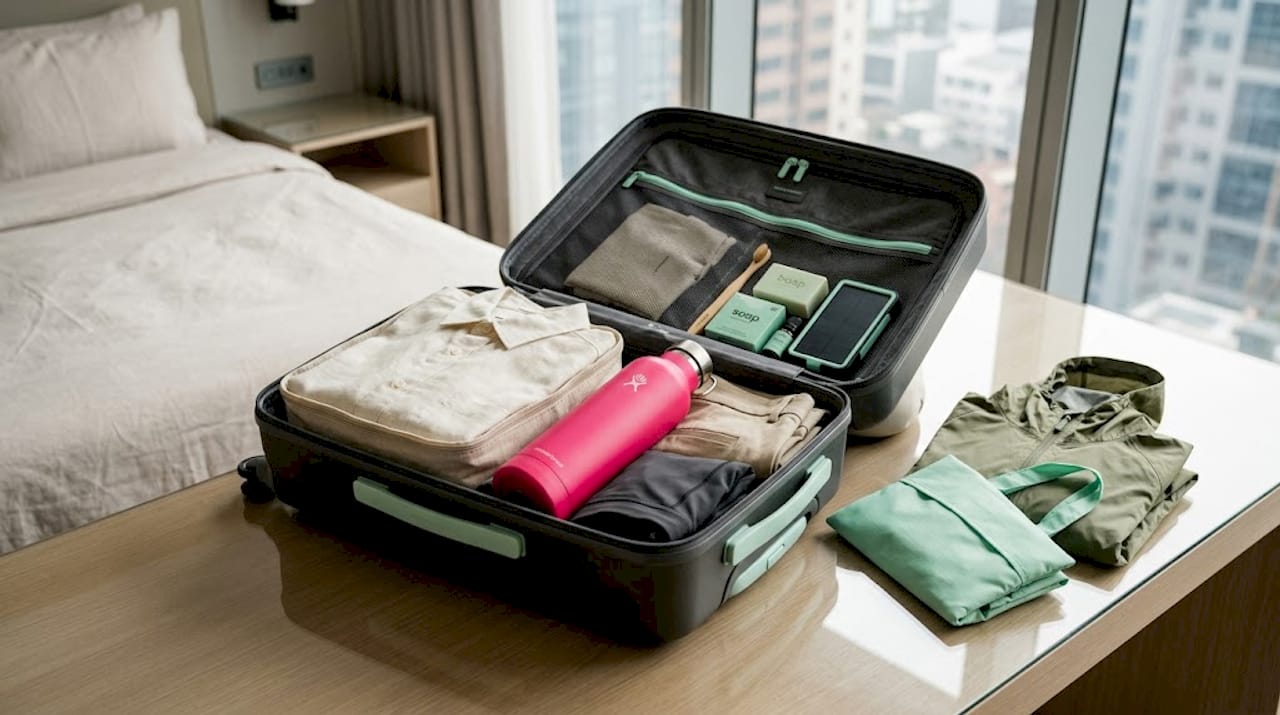
Pro Tip: Choose clothing in neutral tones that mix and match easily. You’ll pack lighter, check fewer bags, and reduce the fuel weight your flight carries. It’s one of the simplest green luxury travel ideas that actually works.
3. Curated sustainable experiences and local immersion
This is where responsible travel checklist thinking gets genuinely exciting. The shift in luxury travel is moving away from passive consumption toward meaningful cultural connection and wellness. The most memorable trips Davidsguide readers describe aren’t the ones with the most amenities. They’re the ones where something real happened.
Here is a practical framework for building an immersive, eco-conscious itinerary:
-
Book community-led tours. Licensed local guides keep money in the community and offer context no international operator can match. Choosing local guides and licensed operators ensures real community benefit rather than revenue flowing to outside companies.
-
Prioritize firsthand sustainability experiences. 49% of luxury travel advisors identify study tours and educational experiences as the most effective way to demonstrate genuine eco-conscious commitment. A morning with a local conservation project beats any spa treatment for lasting impact.
-
Travel off-peak. 57% of advisors say avoiding overcrowded destinations has the greatest positive impact on the travel experience. Shoulder season travel means better access, lower prices, and far less strain on local infrastructure.
-
Practice slow travel. Spending more time in fewer places reduces transportation emissions and creates the kind of depth that rushed itineraries never can. Two weeks in one region beats two days in seven cities, every time.
-
Eat and shop locally. Supporting local restaurants and shops contributes directly to local economies and delivers more authentic experiences than any hotel restaurant or airport duty-free. Ask your concierge for family-owned spots, not just the most-reviewed ones.
-
Choose wellness retreats with substance. A wellness-focused retreat that sources its treatments locally, employs community practitioners, and uses natural products is a fundamentally different experience from a generic spa attached to a chain hotel.
-
Support local artisans directly. Buy crafts from the maker, not the souvenir shop. Ask about the story behind the piece. This is where luxury and ethics genuinely intersect.
4. Comparing your sustainable travel options side by side
Sustainable vacation planning gets easier when you can see your options clearly. Here is a side-by-side look at key decision points for discerning travelers:
| Category | Option A | Option B | Best for |
|---|---|---|---|
| Accommodation | Boutique eco-resort | Large luxury chain with green certification | Boutique for authentic immersion; chain for urban destinations |
| Transport (long-haul) | Direct flight | Private jet with carbon offset | Direct commercial for lowest footprint; private jet for remote access |
| Ground transport | Hybrid rental car | Licensed local driver | Hybrid for flexibility; local driver for community benefit |
| Packing approach | Minimalist capsule wardrobe | Full luxury gear with sustainable materials | Minimalist for shorter trips; full kit for extended stays |
| Dining | Locally owned restaurants | Hotel restaurant with local sourcing | Local restaurants for maximum community impact |
For transport, nonstop flights reduce carbon emissions significantly compared to multi-stop itineraries, since takeoff and landing consume the most fuel. If private aviation is part of your travel style, look for operators who offer verified carbon offset programs and newer, more fuel-efficient aircraft. Davidsguide has detailed coverage of private aviation options for travelers who want to understand the full picture before booking.
Smaller boutique operations consistently deliver higher quality through better guest-to-staff ratios and authentic local sourcing. This isn’t a compromise. It’s an upgrade.
Pro Tip: When booking accommodations for longer stays, look into eco-conscious vacation rentals. A well-chosen private property can offer lower environmental impact than a hotel, especially when it uses local utilities and sources food from nearby markets.
My honest take on sustainable luxury travel
I’ve been covering luxury travel for over a decade, and the conversation has changed more in the last three years than in the previous seven. What I’ve found, though, is that the travelers who get the most out of sustainable travel aren’t the ones who treat it as a sacrifice. They’re the ones who realize it’s actually a higher standard.
The misconception I hear most often is that going green means going without. It doesn’t. Sustainable travel is about greater awareness and incremental choices, not perfect zero-impact travel. I’ve stayed at boutique properties in Costa Rica and Portugal that outperformed five-star chains on every measure of comfort, food, and service, precisely because they were smaller, more intentional, and more connected to their place.
What I’ve seen when travelers prioritize local economies is real. A family-run guesthouse in Oaxaca that employs twelve people from the same village is doing more for that community than any carbon credit ever will. And the experience of staying there, eating their food, meeting their family, is irreplaceable.
My honest advice: use this checklist as a starting point, not a scorecard. You won’t get everything right on every trip. But every choice you make consciously moves the needle. That’s enough.
— David
Plan your next trip with Davidsguide
At Davidsguide, we cover the full spectrum of luxury travel, including the choices that make it sustainable without stripping out the indulgence. Whether you’re weighing eco-conscious city breaks or planning a longer journey that combines private aviation with community-rooted experiences, our guides give you the depth and specificity you need to decide well.
For travelers who want to go deeper, our luxury travel tips hub covers everything from vetting accommodations to building itineraries that balance comfort with genuine impact. If private aviation is part of your plans, we’ve also reviewed the leading operators in detail so you can make an informed, values-aligned choice. Luxury and responsibility aren’t opposites. At Davidsguide, we treat them as the same standard.
FAQ
What makes a hotel truly sustainable?
A truly sustainable hotel holds third-party certification from a recognized body like GSTC or Green Key, employs a majority of staff from the local community, uses renewable energy, and has documented waste and water reduction programs. Marketing language alone is not enough.
How do I avoid greenwashing when booking luxury travel?
Ask properties directly for specific data on local hiring rates, energy sources, and waste reduction targets. Look for independent verification rather than self-reported claims, since 42% of online green claims have been found potentially deceptive.
Is slow travel actually better for the environment?
Yes. Spending more time in fewer destinations reduces the number of flights and transfers you take, which directly lowers your carbon footprint. It also deepens your cultural experience and reduces pressure on overtouristed areas.
Can private jet travel ever be sustainable?
Private aviation carries a higher per-passenger carbon footprint than commercial flights, but newer aircraft and verified carbon offset programs narrow the gap. Choosing direct routes and operators committed to sustainable aviation fuel makes a measurable difference.
What are the most impactful things on a responsible travel checklist?
The highest-impact choices are where you stay, who you hire as guides, and where you spend money locally. These decisions shape economic outcomes for communities far more than any individual product swap.
Recommended
- Luxury Travel Tips – How To Elevate Your Next Vacation – David’s Guide
- How to Make Your Next City Break Truly Luxurious – David’s Guide
- Blog – David’s Guide
- 11 Tips for Making the Most of Your Next Trip – David’s Guide
