
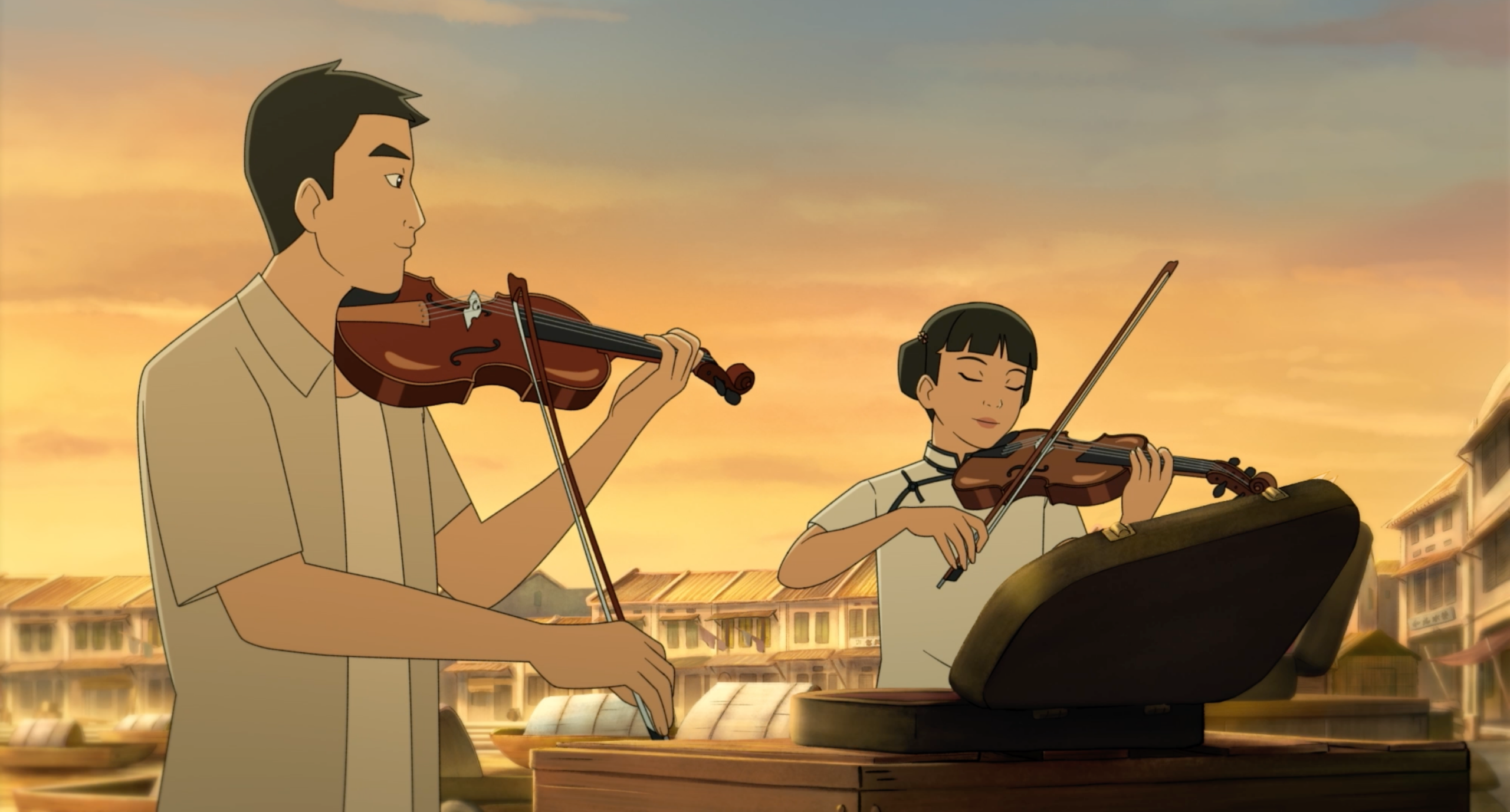
An aging violin legend, a treasured instrument, and a forgotten story stretching back to wartime Singapore form the emotional heart of The Violinist, the animated feature co-directed by Singaporean filmmaker Ervin Han and Spanish animation veteran Raúl García.
The film arrives at TIFF following a major achievement at the Annecy International Animation Film Festival, where it won both the Cristal for Best Feature Film and the SACEM Award for Best Original Music. Its North American premiere at the Toronto International Film Festival marks another important step for a film that connects Singaporean history, animation and music through a deeply personal story.
A Mystery Hidden Inside a Violin
At the centre of The Violinist is a Spanish reporter who begins investigating the mystery surrounding an aging violin legend and her treasured instrument.
What initially appears to be a story about a remarkable musician gradually opens into something much larger. The investigation uncovers a forgotten history of love, war and music, transporting the narrative back to 1930s Singapore.
There, childhood friends Fei and Kai share a powerful bond through music. Their connection grows during a period of innocence, but the arrival of war and the Japanese occupation changes everything, forcing their lives onto very different paths.
The violin becomes more than an instrument. It serves as a link between memory and history, connecting the present-day investigation with a relationship shaped by friendship, music and the upheaval of war.
Animation Meets Historical Memory
The film’s story provides an opportunity for animation to explore history through a particularly intimate lens.
Rather than approaching wartime history solely through large-scale events, The Violinist places individual relationships at its centre. Fei and Kai’s friendship gives the historical setting an emotional anchor, while their shared connection to music provides a language that can survive even when circumstances attempt to separate them.
That combination of personal memory and historical upheaval gives the film a distinctive dramatic foundation. Music is not simply part of the setting; it becomes one of the forces connecting the characters across time.
A Meeting of Singaporean and Spanish Animation
The film brings together two filmmakers with very different but complementary animation backgrounds.
Ervin Han, a Singaporean filmmaker, writer and producer, is the co-founder of Robot Playground Media, an animation studio that has developed and produced projects for international partners including Disney, Warner Bros. Discovery, Netflix and Mediacorp.
For Han, The Violinist represents his feature directorial debut. His previous work includes animated projects such as Downstairs, Mickey Go Local and the horror anthology A Banquet for Hungry Ghosts. His work has received multiple Asian Academy Creative Awards, as well as Asian Television and Content Asia Awards.
The film also reflects Han’s longstanding interest in bringing original stories from Singapore and Southeast Asia to international audiences.
Raúl García’s Disney Legacy
Co-director Raúl García brings decades of experience in international animation to the project.
Born in Madrid, García began his animation career working on projects including Asterix and Caesar Surprise, The Land Before Time and Who Framed Roger Rabbit? He later became a senior animator at The Walt Disney Studios in Burbank, working on celebrated productions including Aladdin, The Lion King and Beauty and the Beast.
García was the first Spanish artist to reach the senior animator position at the studio.
His career subsequently expanded into directing and independent animation. In 2002, he co-wrote and co-directed the Goya Award-winning The Missing Lynx, produced by Antonio Banderas. He also worked on Extraordinary Tales, earning an Annie Award nomination for outstanding directing in an animated feature.
His credits include animation direction on Blue’s Clues Big City Adventure and The Light of Aisha, before joining Han as co-director of The Violinist.
Music as the Film’s Emotional Language
The film’s recognition at Annecy extends beyond its visual achievement.
The Violinist also received the SACEM Award for Best Original Music, reflecting the central role music plays within the story itself.
The score is composed by Ricky Ho, an acclaimed Golden Horse Award-winning composer, alongside Isabel Latorre.
Their work complements a story in which music is inseparable from the characters’ identities and memories. Fei and Kai’s relationship begins through music, while the violin becomes an enduring connection to a past shaped by love and conflict.
The musical dimension therefore operates on both narrative and emotional levels, helping bridge the film’s different periods.
An International Ensemble
The voice cast brings together performers from different backgrounds, including Kheng Hua Tan, Kazuya Tanabe, Adrian Pang, Ayden Sng, Fang Rong and Enrique Arce.
The production is led by Ervin Han of Robot Playground Media, Paloma Mora of TV ON Producciones, Cristiano Bortone of Altri Occhi, and Raúl García.
The collaboration reflects the film’s international character while keeping its story rooted in Singaporean history.
From Annecy to TIFF
Winning two major honours at Annecy has established The Violinist as a significant animated feature before its North American premiere.
The Cristal for Best Feature Film places it at the centre of Annecy’s highest recognition for feature animation, while the SACEM award acknowledges the film’s original music.
Its journey to TIFF now introduces the story to a new audience, bringing its combination of historical drama, animation and music to Toronto.
For Han, the film represents the culmination of more than two decades working in animation and a chance to tell an original story rooted in Singapore and Southeast Asia. For García, it represents another chapter in a career that has moved from some of animation’s most recognizable productions to independent filmmaking.
A Story Carried Across Generations
At its heart, The Violinist is a story about what survives.
A friendship formed through music. A violin preserved through time. A history almost forgotten. And memories that refuse to disappear.
By connecting a present-day mystery with the lives of two young people in 1930s Singapore, the film turns music into a bridge between generations. Its journey from Annecy to TIFF suggests that the story of Fei, Kai and the violin can travel far beyond the place and period in which it began.
The Violinist ultimately asks audiences to consider how art can preserve the emotional traces of a past that history might otherwise leave behind — and how a single instrument can carry an entire story across decades.
If you enjoyed this article, please stay connected and follow Katie Chonacas here