
Aman Tokyo is an 84 suite hotel on the top six floors of the Otemachi Tower in Tokyo, ranked No.11 on The World’s 50 Best Hotels 2026 list. It opened on 22 December 2014 as Aman’s first city hotel and its first hotel in Japan. Entry suites start at 71 square meters, the spa covers almost 2,500 square meters over two floors, and 2026 entry rates start at roughly $1,300 to $1,600 a night in quieter periods, rising well past $2,400 in peak weeks. If you want space, quiet and Japanese design discipline at the top of a tower, this is the Tokyo hotel to beat. If you want nightlife at the door, it is not. The full picture sits inside our ranking of the best hotels in the world, and this profile explains what the ranking does not: what the rooms, the spa and the restaurants are actually like, what guests complain about, and whether the rate holds up.
Where Aman Tokyo sits in the 2026 rankings
The 2026 edition of The World’s 50 Best Hotels was revealed in Paris in September 2026, reported by PR Newswire and Luxury Travel Advisor. Rosewood Hong Kong repeated at No.1. Aman Tokyo placed at No.11, the highest ranked hotel in Tokyo and one of four Japanese hotels on the list, alongside Bulgari Tokyo at No.24, Patina Osaka at No.33 and Park Hyatt Kyoto at No.37.
The trajectory matters more than the single number. Aman Tokyo was No.7 in 2024, fell to No.25 in 2025, and climbed back to No.11 in 2026, per the 50 Best previous lists and the PR Newswire releases for each year. A hotel that opened in 2014 holding a top 15 place in 2026, in a list that rewards new openings, is not coasting on a launch. BusinessClass also lists the hotel with Two MICHELIN Keys in its August 2026 research snapshot, plus DestinAsian Readers Choice Awards 2026 Best Hotel in Japan recognition. Rankings are not a stay, but they set the expectation the rate has to meet.
Location and building: the top of Otemachi Tower
Aman Tokyo occupies levels 33 to 38, the top six floors of the Otemachi Tower, at 1-5-6 Otemachi, Chiyoda-ku, Tokyo 100-0004. Otemachi is the financial district, directly beside the Imperial Palace Gardens and a short walk from Tokyo Station and the boutiques of Ginza. The five line Otemachi subway station connects directly to the building, which makes the rest of Tokyo a train ride rather than a taxi negotiation. Hotel location material puts Haneda Airport at about a 40 minute drive and Narita Airport at about 60 minutes, and Tokyo Station gives access to the nationwide Shinkansen bullet train network.
You arrive at street level and rise to reception on level 33. That vertical break is the whole idea. Street level Otemachi is offices, traffic and station crowds. Level 33 is gardens, stone and sky. Views run over the Imperial Palace Gardens and the Shinjuku skyscrapers, with Mount Fuji on the horizon on clear days. The trade off is honest: Otemachi goes quiet at night and on weekends. Guests who want restaurants and bars spilling out of the lobby door will commute to Ginza, Marunouchi or further west, every night.
Design: a paper lantern above the city
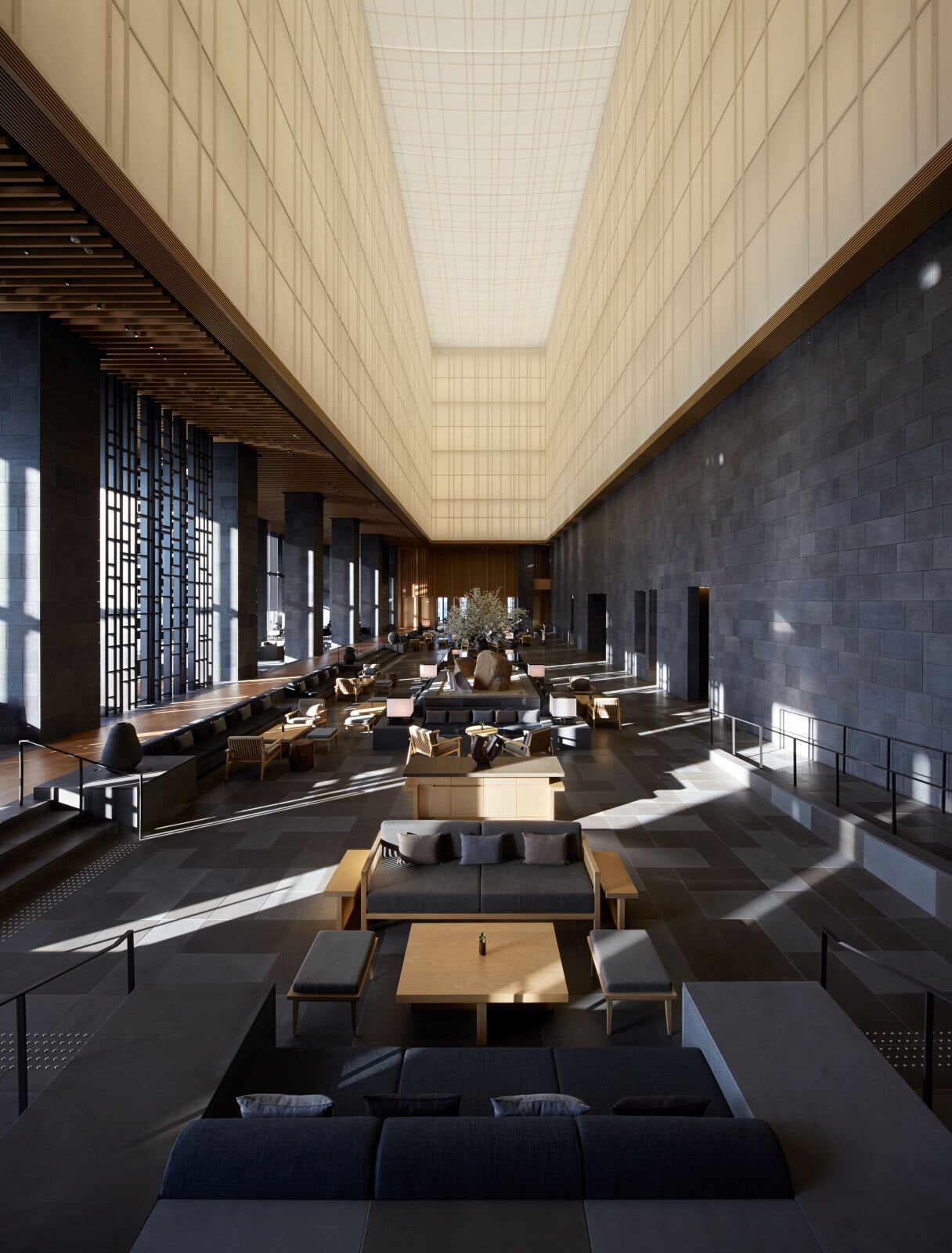
Aman Tokyo was designed by Kerry Hill Architects, the firm’s sixth Aman property, and it translates a traditional Japanese residence into a tower. Camphor wood, washi paper and stone run through the whole hotel, with sliding shoji style screens, low residential proportions and a restrained palette that does its work through light and volume rather than decoration.
The atrium
The centerpiece is the reception level atrium, a six storey volume around 30 meters high, built to feel like the inside of a Japanese paper lantern, with layers of textured washi paper filtering the daylight. At its base sits an inner garden with ikebana arrangements and rock garden elements, ringed by an engawa, the inner veranda found in traditional Japanese houses, which leads out to the lounge and dining areas. Multiple fetched sources describe the same arrival effect, and guest reviews return to it constantly, which is covered in the guest sentiment section below.
Rooms as residences
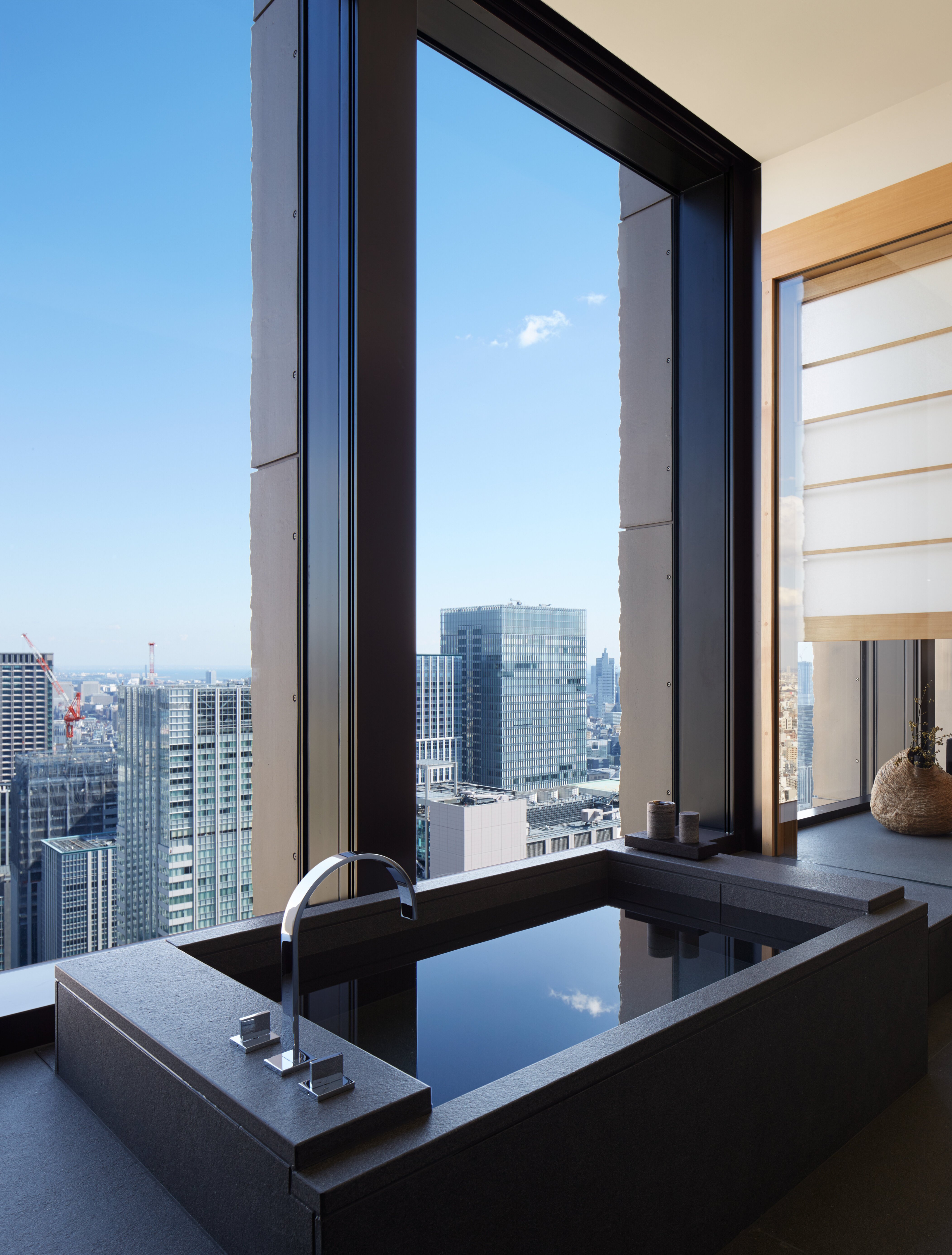
The residential logic continues upstairs. Rooms use the same wood, washi and stone, deep window seats, and bathrooms built around a furo, the deep Japanese soaking tub. Nothing in the design shouts. The luxury signal is square meters, silence and the view, held consistently across all 84 keys.
Rooms and suites: 84 keys, all of them large
Aman Tokyo has 84 rooms and suites, and every category is sold as a suite. Sizes, per the hotel’s accommodation material reproduced by Foray Travels and cross checked against BusinessClass:
- Deluxe Suite: 71 square meters (764 square feet), described by the hotel as the largest entry level rooms in the city, with floor to ceiling windows and a furo soaking tub in the bathroom.
- Garden View Suite: the same 71 square meters, on the hotel’s highest floor, facing the Imperial Palace Gardens. You pay for the view and the floor, not for extra space.
- Tokyo Suite: 77 square meters (829 square feet), facing east Tokyo, with a large foyer and an expansive bathroom.
- City Suite: a minimum of 121 square meters (1,302 square feet), with separate bedroom, living room with dining area, guest powder room and a personal bar with a mini wine cellar.
- Grand Suite: a minimum of 141 square meters (1,517 square feet), with a living room and dining area for four and a pantry.
- Aman Suite: 157 square meters (1,689 square feet) in the northwest corner of the tower, the largest in the hotel, with separate bedroom, living and dining spaces and views over the Imperial Palace Gardens and east Tokyo.
The decision that matters is Deluxe against Garden View. BusinessClass priced both across four direct booking samples and found the Garden View premium swung from about 8 percent to about 56 percent for the identical 71 square meter footprint. At 8 percent, take the palace view. At 56 percent, the Deluxe on a high floor is the smarter buy and the City Suite, with 50 extra square meters, is where a real upgrade starts. Every room includes daily breakfast, complimentary in room refreshments excluding alcohol, welcome amenities and access to the wellness facilities, per the hotel’s stay inclusions listed by Foray Travels. One caution from BusinessClass: its August 2026 direct booking pages showed a contradiction between room only rate labels and listed breakfast inclusions, so read the final booking summary before you pay.
Rates at a glance
Rates below were checked October 2026 against two published 2026 sources, and they move hard by date.
- HotelsForKings, in its 2026 verdict on Aman Tokyo, puts entry rates at roughly $1,300 to $1,600 a night in quieter months, climbing past $2,400 a night in peak cherry blossom and autumn foliage weeks, with larger suites substantially higher.
- BusinessClass, in August 2026 research using Aman’s direct booking engine, captured average nightly Deluxe Suite rates after tax of about 1,600 euros for 19 to 21 January 2027, about 2,503 euros for 1 to 3 December 2026, and about 3,058 euros for 20 to 22 October 2026. The same samples put City Suites between about 3,336 and 4,239 euros a night and Grand Suites between about 3,544 and 4,447 euros a night. Aman displays approximate currency conversions but takes payment in Japanese yen.
- Trip.com listings for the hotel have shown from rates in the $1,700 to $2,100 range in recent crawls, with a 4.7 out of 5 guest rating. Treat any single from rate as a date specific snapshot, not a promise.
The pattern across all three sources is the same. January is the softest sampled month, October the hardest, and the view premium is the least predictable number in the booking. Price your exact dates on the direct engine and one comparison channel before you commit, because BusinessClass found direct and Trip.com at effective price parity, with direct offering wider category availability and payment at the hotel.
Dining: Arva, Musashi and a cafe in a forest
For a hotel built on quiet, Aman Tokyo feeds people unusually well. The official Aman material lists Arva, Musashi by Aman, The Lounge by Aman and The Cafe by Aman, plus La Patisserie.
Arva
Arva, on the reception level, serves Italian cooking built on seasonal Japanese ingredients, under chef Masakazu Hiraki. The name means cultivated land in Latin, and the menu follows the rustic, produce first logic of Italian home cooking rather than fine dining theatre. It serves breakfast, lunch and dinner with Palace Garden views, and houses a 1,200 bottle walk in wine cellar with two private dining rooms above it. Guest feedback on breakfast at Arva is genuinely mixed in BusinessClass’s review analysis: praised by some, called ordinary for the price by others. Dinner draws the stronger reports.
Musashi by Aman
Musashi by Aman is the Edomae sushi counter, named for Master Chef Musashi. Eight seats at a hinoki cypress counter, omakase only in spirit, with the fish sourced each morning and prepared with traditional Edomae techniques such as zuke, marinating in soy, and shime, curing with salt and vinegar. BusinessClass lists it as a dinner service on an upper floor with set closing days and a minimum age, so book it when you book the room. Eight seats do not wait for walk ins.

The Lounge, The Cafe and La Patisserie
The Lounge by Aman fills the atrium level, designed to resemble the inside of a shoji paper lantern, and runs all day: breakfast, the hotel’s well known afternoon tea, drinks and cocktails, plus a humidor with more than 50 Cuban and world cigars. Down at ground level, The Cafe by Aman sits in the Otemachi Forest, a 3,600 square meter woodland of more than 56,000 plants at the foot of the tower, serving lunch, dessert sets and champagne indoors and out. La Patisserie by Aman Tokyo, on the B2 level under Executive Pastry Chef Yoshihisa Miyagawa, sells the French pastry and bread program to the whole district. You can eat three distinct meals a day inside this hotel without repeating a room, which is rare for Aman and matters on a rainy Tokyo week.
The Aman Spa and the 30 meter pool
Wellness is half the product here. Aman Tokyo’s wellness facilities cover almost 2,500 square meters across two floors, per the official Aman material. The Aman Spa has eight treatment rooms. Changing areas include steam rooms, showers and traditional Japanese baths. There is a fitness centre, listed by BusinessClass as 24 hour, plus dedicated yoga and Pilates studios.
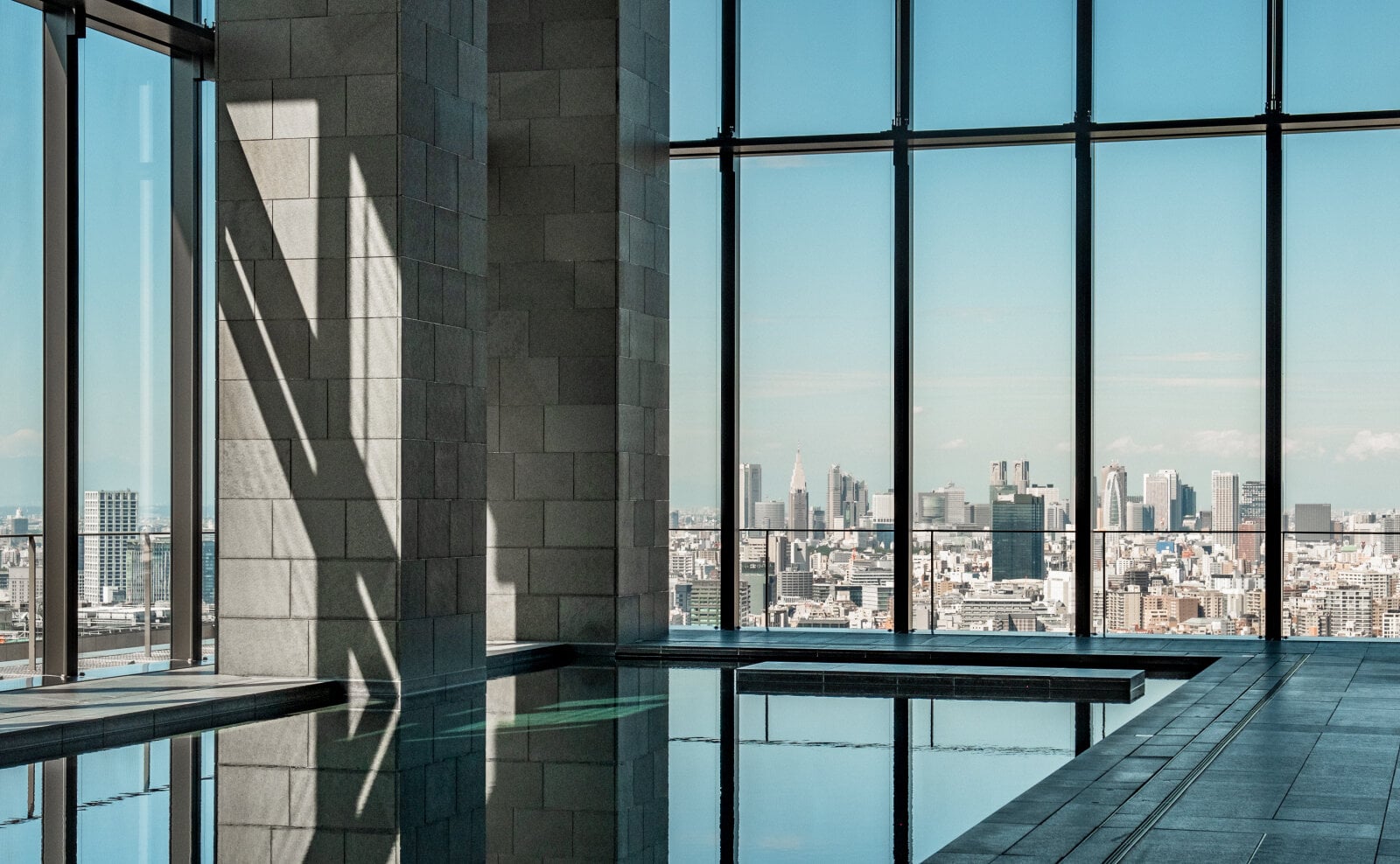
The pool is the image everyone remembers: 30 meters long, temperature controlled, dark stone, with panoramic city views through floor to ceiling glass. Treatments draw on kampo, the Japanese herbal healing tradition derived from traditional Chinese medicine, and the Signature Spa Journey uses a scrub of camphor, kuromoji powder and Japanese clay before the massage work. BusinessClass notes age rules in its retained directory material, with spa treatments and facilities set at 16 and above and pool access for younger guests only with a guardian, so families should confirm the current rules before booking spa time. For context on how the hotel stacks against the city, see our guide to the 10 best luxury hotels in Tokyo.
What guests say
The scores first. BusinessClass, in its August 2026 snapshot of review platforms, recorded Tripadvisor at 4.3 out of 5 from about 695 reviews, with subscores of 4.8 for rooms, 4.9 for cleanliness, 4.6 for location, 4.7 for sleep quality, 4.3 for service and 3.9 for value. The same snapshot put Google at 4.4 out of 5 from about 1,965 reviews and Trip.com at 9.6 out of 10 from about 160 verified reviews. Read that spread carefully: rooms and cleanliness score at the top of the scale, value scores below 4. Guests love the hardware. They argue about the price.
The praise is specific. A Tripadvisor reviewer who stayed in February 2026 wrote that the stay had probably ruined all future hotel experiences, singled out a bathroom built for bathing with a view over Tokyo, and said every employee called them by name, with staff escorting them to Tokyo Station and helping with luggage and tickets at departure. An August 2026 Tripadvisor review called the spa extraordinary and the pool certainly one of the most beautiful in the world, and advised staying at least three nights. Another August 2026 reviewer, visiting from Hong Kong, described stepping into the lobby as walking into a colossal shoji paper lantern, praised the pool in detail for its serene blue and grey palette and floor to ceiling light, and called the location unbeatably convenient for Otemachi Station, Tokyo Station and Nihonbashi shopping. A Trip.com reviewer from March 2026 praised the spacious room, the view, the stunning lobby and the nightly turndown gifts.
The complaints repeat too, and they cluster in three places. First, breakfast. The March 2026 Trip.com reviewer called it not very good, nearly identical across a seven day stay, with no buffet and extra charges for additional items, and BusinessClass found the same split across its wider review set. Second, service consistency at the price. BusinessClass’s analysis of 2025 and 2026 reviews found recurring reports of reservation errors, concierge coordination problems, communication difficulties in English and some formal, distant interactions, alongside the excellent individual service other guests describe. Third, fit. HotelsForKings, summarizing recent verified reviews, notes that some guests find the design too austere and the atmosphere too quiet, and that the Otemachi setting means commuting to livelier districts. None of this reads as a hotel in decline. It reads as a hotel whose rate leaves no room for an ordinary morning.
The verdict: who should book Aman Tokyo
Book Aman Tokyo if space and silence are what you buy a hotel for. The 71 square meter entry suite is a fact, not a flourish, and no other Tokyo hotel pairs that footprint with a 2,500 square meter spa, a 30 meter pool and this level of design coherence. Couples on a design or wellness led trip get the most from the rate. So do premium business travelers with Otemachi, Marunouchi or Tokyo Station commitments, who get quiet rooms, same day laundry, a 24 hour gym and a station connected to the building. Aman loyalists will find the brand’s resort discipline intact in a tower, which is exactly what this hotel was built to prove in 2014. If Tokyo is one leg of a longer trip, our 7 day Japan luxury itinerary shows where a Kyoto or Osaka stay pairs with it, and Aman completists can compare it with our Amangiri profile, its desert sibling at No.45 on the 2026 list.
Skip it if your Tokyo is nightlife, shopping and restaurant hopping on foot, if you need a points and status program, since Aman runs no conventional loyalty currency, or if you are traveling with young children and want a hotel built around them. Skip it, too, if a four figure nightly rate makes you audit every interaction. At these prices a slow breakfast or a concierge miss stops being a footnote, and several guests in the review record made exactly that calculation and landed on value scores under 4.
Worth the rate? Yes, for the traveler who will actually use the rooms, the spa and the pool, and who treats Otemachi quiet as a feature. The No.11 ranking on the 2026 list is defensible on hardware alone. For everyone else, Tokyo now has a deep bench of excellent luxury hotels at half to two thirds of this price, and the honest move is to book one of those and spend the difference on dinner.
Aman Tokyo FAQs
How much does Aman Tokyo cost per night?
Entry Deluxe Suites ran from roughly $1,300 to $1,600 a night in quieter months and past $2,400 in peak weeks, per HotelsForKings 2026 research, while BusinessClass direct samples in August 2026 ran from about 1,600 euros a night in January 2027 to about 3,058 euros a night in October 2026, after tax. Rates checked October 2026. Always price your exact dates.
How many rooms does Aman Tokyo have?
84 rooms and suites, all sold as suites, ranging from the 71 square meter Deluxe Suite to the 157 square meter Aman Suite.
When did Aman Tokyo open?
22 December 2014. It was Aman’s first city hotel and its first property in Japan, designed by Kerry Hill Architects.
Does Aman Tokyo have a pool and spa?
Yes. The Aman Spa covers almost 2,500 square meters across two floors, with eight treatment rooms, Japanese style baths, steam rooms, a fitness centre, yoga and Pilates studios, and a 30 meter temperature controlled indoor pool with city views.
Is Aman Tokyo good for families?
The rooms are large and the location is calm, but the hotel is a quiet sanctuary first. Spa facilities carry age rules, dining at Musashi has a minimum age, and there is no children’s club in the hotel’s listed facilities. Families with older children who want space do well here. Families wanting a resort program for young kids should look elsewhere.
Sources checked
- The World’s 50 Best Hotels 2026 list, PR Newswire release via Morningstar and the full table in Luxury Travel Advisor, both fetched October 2026: Aman Tokyo at No.11, ceremony in Paris, Rosewood Hong Kong at No.1.
- The World’s 50 Best Hotels 2025 list, PR Newswire release, fetched October 2026: Aman Tokyo at No.25. The 50 Best previous list for 2024, fetched October 2026: Aman Tokyo at No.7.
- Aman Tokyo official hotel material, Aman Copy Deck PDF hosted on aman.com, via search extract fetched October 2026: top six floors of the Otemachi Tower, 84 suites, Arva and Musashi by Aman, 1,200 bottle wine cellar, eight seat hinoki counter, Cafe by Aman in the 3,600 square meter Otemachi Forest, wellness facilities of almost 2,500 square meters, eight treatment rooms, 30 meter pool.
- Aman Tokyo launch release, November 2014, via Hotel Online and eHotelier, fetched October 2026: opening on 22 December 2014, first city property, 84 rooms and suites, levels 33 to 38, Kerry Hill Architects, camphor wood, washi paper and stone.
- Foray Travels Aman Tokyo profile, reproducing hotel accommodation, dining and spa material, fetched October 2026: room by room sizes from 71 to 157 square meters, furo tubs, stay inclusions, chef names, La Patisserie, kampo based spa program, airport drive times.
- BusinessClass Aman Tokyo review, researched August 2026, fetched October 2026: direct booking rate samples in euros after tax, room size table, Tripadvisor, Google and Trip.com score snapshot, MICHELIN Two Keys listing, dining and location analysis, service and breakfast criticism drawn from 2025 and 2026 reviews.
- HotelsForKings, Is Aman Tokyo Worth It, 2026 verdict, fetched October 2026: entry rates of roughly $1,300 to $1,600 a night in quieter months and past $2,400 in peak weeks, guest sentiment summary.
- Tripadvisor Aman Tokyo reviews, fetched October 2026: 4.3 out of 5 overall, individual reviews from February 2026 and August 2026 quoted or closely paraphrased in the guest sentiment section.
- Trip.com Aman Tokyo listing and reviews, via search extracts fetched October 2026: address, check in and check out times, no pets policy, March 2026 guest review including breakfast criticism.
