
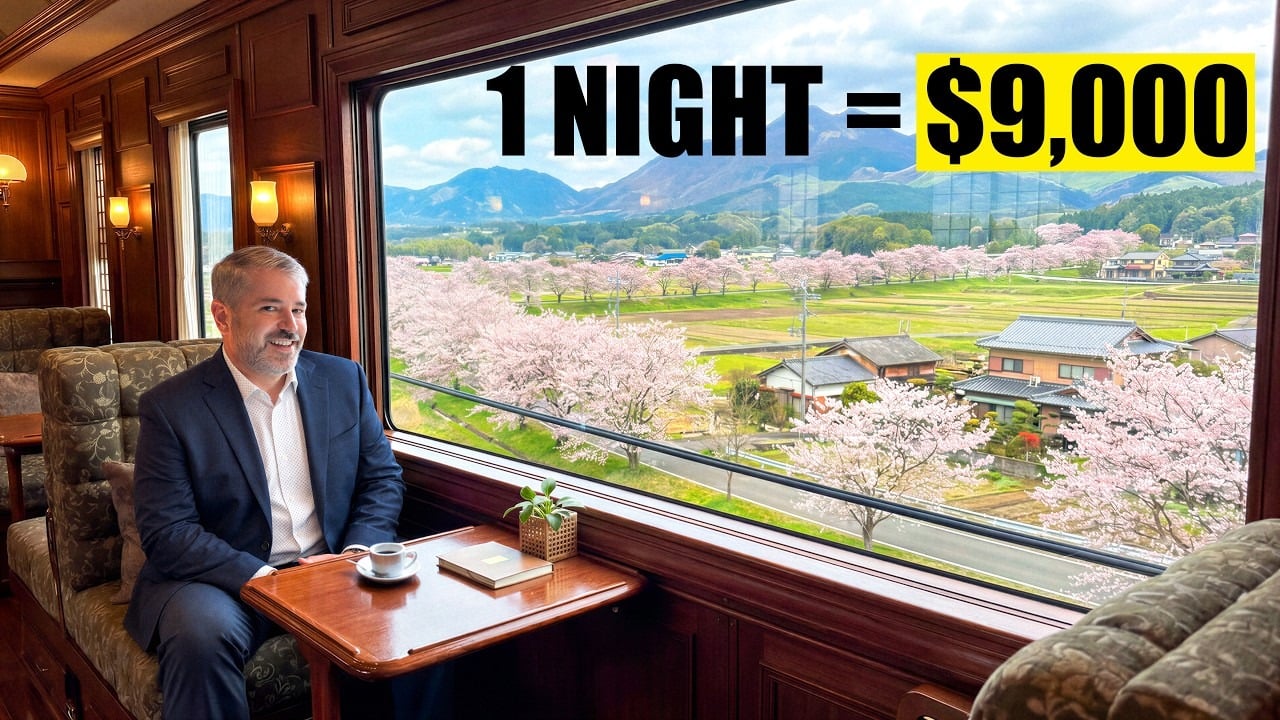
YouTuber Jeb Brooks, whose first class flight reviews have become some of the most watched luxury travel videos on YouTube, spent years trying to get a ticket for Japan’s most exclusive train. In “I Tried the WORLD’S #1 Luxury SLEEPER TRAIN,” published July 11, 2026, he finally boards the Seven Stars in Kyushu, the cruise train that bills itself as the world’s only 7-star train. The video has pulled in over 800,000 views, and unlike his flight reviews, there is no written recap of it anywhere in Google’s text index. Here is what the video actually shows, with the hard numbers verified.
The premise is simple enough. There is first class train travel, and then there is the Seven Stars. In the video’s own words, this luxury Japanese train is one of the world’s most expensive trains. What follows is a roughly 21 minute tour of the train, the suites, the food, and the booking system that keeps almost everyone out. Below are 12 takeaways.
1. The number seven is doing a lot of work
The train is called Seven Stars because the number seven appears three times in its concept. Kyushu, Japan’s southernmost main island, has seven prefectures: Fukuoka, Saga, Nagasaki, Kumamoto, Oita, Miyazaki, and Kagoshima. The train is designed around seven tourist attractions of the island: nature, food, hot springs, history, culture, power spots, and humanity. And the train itself is made up of seven cars. The naming is deliberate, and it sets the tone for a journey that treats every detail as part of a larger design idea.
2. The entire train holds just 10 suites
Four of the seven cars are sleeping cars, and between them they contain only 10 guest suites: eight standard suites and two deluxe suites. That means roughly 20 to 30 passengers per departure, fewer people than fit in the first class cabin of a large airliner. When Jeb Brooks tours the train, the sense of scale is striking. This is not a train with a luxury carriage attached. The whole consist is the luxury product, and scarcity is built into the design.
3. A night on board costs about $6,000, and the real prices climb from there
The commonly quoted figure for the Seven Stars is around $6,000 per night, and the official pricing backs it up. A two day, one night itinerary starts at ¥680,000 (about $7,000) per person in a twin suite. A single traveler booking the two day course pays around 900,000 JPY (about $6,000). The four day journeys start at ¥1,200,000 (about $12,350) per person and climb higher. Third party travel agencies selling packaged departures list prices above $10,000 per passenger, with one 11 day Kyushu program priced at £32,165 per suite for two sharing. By any measure, this is one of the most expensive ways to travel on land anywhere in the world.
4. You cannot just book a ticket. You enter a lottery.
Demand for the Seven Stars has outstripped supply since its debut, so most prospective passengers apply through a ticket lottery held twice a year. Jeb notes in the video that he and his team tried for years to get on board before the day finally arrived. Applications are handled through the train’s official booking site, and winning a slot is only the start: international travelers often book through specialist agencies that bundle the train with hotels, transfers, and domestic flights, which is how prices reach the five figure sums quoted above.
5. Deluxe Suite A is the most fought over room on rails
Of the 10 suites, the two deluxe suites sit in the seventh and final car, and Deluxe Suite A is the crown jewel. It measures about 21 square meters (226 square feet) and its defining feature is a panoramic window stretching across the full width of the carriage at the very back of the train, so the landscape recedes behind you as you ride. JR Kyushu says it is by far the most popular accommodation on the train. Deluxe Suite B, at about 17 square meters (183 square feet), is slightly smaller but still richly detailed. The eight standard suites are each around 10 square meters (108 square feet), with foldable beds that convert into sofas during the day, plus a private shower and toilet in every room.
6. There are no televisions anywhere on the train, on purpose
One of the most telling details in the tour: the Seven Stars has no TVs in any suite or public space. The design philosophy is that passengers should look out the windows and talk to each other instead. Pocket Wi-Fi is provided, though the signal drops in mountainous areas. It is a deliberate rejection of the screen filled cabins found on airlines and cruise ships, and it says a lot about who the train is built for. The luxury here is attention, not entertainment.
7. The Blue Moon lounge is a saloon on wheels with live piano
Car 1 is the Blue Moon, a lounge and bar car that functions as the train’s social heart. During the day it is a restful observation space with comfortable sofas and panoramic windows. In the evening, the atmosphere shifts: live piano music plays while passengers sip cocktails and watch Kyushu roll past. Jeb’s room tour segment, which runs for more than 11 minutes of the video, lingers on these shared spaces because they are where the journey’s character lives. A fully attended bar keeps the drinks coming.
8. The dining, tea house, and gallery cars complete the concept
Car 2 holds two distinct spaces: a traditional tea house with tatami flooring in the ryurei style, where the crew serves famous regional teas like Yame and Chiran, and a salon for conversation, drinks, and onboard activities. The dining car, named Jupiter, serves cuisine prepared by renowned chefs from across Kyushu, built around the island’s regional ingredients. Car 3 combines a gallery shop selling crafts from all over Kyushu with the KAZ bar, a compact cocktail bar tucked into the limited space of the train (drinks there carry additional charges). Smoking is prohibited in all cars.
9. It was designed by Eiji Mitooka and has run since October 15, 2013
The Seven Stars is the work of designer Eiji Mitooka, who created nearly everything on board specifically for the train, from the woodwork and textiles to the washi paper details. Operated by the Kyushu Railway Company (JR Kyushu), it entered service on October 15, 2013, which makes it more than 13 years old and still the benchmark other luxury trains are measured against. The train runs on a DF200 diesel locomotive with a top speed of 100 km/h. It does not go fast. The point was never speed.
10. The itineraries now include Takachiho, Unzen, and Kuju
The classic journeys are the two day and four day circuits around Kyushu, starting and ending at Hakata Station in Fukuoka. JR Kyushu has added newer courses spotlighting Takachiho, Unzen, and Kuju, steering travelers toward remote onsen towns and volcanic landscapes. The days mix time on board with off train excursions: pottery villages, hot spring soaks, and stays in traditional ryokan inns. The train is the centerpiece, but the itinerary is a curated tour of Kyushu’s culture, and meals, guides, and transfers at each stop are part of the package.
11. The booking reality: plan a year ahead and bring patience
Jeb devotes the final section of the video to how to book and what it costs, and the message is consistent with everything else about the train. Lottery applications open in defined windows, specialist agencies run inquiry forms for the 2026 to 2027 departures, and packages for two start from around 2,512,558 JPY through some operators. Each suite accommodates one to two passengers, and children under 12 are not allowed on board. If you want the Deluxe Suite A with the rear panoramic window, you are competing with every other applicant for the single most requested room on the train.
12. The verdict: first class train travel, then the Seven Stars
The video’s framing never wavers. Jeb’s channel has reviewed first class cabins on the world’s best airlines, from Emirates’ fully enclosed Game Changer suites to Qantas’ A380 first class, and the Seven Stars is presented as something in a different category entirely. It is not transportation with luxury added. It is a moving boutique hotel with 10 rooms, a tea house, a gallery, a bar car, live piano, and a lottery for the privilege of paying $6,000 a night. Whether it is worth it depends on what you value, but nothing else on rails looks quite like it.
By the numbers: Seven Stars in Kyushu
- 800,000+ YouTube views on Jeb Brooks’ review since July 11, 2026
- 7 cars, 7 prefectures, 7 tourist attractions in the naming concept
- 10 guest suites total (8 standard, 2 deluxe), roughly 20 to 30 passengers per departure
- 21 square meters (226 sq ft): Deluxe Suite A, with a full width panoramic rear window
- 17 square meters (183 sq ft): Deluxe Suite B
- 10 square meters (108 sq ft): each standard suite
- ¥680,000 (about $7,000): starting price per person, two day itinerary, twin suite
- ¥1,200,000+ (about $12,350+): starting price per person, four day journey
- 900,000 JPY (about $6,000): two day course, single occupancy
- October 15, 2013: the train’s first day of operation
- 100 km/h: maximum speed
- 2 lotteries per year for tickets
- 12: minimum age for passengers
- 0 televisions on board, by design
For travelers dreaming of Japan beyond the usual routes, the Seven Stars is the extreme end of a spectrum that includes everything from bullet trains to a tranquil farm stay in Japan. Watch Jeb Brooks’ full review below.

The Seven Stars in Kyushu has been running for over a decade, and the lottery is still the only way most people will ever get on board. Some journeys are about the destination. This one is about the train.
