
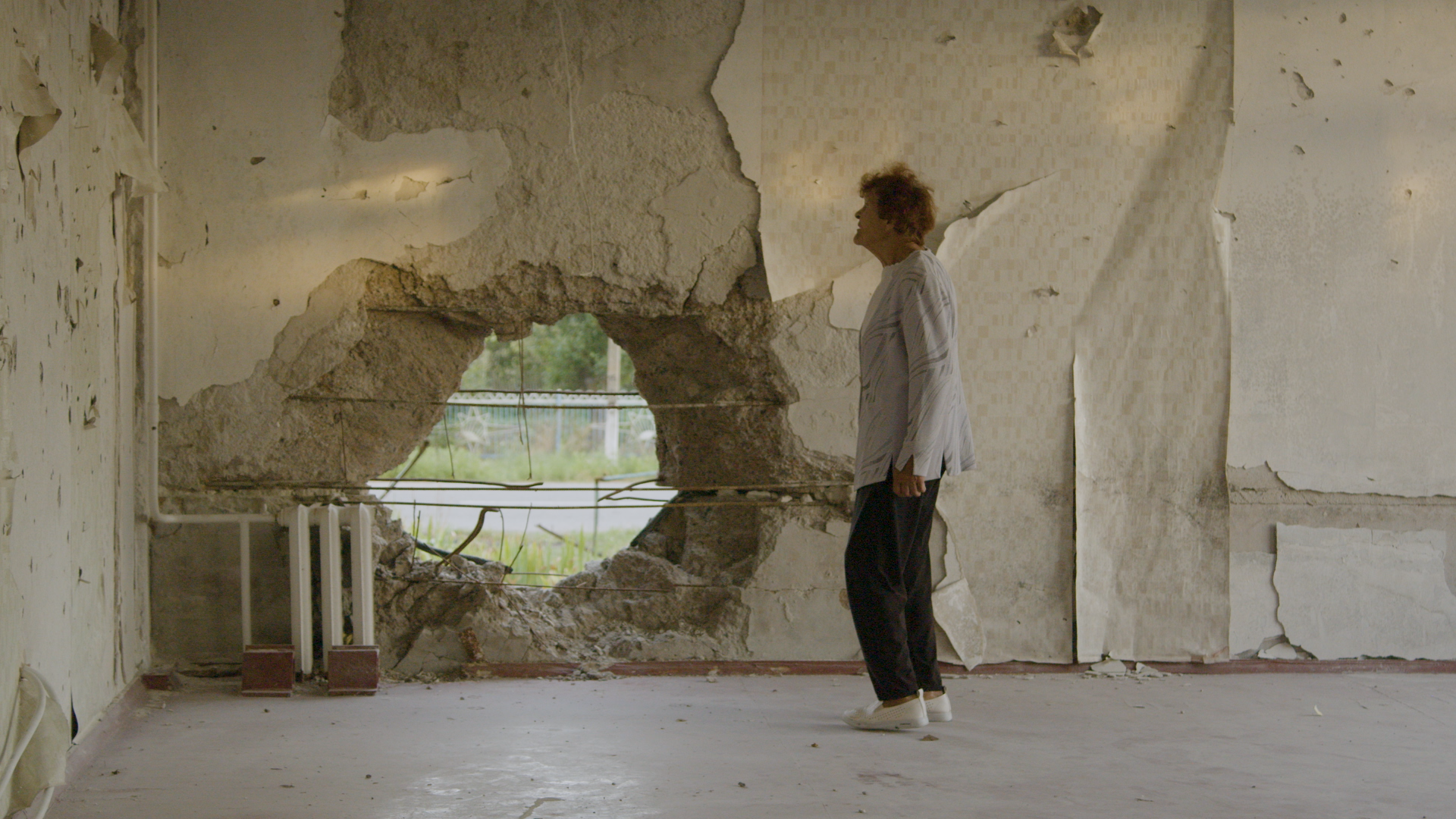
Some documentaries aim to explain a conflict. Others focus on documenting history in real time. TRACES, the powerful new feature documentary from Ukrainian filmmaker Alisa Kovalenko and co-director Marysia Nikitiuk, does something more intimate and far more difficult. It creates space for survivors to speak for themselves.
Following strong recognition at the Berlin International Film Festival, the film has emerged as one of the standout audience favorites at the Hot Docs Canadian International Documentary Festival in Toronto and is now set to screen next at the DOXA Documentary Film Festival in Vancouver.
WATCH TRAILER
What stood out to me while reading about the project is that TRACES never positions survivors simply as subjects of testimony. Instead, the film appears deeply committed to survivor-led storytelling, allowing those most affected by violence to shape the narrative themselves.
A Story Told From Within
At the center of the documentary is Iryna Dovhan, a former captive who later became an activist and head of SEMA Ukraine. Through her work, she documents testimonies from survivors of conflict-related sexual violence and torture across de-occupied Ukrainian territories.
The women featured in the film are not presented through detached observation. They actively reclaim their own stories, transforming deeply personal trauma into a form of collective resistance.
What I found particularly powerful is how the documentary frames testimony not only as remembrance, but as action. Speaking becomes part of resisting silence, stigma, and erasure.
The film also emphasizes that these crimes are not isolated incidents. Sexual violence is portrayed as part of a deliberate wartime strategy used to intimidate, destabilize, and exert control over occupied communities.
Importantly, the documentary acknowledges that both women and men, including Ukrainian prisoners of war, have been targeted, highlighting the broader and systematic nature of these abuses.
The Meaning Behind the Title
The title TRACES carries multiple meanings throughout the film.
On one level, it refers to the visible destruction left by war, damaged communities, fractured lives, and physical violence. But the title also points toward the invisible marks carried by survivors long after the immediate violence ends.
Psychological trauma, social stigma, silence, and memory all become part of those “traces.”
What stood out to me is how the film appears to approach trauma with restraint rather than sensationalism. The focus is not on graphic representation, but on the emotional and social realities that continue afterward.
Rather than reducing survivors to victims, the documentary seems deeply invested in their agency, resilience, and ability to reclaim space for themselves and for others.

A Personal Connection for the Director
One of the most significant aspects of TRACES is the deeply personal relationship director Alisa Kovalenko has to the subject matter.
In her director’s statement, Kovalenko explains that the film resonates “at the core” of her own experience because she herself is a survivor of conflict-related sexual violence.
That perspective fundamentally shapes the documentary. Kovalenko describes the project as existing “on equal terms,” both as a filmmaker and as part of the survivor community itself.
What I found especially meaningful is her emphasis on the principle: “Nothing about us without us.”
That idea feels central to the film’s identity. TRACES is not speaking on behalf of survivors from an outside perspective. It is creating space from within the community itself.
After years working as a human rights activist, Kovalenko also frames the documentary as a call for international solidarity and action, while simultaneously offering hope to survivors around the world.
A Film About Solidarity as Much as Trauma
Although the subject matter is undeniably heavy, the documentary does not appear solely focused on suffering.
Again and again, descriptions of the film return to ideas of solidarity, collective action, and mutual support. Survivors are shown building networks, documenting testimony together, and refusing to allow silence to define their experiences.
What stayed with me while researching the project is how strongly the film seems to resist isolation. Trauma is acknowledged fully, but so is connection.
The women within TRACES are not portrayed as passive figures waiting for justice. They are actively demanding accountability while supporting one another through the process.
That distinction gives the documentary a very different emotional texture than many war-related films.
Recognition on the International Festival Circuit
The film’s growing international visibility reflects both its emotional impact and its urgency.
After earning attention at Berlinale, TRACES made its North American premiere at Hot Docs, where it quickly became one of the festival’s most discussed audience titles.
Its upcoming screening at the DOXA Documentary Film Festival continues that momentum, bringing the film to wider Canadian audiences at a time when conversations around war crimes, trauma, and accountability remain globally relevant.
What stood out to me is how consistently responses to the film emphasize its emotional honesty rather than political messaging alone. The documentary appears deeply human first, which ultimately gives its political implications even greater weight.
Beyond Documentation
There are many documentaries about war, but fewer that feel built around preserving dignity as carefully as TRACES appears to do.
The film is certainly a record of violence and testimony, but it is also something more reflective. It examines how memory is carried, how communities survive, and how survivors reclaim language after trauma attempts to erase it.
What I found particularly compelling is the film’s focus on voice itself. Refusing silence becomes an act of resistance.
And in that sense, TRACES feels less like a film solely about the past and more like an ongoing conversation about justice, accountability, and visibility.
A Documentary That Refuses Silence
What ultimately makes TRACES feel so significant is that it approaches its subject matter with both emotional intimacy and political clarity.
The film understands that testimony alone is not enough without recognition, solidarity, and continued attention. By centering survivor voices directly, Kovalenko and Nikitiuk create a documentary that feels personal, urgent, and deeply human all at once.
At a time when audiences are often overwhelmed by the scale of global conflict coverage, TRACES narrows its focus deliberately, toward individual voices, individual memories, and individual acts of courage.
And through those stories, the film appears to reveal something much larger about resilience itself.
For more information, visit here.
She’s All Over the Place Podcast