
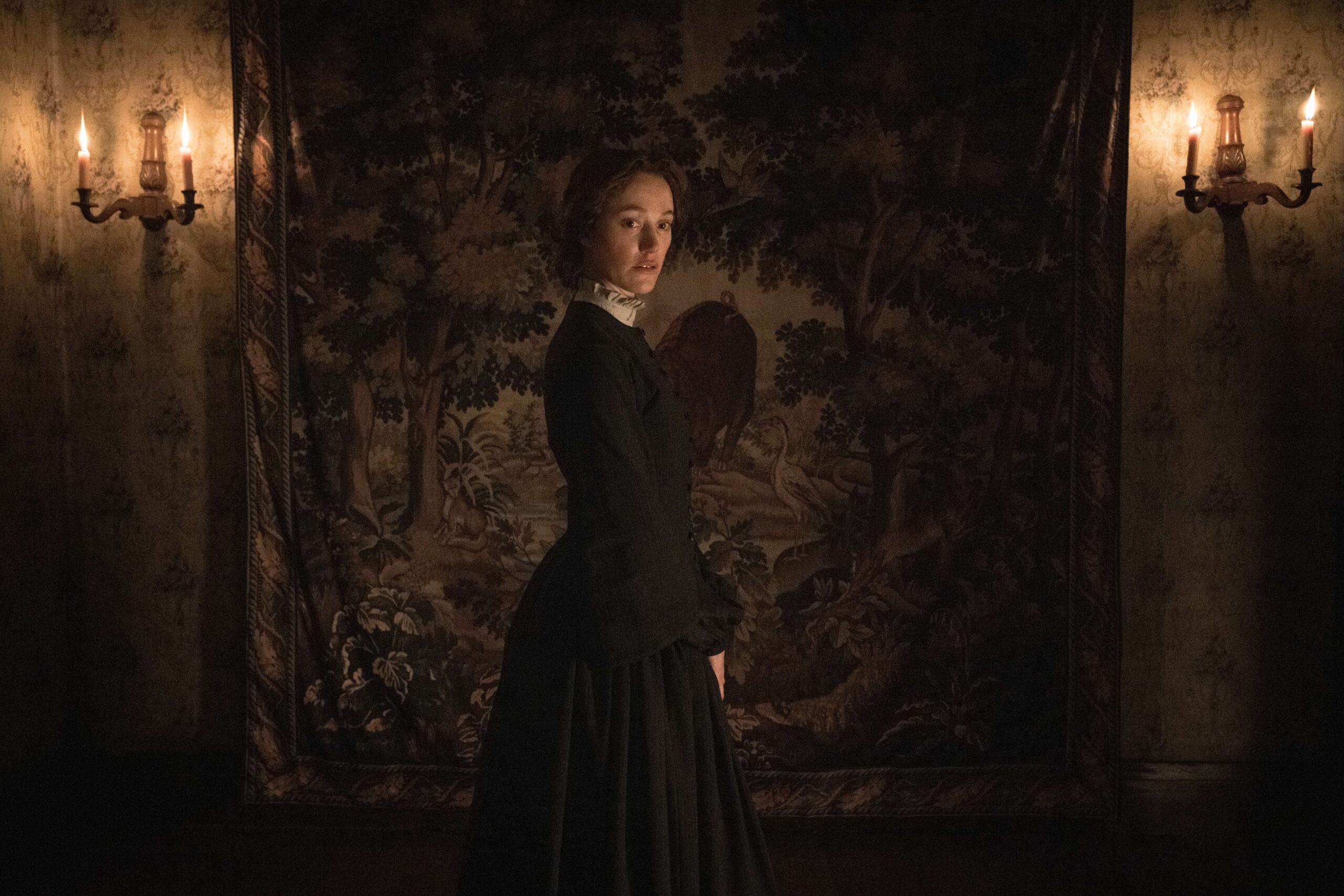
There has been a noticeable resurgence of gothic horror in recent years, but few upcoming releases seem as visually unsettling and psychologically charged as Victorian Psycho. Directed by Zachary Wigon and adapted from the novel by Virginia Feito, the film is already generating significant attention ahead of its world premiere at the Cannes Film Festival in the Un Certain Regard section this May.
Set for a nationwide theatrical release on September 25 through Bleecker Street, the film stars Maika Monroe alongside Thomasin McKenzie, Jason Isaacs, and Ruth Wilson.
What stood out to me immediately is how carefully the film appears to balance classic Victorian atmosphere with modern psychological horror. Even from the early promotional material, there is a sense of restraint that feels far more unsettling than overt spectacle.
A Governess Arrives at a Remote Manor
Set in 1858, Victorian Psycho follows Winifred Notty, played by Maika Monroe, an eccentric young governess who arrives at the isolated gothic estate known as Ensor House.
At first, the setup feels familiar within the gothic tradition. A mysterious outsider enters a remote household filled with unease and hidden tension. But as Winifred begins settling into life at the manor, staff members start disappearing under increasingly suspicious circumstances.
The family soon begins questioning whether their new governess may be far more dangerous than she appears.
What I find particularly compelling is that the film seems less interested in jump scares than in psychological instability. The atmosphere appears built around uncertainty, suspicion, and the gradual unraveling of trust inside the household.
Maika Monroe Continues Her Horror Run
The casting of Maika Monroe feels especially significant given her growing reputation within modern horror cinema.
Following performances in It Follows, Longlegs, Watcher, and Significant Other, Monroe has become one of the genre’s most recognizable contemporary faces.
What stood out to me while researching the film is how naturally this role seems to fit her screen presence. Director Zachary Wigon himself described Monroe’s performances as carrying an “intense screen presence” and praised her ability to portray psychologically complex characters.
Her character, Winifred Notty, appears designed around that exact tension, someone who feels both emotionally readable and deeply unknowable at the same time.
Interestingly, Monroe replaced Margaret Qualley, who had originally been attached to the role before exiting the project due to scheduling conflicts.
A Cast Built Around Psychological Tension
Alongside Monroe, the film features Thomasin McKenzie, whose previous work in Last Night in Soho and Old already established her comfort within psychologically uneasy material.
Jason Isaacs, known to broader audiences through Harry Potter and the Chamber of Secrets and more recently The White Lotus, adds another layer of intensity to the cast.
Ruth Wilson’s involvement also feels especially fitting for the film’s atmosphere. Her ability to balance emotional fragility with unpredictability aligns naturally with gothic storytelling traditions.
What I noticed while reviewing the cast is how strongly the film leans into performers known for emotional complexity rather than straightforward horror archetypes.
Zachary Wigon Moves Further Into Psychological Cinema
For Zachary Wigon, Victorian Psycho marks his third feature following The Heart Machine and the psychological thriller Sanctuary.
What makes Wigon particularly interesting as a filmmaker is how consistently he gravitates toward unstable emotional dynamics and psychological power struggles. Even in his earlier work, tension often emerged through conversation, manipulation, and emotional imbalance rather than physical action alone.
That sensibility appears ideally suited for gothic horror, especially one centered on suspicion and hidden identity.
The screenplay comes directly from Virginia Feito, adapting her own novel for the screen. Feito’s writing has often been described as darkly satirical and psychologically sharp, qualities that seem deeply embedded into the film’s tone.
Gothic Horror With Contemporary Energy
Although Victorian Psycho is rooted in Victorian England, the project feels very much aligned with the current evolution of elevated horror cinema.
Several publications have already described the film as combining gothic horror traditions with psychological thriller elements.
One comparison surrounding the novel described it as “Jane Eyre meets American Psycho,” which immediately suggests the film’s unusual tonal mix, literary gothic atmosphere combined with deeply unstable psychological interiority.
What stood out to me is how visually restrained the promotional campaign has been so far. The posters rely heavily on dim candlelight, dark textures, and stillness rather than overt horror imagery. That choice creates a sense of dread that feels much more classical and emotionally lingering.
Cannes Gives the Film Early Prestige
The film’s selection for Cannes’ Un Certain Regard section immediately positions it as more than a conventional genre release.
Historically, Un Certain Regard has highlighted films that experiment stylistically or offer distinct directorial voices. The inclusion of Victorian Psycho suggests confidence not only in its horror elements, but in its cinematic ambition overall.
What I find especially interesting is how horror continues gaining greater visibility within prestigious festival spaces. Rather than existing separately from auteur cinema, psychologically driven horror films are increasingly becoming part of those conversations directly.
A Fall Release Positioned for Attention
Following its Cannes debut, Victorian Psycho will arrive in theaters nationwide on September 25, placing it directly within the fall horror season.
Produced by companies including Anton, Traffic., and Anonymous Content, the project appears positioned as both a prestige festival title and a larger theatrical genre release.
That combination can be difficult to balance, but the early reactions surrounding the film suggest it may have the kind of crossover appeal modern psychological horror increasingly thrives on.
Why Victorian Psycho Already Feels Intriguing
What ultimately makes Victorian Psycho stand out right now is not simply its premise, but its atmosphere.
The film seems less concerned with traditional horror mechanics than with creating emotional unease through isolation, suspicion, and character psychology. The gothic manor setting, the mysterious governess, the disappearing staff, all of it feels rooted in classic horror tradition while still carrying a distinctly modern psychological intensity.
And perhaps that is why the project already feels so compelling before audiences have even seen it.
It understands that gothic horror works best not when everything is revealed, but when uncertainty quietly takes over the room.
For more information, visit here.
She’s All Over the Place Podcast