
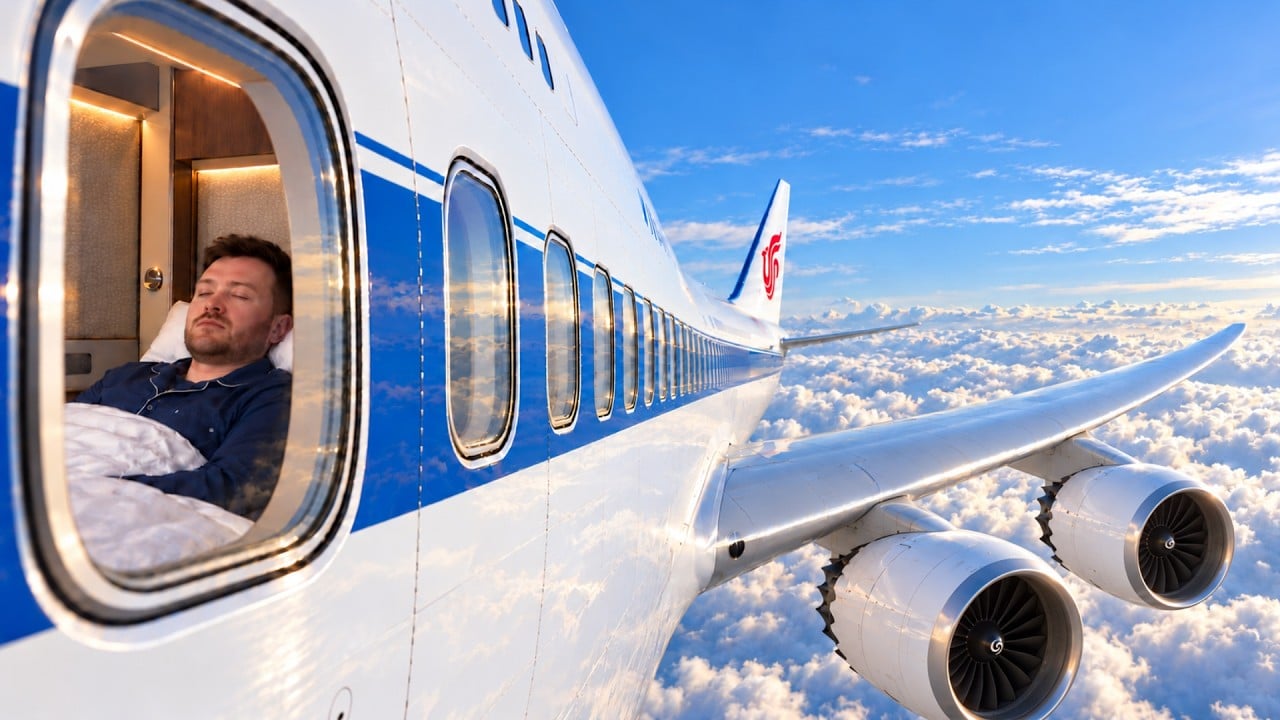
Air China’s Forbidden Pavilion first class is the hardest premium cabin on earth to review: 12 suites on a Boeing 747-8 that mostly flies US-China routes, a product so rarely filmed that Trek Trendy chased it for months before capturing its return to Frankfurt. Here are 12 takeaways from his secretive-cabin review, plus the fares, specs, and his final verdict.

Watch the video first, then read the takeaways
Trek Trendy’s latest video, “I Tried the World’s Most Secretive First Class,” opens with a promise that caught my attention immediately: “Today I’m flying in two First Class cabins you hear almost nothing about.” The first is Air China’s Forbidden Pavilion on the Boeing 747-8. The second is China Eastern’s first class on the Boeing 777, reached after a Beijing to Shanghai high-speed train crossing. I have photographed celebrities in private jets and reviewed hotel suites for 27 years, and this is the first time I have seen anyone put Air China’s actual flagship product through a full modern flight review. The Forbidden Pavilion name alone, named for the Forbidden City in Beijing, is worth the price of admission. Here is everything the video reveals, takeaway by takeaway.
1. What the Forbidden Pavilion actually is
Forbidden Pavilion is Air China’s name for first class, and it is fitted to a tiny fleet: the Boeing 747-400, the 747-8, and select 777-300ERs. On the 747-8, the cabin holds just 12 suites in a 1-2-1 layout across three rows. Each suite is a Zodiac Aerospace Venus open suite, 26.5 inches wide with 82 to 83 inches of pitch, converting to a fully flat bed with direct aisle access from every seat. The name is not marketing fluff: the suites carry Chinese design motifs, and Air China treats the cabin as its national-carrier flagship, the equivalent of what Emirates’ Game Changer suites are to Dubai’s airline.
2. The cabin sits in the strangest place on the plane
On nearly every 747 ever built, first class occupies the nose, up front ahead of the upper-deck stairs. Air China’s 747-8 breaks the rule. The Forbidden Pavilion sits on the lower deck behind the business class cabin and in front of premium economy. That makes it one of the only jumbo-jet first class cabins in the world where you walk through business class to reach first. SeatRecon’s seat map confirms the layout, rows 1 through 3, and notes the lavatories and galleys sit at the back of the cabin with enough distance to keep things quiet. For couples, seats 1D and 1H are the pairing to book; solo travelers want the window suites, 1A or 1L.
3. Getting a seat required months of chasing
In the video’s intro, Trek Trendy says it plainly: “This has been quite the bucket list tick, as I’ve been chasing Air China’s 747-8 for months now.” The 747-8 fleet is small, the Forbidden Pavilion routes rotate, and Air China releases very little first-class award space. The video’s hook is not just the cabin, it is the rarity: this is a review almost nobody else has filmed in 2026. In a landscape where the Emirates Game Changer suites get reviewed weekly, the Forbidden Pavilion is genuinely uncharted territory.
4. Booking it came with “frankly obscene fares”
“Booking this journey was quite the challenge, with some frankly obscene fares!” That is the creator’s own description of the ticketing. Air China first class cash fares on US-China routes routinely price well into four figures each way, and the itinerary stacks two first class flights plus a high-speed train. The video promises a full cost breakdown in the final chapter, and the number is the payoff the comments were waiting for. The lesson is one frequent flyers already know: on Chinese carriers, the hard product can be superb while the pricing logic feels like it was set by a different industry entirely.
5. The video captures the 747-8’s return to Frankfurt
The headline moment of the first flight segment is in the description: “today I capture its return to Frankfurt!” Air China’s 747-8 first class rotates across its long-haul network, and Frankfurt is one of the European stations where the jumbo makes sense, given the airline’s Frankfurt service history. Spotting a passenger 747-8 in 2026 is already rare, since only a handful of airlines still fly the type with passengers: Lufthansa, Korean Air, and Air China. Seeing one in the Forbidden Pavilion configuration, in first class, is the aviation equivalent of a solar eclipse.
6. The lounges tell you everything about the soft product
The video’s first chapter after the intro is the lounge, and it sets expectations for the whole trip. Air China’s first class lounges are functional rather than decadent, built around noodle soup bars, tea service, and solid showers rather than champagne rooms. It is a useful reality check before the suite tour begins: the airline’s flagship airport experience does not match the hardware in the air. If you fly this cabin, expect the wow to start at the gate, not before it.
7. The food is the quiet star of the cabin
The food chapter is where the Forbidden Pavilion earns its keep. Air China serves a proper multi-course first class meal service with Chinese and Western options, and Chinese flag carriers consistently put their catering budget into the cabin rather than the lounge. Compared with Jeb Brooks’ 16-hour Qantas first class haul, which leaned heavily on Neil Perry’s menu, the Forbidden Pavilion’s Chinese menu is the more distinctive offering. There is a reason premium cabin reviews of Chinese airlines always spend so long on the food: it is consistently the strongest part of the soft product.
8. The bed: 83 inches of pitch in the sky
At 83 inches of pitch, the Forbidden Pavilion bed is among the longest first class beds flying today, just shy of Emirates’ A380 suites at 86 inches. The Venus suite converts to a true fully flat bed, and the 26.5-inch width gives real shoulder room. The video walks through the bed mode carefully, because this is the part of the product that has to justify those obscene fares. The seat is open-suite rather than fully enclosed, so it lacks the sliding-door privacy of the newest products, but the sleeping surface itself is competitive with anything in the sky.
9. The middle of the trip is a 1,318-kilometer train ride
Between the two first class flights, Trek Trendy crosses China from Beijing to Shanghai by high-speed train, and the numbers on that leg are staggering in their own right. The Beijing-Shanghai line runs 1,318 kilometers, and the fastest G-trains cover it in 4 hours and 18 minutes at up to 350 km/h, departing from Beijing South and arriving at Shanghai Hongqiao. Second class costs about ¥553, roughly 77 dollars. More than 40 G-trains run the route daily. For context, the flight between the two cities is about two and a half hours in the air, but once you add airport transfers and security, the train wins door to door. It is a smart travel-hack cameo inside a first class video: proof that in China, the fastest way between two megacities is sometimes not a plane at all.
10. China Eastern’s 777 first class has only six suites
The second flight is the real sleeper pick. China Eastern’s Boeing 777-300ER carries just six first class suites in rows 1 and 2, in a 1-2-1 layout with electrically operated sliding doors on every suite. The suites measure 26.5 inches wide with 79 inches of pitch and convert to a two-meter flatbed. Here is the detail that matters: seats 2D and 2H, the two middle suites, lower their center divider and combine into a genuine double bed, one of only a handful of double beds in commercial first class anywhere. For comparison, Singapore Airlines’ A380 Suites also offer a double bed, but at a far higher fare. China Eastern flies this product from Shanghai to San Francisco, Los Angeles, Chicago, and New York.
11. The cost and verdict chapter is the whole point
The video’s final chapter, “Cost & Verdict,” is where the journey’s economics get laid bare. Two of the world’s least-reviewed first class cabins, booked at what the creator calls obscene fares, plus a high-speed train across China. The verdict lands where most honest reviews of Chinese flag carriers land: the hardware is superb, the value depends entirely on how you booked it. Cash fares on these cabins are for the truly committed. The review’s power is not in a thumbs-up or thumbs-down, it is in documenting a product that Google’s text index barely covers. Before this video, finding a 2026 English-language review of the Forbidden Pavilion meant digging through forum threads from 2017.
12. Why “secretive” is the right word
The video’s title is not clickbait. Air China operates one of the smallest first class footprints of any major flag carrier, the cabin is absent from most award-booking tools, and English-language reviews are years out of date. China Eastern’s six-suite 777 first class is nearly as invisible. Together, these two cabins may be the least documented premium products flying long haul in 2026. That is exactly why this video matters: it fills a gap that no written review, including this one’s research, could fully close before it existed.
By the numbers
• 12: Forbidden Pavilion suites on Air China’s 747-8, in a 1-2-1 layout across rows 1 to 3
• 26.5: inches of suite width in both the Forbidden Pavilion and China Eastern’s 777 first class
• 83: inches of pitch in the Forbidden Pavilion, versus 79 inches on China Eastern’s 777
• 365: total seats on Air China’s 747-8: 12 first, 54 business, 66 premium economy, 233 economy
• 6: first class suites on China Eastern’s 777-300ER, one of the smallest first class cabins in the sky
• 2: meters, the length of China Eastern’s flatbed; seats 2D and 2H combine into a double bed
• 24: inches, the size of China Eastern’s Panasonic eX3 entertainment screen
• 23: inches, the Forbidden Pavilion’s entertainment screen, with universal AC and USB-A power
• 1,318: kilometers covered by the Beijing to Shanghai high-speed train, in as little as 4 hours 18 minutes
• 350: km/h top speed of the Beijing-Shanghai G-trains, departing Beijing South for Shanghai Hongqiao
• 40+: daily G-trains between Beijing and Shanghai; second class costs about ¥553, around 77 dollars
• 4: US cities served by China Eastern’s 777 first class: San Francisco, Los Angeles, Chicago, New York
• 3: Air China 747-8 first class US routes: Los Angeles to Beijing, New York to Beijing, Washington DC to Beijing
Forbidden Pavilion vs China Eastern First: the numbers side by side
Here is the comparison nobody else has compiled in one place, drawn from the video and verified fleet data. The Forbidden Pavilion gives you 12 suites, 83 inches of pitch, and a 23-inch screen on the 747-8, with no closing doors. China Eastern’s 777 gives you 6 suites, 79 inches of pitch, a 24-inch screen, and electrically operated sliding doors on every suite, plus the 2D/2H double bed option. The quotable line: Air China’s Forbidden Pavilion is the rarer and roomier cabin, but China Eastern’s six-suite 777 first class is the more private one, and the only one of the two with a double bed. If privacy is your priority, fly China Eastern. If raw space and rarity are the goal, chase the Forbidden Pavilion.
Frequently asked questions
What is Air China’s Forbidden Pavilion? It is Air China’s first class product, named for the Forbidden City in Beijing, fitted to the Boeing 747-400, 747-8, and select 777-300ERs. On the 747-8 it has 12 suites in a 1-2-1 layout.
How many first class seats does China Eastern’s 777 have? Just six, in rows 1 and 2, each with a sliding door. It is one of the smallest first class cabins flying long haul.
Which is better, Air China or China Eastern first class? Air China’s Forbidden Pavilion offers more pitch, 83 inches versus 79, while China Eastern offers more privacy with closing doors and a double-bed option for couples at seats 2D and 2H.
How long is the Beijing to Shanghai high-speed train? The line is 1,318 kilometers and the fastest G-trains do it in 4 hours 18 minutes at up to 350 km/h, from Beijing South to Shanghai Hongqiao.
Watch the full review below, then tell me in the comments which of the two secretive cabins you would book first.
