
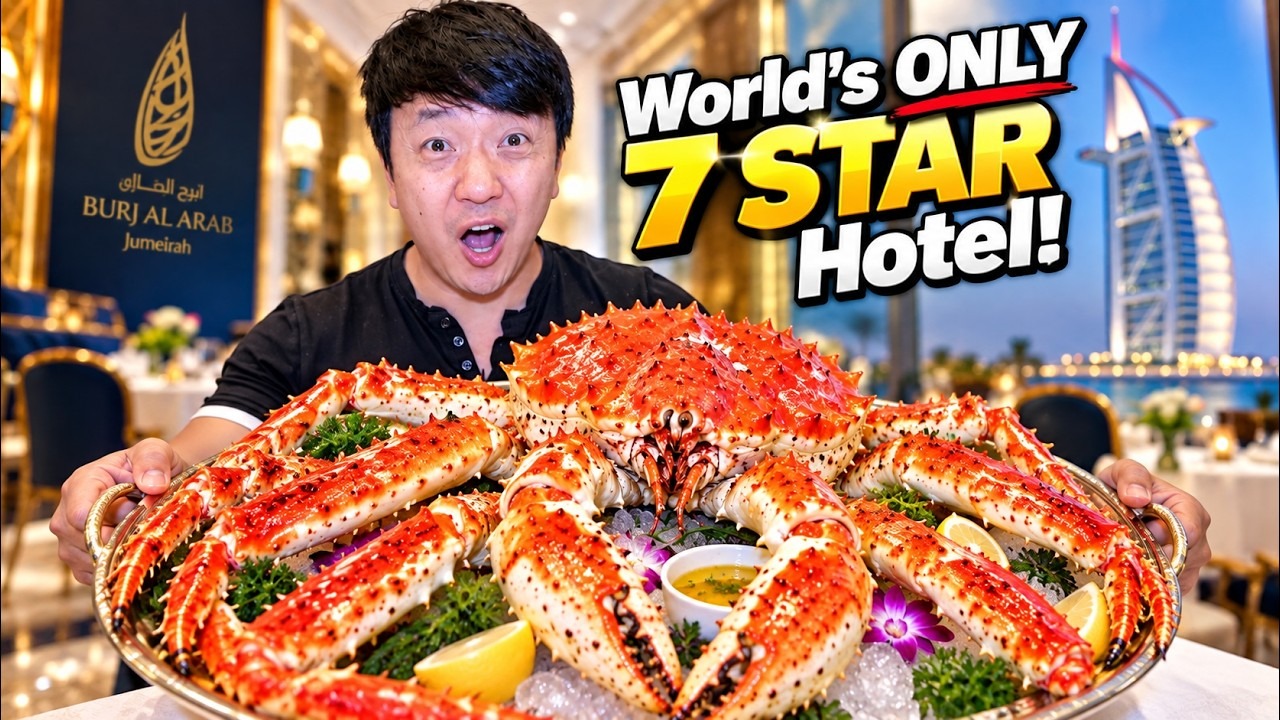
In September 2026, YouTuber Mike Chen did what most travelers only joke about. He checked into the Burj Al Arab in Dubai, the sail-shaped icon his own video description calls “the world’s only ‘7-star hotel,'” and paid more than $2,500 for a single night. The video, published on his Mike Chen Clips & BEST Eats channel, has since passed 140,000 views, and it doubles as one of the most detailed public audits of what that kind of money actually buys in the most famous hotel on earth.
Here is the gap this article fills. The video is everywhere in the algorithm, but nobody has written it down. There is no text recap of the stay anywhere on Google, which means every specific detail below, from suite sizes to the helipad’s stunt history, lives only in the video until now. Watch the full review first, then read the eight takeaways that matter.

1. The Building Is the First Amenity
Before a single dirham is spent inside, the Burj Al Arab sells you the approach. The tower stands 321 meters tall, shaped like the sail of a dhow, on its own man-made island off Jumeirah Beach. It opened in December 1999, designed by British architect Tom Wright, and it remains the most photographed silhouette in Dubai. Chen’s video opens on the arrival, and the scale does the first round of persuading for free. You are not checking into a hotel. You are checking into a landmark.
2. There Are No Rooms, Only Duplex Suites
Every one of the hotel’s 202 suites is a two-floor duplex, and the smallest starts at 170 square meters. That is larger than most two-bedroom apartments, and it reframes the $2,500 figure immediately. You are not renting a hotel room. You are renting a small villa stacked vertically inside a sail, with a staircase, a separate living floor, and panoramic views of the Persian Gulf. When we ranked the best luxury hotels in Los Angeles, space per dollar was the metric that separated the icons from the also-rans. By that measure, the Burj Al Arab starts the race several laps ahead.
3. A Butler Shadows You Around the Clock
The hotel staffs more than 120 butlers, and round-the-clock butler service comes standard with every suite. Unpacking, pressing, restaurant bookings, baths drawn while you are at dinner, the small logistics of a stay handled before you think to ask. The video captures the service cadence up close, and it is the single feature that makes the property feel less like a hotel and more like a staffed private residence. This is the line item that justifies the rate more than any chandelier.
4. The Fleet Outside Is Part of the Room Rate
The forecourt keeps a fleet of Rolls-Royces, and chauffeur transfers are woven into the stay rather than billed as extras. In a city where the valet line is a status contest, arriving in the hotel’s own Rolls-Royce is the Burj Al Arab’s version of a welcome drink. Chen’s footage of the arrival sequence makes the point without commentary. The luxury starts at the curb, not at the front desk.
5. The Helipad Has Hosted More Stunts Than Landings
The cantilevered helipad jutting off the summit is the hotel’s unofficial stage. Roger Federer and Andre Agassi played an exhibition tennis match on it, Tiger Woods teed off from it, and a Formula One car once did donuts across its surface. It is a working helipad that moonlights as a billboard, and the video’s aerial shots remind you why sponsors and athletes keep renting it. Few hotel features in the world have their own highlight reel.
6. Dinner Happens Under the Sea
The Al Mahara restaurant sits beneath the lobby atrium, reached by a simulated submarine voyage, with floor-to-ceiling aquarium walls curving around the dining room. It is the kind of set piece that sounds like a gimmick until you are inside it. Between this, the sky-high Al Muntaha restaurant, and the hotel’s other dining rooms, a guest could eat somewhere spectacular every night for a week without repeating a room. The video’s restaurant footage is some of its strongest, because the interiors do the talking.
7. Gold Is a Building Material Here
Gold leaf, gold-plated fixtures, and interiors finished in precious stone appear in nearly every frame. The aesthetic is maximalist on purpose. The Burj Al Arab was built in the late nineties to photograph like wealth itself, and more than two decades later the formula still works on camera. Love it or find it loud, you will not mistake it for anywhere else. That memorability is the product, and it is why the hotel still anchors Dubai’s luxury image a quarter century after opening.
8. The Terrace Is a Resort Bolted Onto a Hotel
The hotel added a 10,000-square-meter Terrace stretching out over the sea, anchored by an 828-square-meter saltwater infinity pool, 80 meters long, ringed by 32 private cabanas, with its own restaurant, bar, and lounge. For guests who never want to leave the property, the Terrace is effectively a second hotel floating at the foot of the first. It is also the newest-feeling part of the property, and the video lingers there for good reason. Compare that footprint with the best luxury hotels in New York City to see what $2,500 a night buys when the land itself is the constraint.
9. So, Was It Worth $2,500?
Here is the math the video invites. Published rate ranges for the Burj Al Arab commonly start around $1,500 a night for entry suites and climb past $25,000 for the Royal Suite, which puts Chen’s $2,500-plus bill at the accessible end of the property’s pricing. What it buys is not a night of sleep but a night of theater: the duplex suite, the butler, the cars, the restaurants, and the right to say you stayed in the sail. One caveat for anyone booking after watching the video. The hotel closed in April 2026 for a major refurbishment led by French interior architect Tristan Auer and is scheduled to reopen in October 2027. The video is a time capsule of the original interiors, so treat it as a preview of the legend rather than a preview of your room. For a quieter flavor of five-star calm in the meantime, see our feature on the Namia River Retreat in Hoi An.
If the sail is on your bucket list, watch the video, mark the reopening date, and start saving. Some hotels you visit. This one you attend.
