
By Paulina Phan, Senior Editorial Contributor | June 17, 2026
“Thank you so much. You’ve helped me achieve this dream and I can’t thank you enough… To my family, I love you. To my fans, thank you for continuing to remind me who I am.”
Listen to that team radio again, the one Lewis Hamilton sent crackling across the Barcelona airwaves on Sunday afternoon, and listen past the words to the voice underneath them. That is not the voice of a man who has won 105 Grands Prix before. That is the voice of a man who was not sure he would ever win another one. The catch in it, the rush of it, the gratitude spilling over the edges of the radio protocol, tells you everything about what 686 days without a victory does to even the greatest driver of his generation. It hollows you out. It makes you wonder. And then, on one searing afternoon in Catalonia, it ends, and all the feeling comes flooding back at once.
Hamilton’s first victory for Ferrari, his 106th in Formula 1, was about more than points or standings or strategy, though it was about all of those things too. It was about a 41-year-old champion proving that the fire never went out, about the most famous red cars in racing finally giving their most famous driver the win he crossed the world to find, and about what it means to win in red after a lifetime of winning in silver. This is the story of the wait, the tears, and the history, and of why this one, as Hamilton himself said, is something else.
The Wait
Six hundred and eighty-six days. Forty-one races. Let those numbers sit for a moment, because they are the key to everything.
Hamilton’s last victory before Sunday came at the 2024 Belgian Grand Prix, in his final season with Mercedes. Then came the move that stunned the sport: the seven-time champion, the most successful Mercedes driver in history, leaving the Silver Arrows for Ferrari. It was the transfer of the decade, the kind of move that gets announced with orchestral music and breaks the internet. And then, almost immediately, it got hard.
His first season in red, 2025, was difficult by any honest measure. A new team, a new car, a new language of working, and the weight of the tifosi, the most passionate and least patient fanbase in sports. There were flashes, but the wins did not come. The paddock began to murmur. Was the move a mistake? Was the magic gone? Was 40 too old, even for him?
In May, with the murmurs growing, Hamilton shut the retirement talk down himself. He remains under contract with Ferrari, he said, he will be in the sport “for quite some time,” and he is already “thinking and planning for the next five years.” It was a striking thing for a 41-year-old to say, not defensive but declarative, the words of a man who has stopped listening to the calendar. Three weeks later, he made the words true.
What those 686 days really were, in hindsight, was an education. Hamilton had to learn Ferrari the way he once had to learn Mercedes, from the inside, slowly, through frustration and small breakthroughs. “They (wins) are all special in their own way,” he said afterward, “but this one is something else.” You can hear why. The others were confirmations. This one was a vindication.
The Tears
If you want to understand what this win meant, do not look at the trophy. Look at the phone.
Hours after the race, Hamilton posted on Instagram, and the post was pure theater, the kind only he can stage. “REMEMBER WHO YOU ARE,” it read, in capital letters, the way you write something you have been saying to yourself in the mirror for two years. And then: “DREAM THE IMPOSSIBLE… Grazie mille @scuderiaferrari.” Thank you very much, Ferrari. In Italian, because some things need to be said in the language of the team that finally gave them back to you.
There is an art to the Hamilton Instagram post, honed over a decade of being the most followed driver in the sport. “REMEMBER WHO YOU ARE” was not addressed to his fans, not really. It was addressed to himself, to the version of him that had started to forget during the long months of 2025. It was a clapback dressed as a caption, and it was perfect.
And then there is the radio message, the one that will be replayed for years. “To my fans, thank you for continuing to remind me who I am.” Not “for supporting me” or “for believing in me,” but for reminding him who he is. As if identity were something that could slip away in the bad months and had to be held for him by other people until he could take it back.
What Red Means
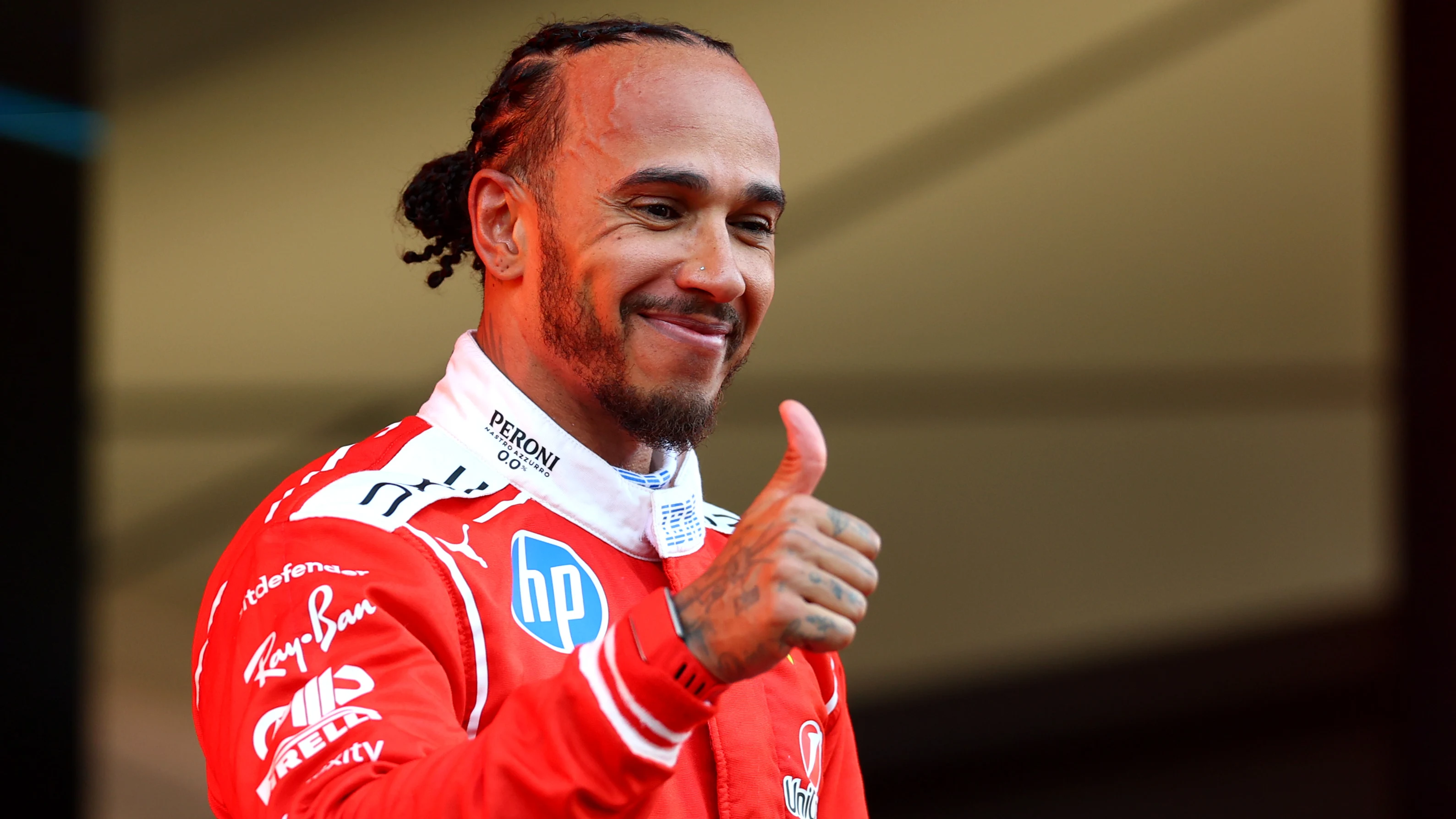
To grasp the weight of this win, you have to understand what Ferrari red means, and what it means specifically to Lewis Hamilton.
Hamilton won his first championship with McLaren in 2008, in silver and chrome. He won six more with Mercedes, in silver so iconic it became his identity. For the entirety of his winning life, silver was the color of victory. Red was the color of the enemy, the historic rival, the team you beat. To choose red at 40, to walk away from everything he had built and start over in Maranello, was the bravest decision of his career, and for a long time it looked like it might also be the most punishing.
Because Ferrari is not just a team. It is a nation, a religion, a fashion house, a myth. The tifosi do not support Ferrari the way other fans support teams; they worship, they suffer, they demand. Every Ferrari driver learns that the red suit is heavier than it looks. It carries the weight of Schumacher and Lauda, of decades of longing, of a fanbase that treats second place as a tragedy. Hamilton knew this. He chose it anyway. And on Sunday, the red finally gave back what he had given it: faith.
The symmetry is almost too perfect. Hamilton’s first Ferrari victory came at the Circuit de Barcelona-Catalunya, almost exactly 30 years after Michael Schumacher’s first Ferrari victory at this same circuit in 1996. Schumacher’s win that day, in torrential rain, in a car that had no business winning, announced that his Ferrari project was real and that the years of waiting were over. Hamilton’s, in furnace heat, in a car that finally matched his ambition, felt like the same announcement from a different era. Thirty years apart, the same red, the same circuit, the same exhale. One can imagine the old photographs being pulled out in Maranello this week, the comparisons being drawn, the sense of a circle closing.
And the history books kept turning. First British driver to win for Ferrari since Eddie Irvine at the 1999 Malaysian Grand Prix. Only driver ever to win Grands Prix for McLaren, Mercedes, and Ferrari. At 41, the oldest winner since Jack Brabham in 1970. Each record is a door, and Hamilton keeps walking through them into rooms nobody else has ever entered.
The All-British Podium
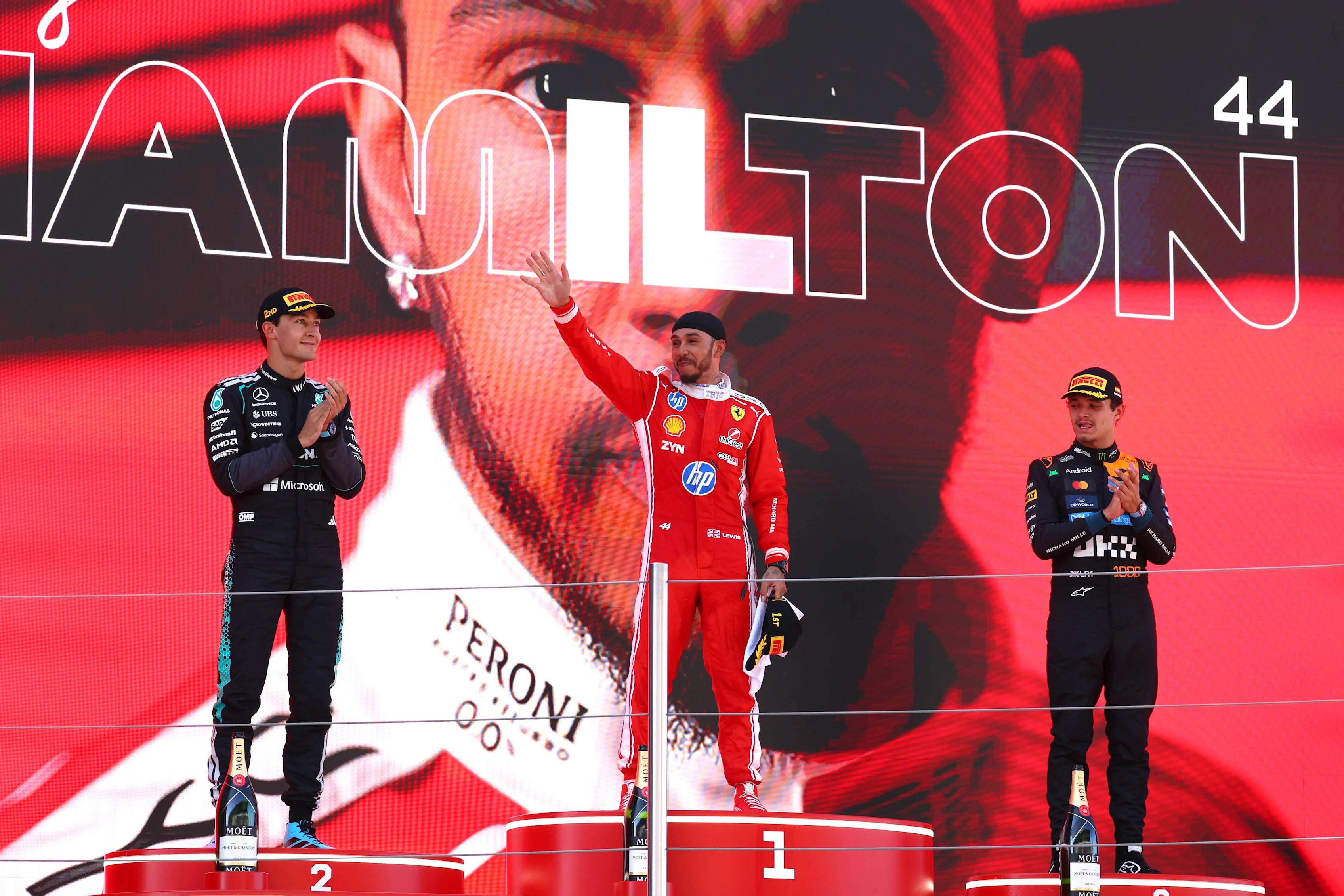
Then there was the podium itself, and it deserves its own chapter, because podiums like Sunday’s do not happen. They accumulate, across decades, until the sport finally allows one.
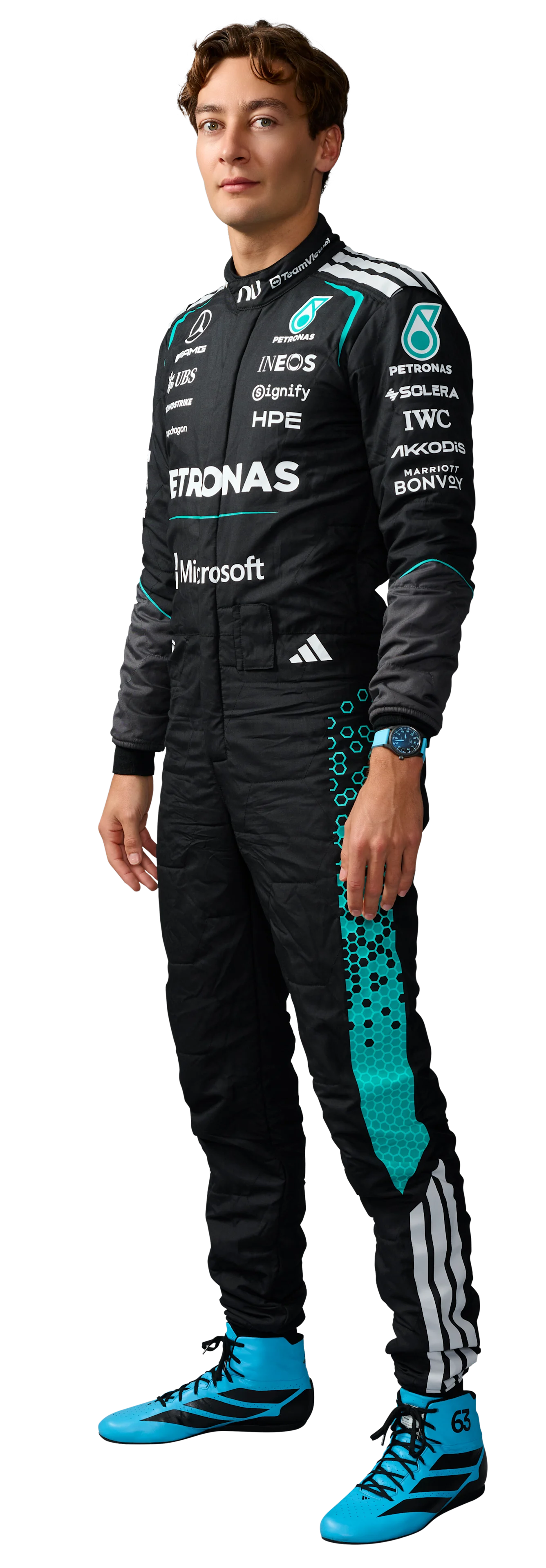
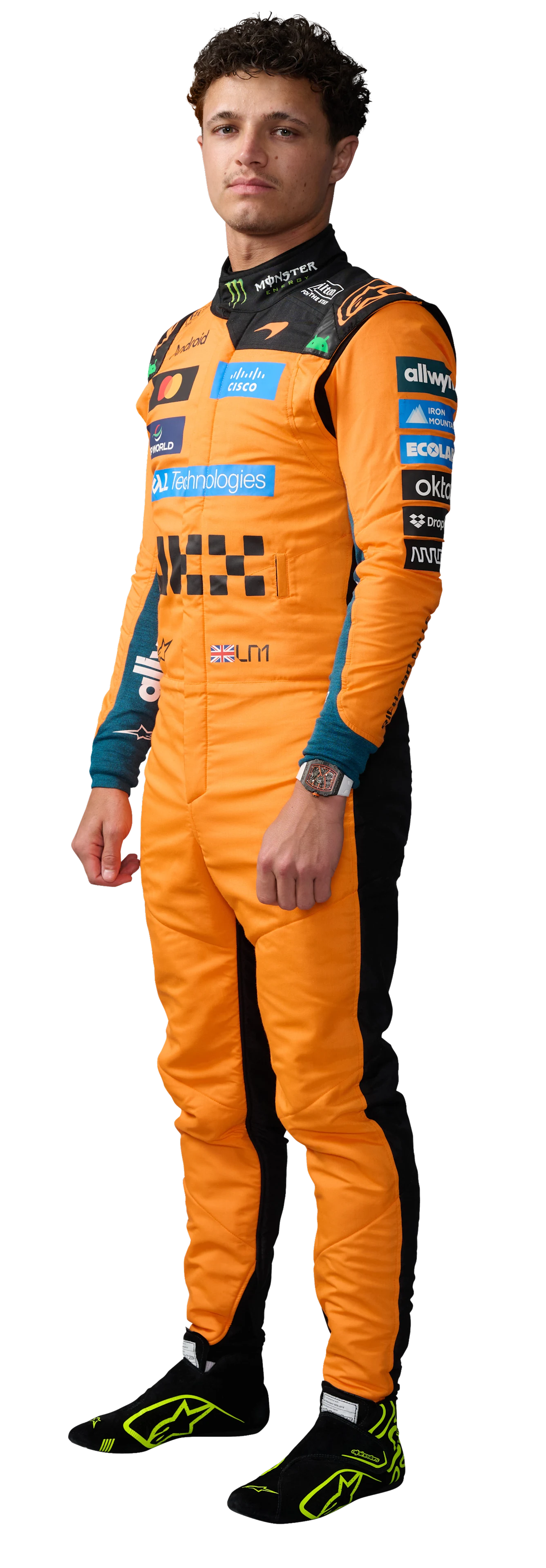
Hamilton on the top step. George Russell, his former Mercedes teammate, on the second. Lando Norris, the reigning world champion, on the third. Three Britons, three generations of the same small island’s racing dream, standing together in the Spanish sun. The last all-British podium was Jackie Stewart, Graham Hill, and John Surtees at the 1968 United States Grand Prix, more than 57 years ago. In all the decades since, through all the British champions and all the British winners, the three steps never aligned. Until Sunday.
There is something quietly moving about where it happened. Not at Silverstone, where it would have been a coronation, but at Barcelona, on Spanish soil, in front of a crowd that had come to say goodbye to Fernando Alonso. It was not staged. It was not expected. It simply happened, because the three fastest drivers on the day happened to share a passport.
And Russell, who had every reason to be bitter, watching his old teammate win in another team’s car while he settled for second, was instead the first to congratulate him. “Huge congrats to this guy because I know how hard he works,” Russell said. “We spent a lot of years together at Mercedes, so I’m really pleased to see him back to the Lewis I remember when I was growing up watching Formula 1.” Think about that sentence. Russell grew up watching Hamilton. Then he became his teammate. Then he watched him leave. And on Sunday, he watched him win again, and his first instinct was joy. Whatever the championship says about their rivalry, that is respect, and it is real.
The photographs from that podium will be framed in houses across Britain. Three drivers, three smiles, one flag repeated three times on the timing screens. Fifty-seven years of waiting, over in an afternoon.
The Ageless Champion
At 41, Lewis Hamilton is the oldest Grand Prix winner in 56 years. Sit with that for a moment, because in modern Formula 1, it should not be possible.
This is a sport that has convinced itself it belongs to the young. The grid is full of teenagers and twenty-somethings, drivers signed to academies at 14 and in F1 cars at 18. The physical demands are real: neck muscles strained by 5G cornering, reflexes tested at 350 km/h, concentration held for two hours in cockpits that reach 50 degrees. The conventional wisdom says the late thirties are the cliff, and almost everyone obeys it. Then there is Hamilton, winning at 41, and Fernando Alonso, still racing at 44, still qualifying, still fighting, even as he admitted that Barcelona was likely his last race at the circuit where he last won in 2013.
The Alonso parallel is worth lingering on, because the two men have defined longevity in opposite ways. Alonso’s is the longevity of defiance, the refusal to leave, the racer who simply cannot stop. Hamilton’s is the longevity of reinvention, the champion who keeps finding new mountains after climbing the old ones. On Sunday, their stories crossed in the most poetic way possible: Alonso’s retirement on lap 41 triggered the Virtual Safety Car that gave Hamilton the free pit stop that won him the race.
What does it take to win at 41? Everything it took at 25, plus the wisdom to know what not to waste energy on. Hamilton’s Sunday was not the win of a young charger. It was the win of a master: patient in the early laps, decisive when the strategy called, relentless in the final stint, building a 19-second gap with the metronomic calm of a man who has done this 105 times before. Youth gives you speed. Age, if you are lucky and stubborn enough, gives you everything else. Hamilton, at 41, appears to have both.
Is Ferrari Now a Threat?
This is the question the paddock is asking, and it is the only one that really matters for the rest of the season. Was Barcelona a breakthrough or a blip?
The case for breakthrough is strong. Ferrari brought upgrades to Spain and they worked, visibly, measurably, on one of the most demanding circuits on the calendar. Hamilton’s pace was not tire magic or luck; it was a car with genuine performance, driven by a driver operating at the peak of his powers. The three-stop strategy was aggressive, but it was the aggression of a team that believed it had the pace to make it work, and it did. Ferrari’s first win in 595 days did not look like an accident. It looked like arrival.
And reinforcements are coming. Under the 2026 regulations, Ferrari is entitled to ADUO, Additional Development and Upgrade Opportunities, in-season upgrade chances granted to power unit manufacturers rated 4 percent or more off the benchmark. In plain language: the rules recognize Ferrari’s engine is behind, and the rules are giving them extra chances to catch up. In a season where Mercedes power has set the standard, that mechanism could be the story of the summer. The Barcelona upgrades were the first wave. There will be more.
But caution is warranted, and the honest answer is that we do not know yet. Barcelona rewards a particular kind of car balance, and the furnace conditions played to Ferrari’s strengths on the day. The Red Bull Ring, up next on June 26-28, is a very different test: short, sharp, high-altitude, a power circuit. If Ferrari is genuinely quick in Austria, then the championship has a real fight on its hands. If Barcelona was a one-weekend wonder, the season resumes its previous shape. The evidence points toward something real, but in Formula 1, one data point is not a trend. It is a question.
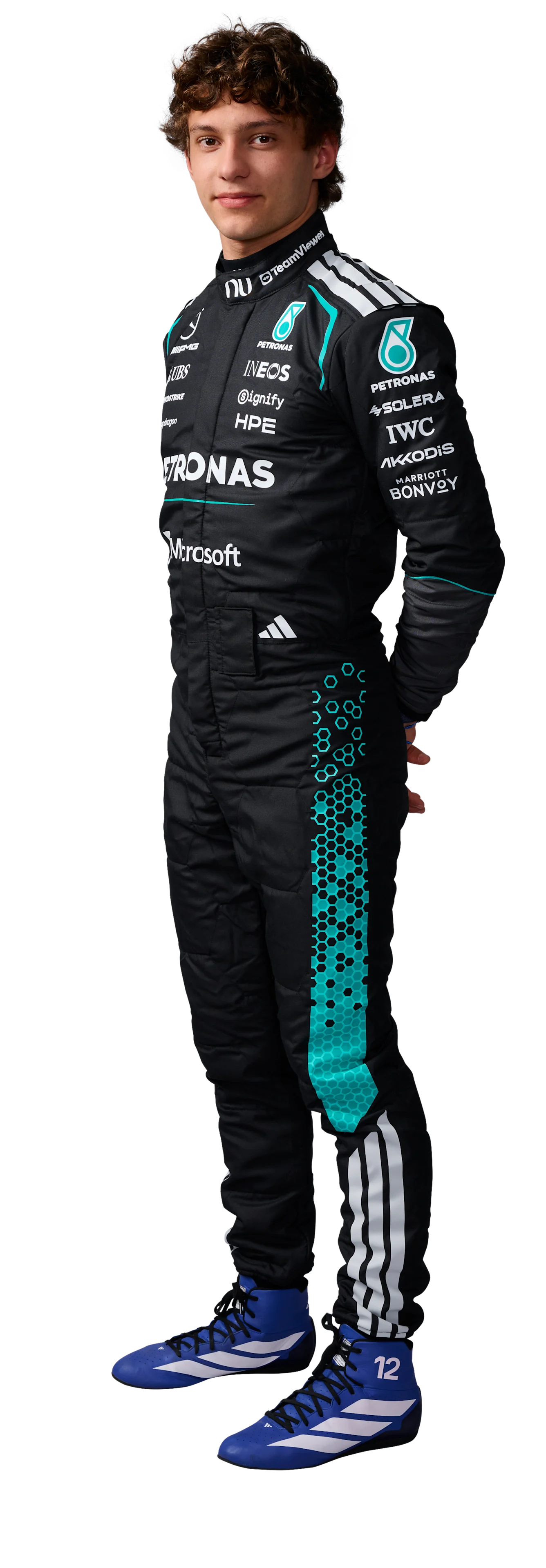
What is certain is that Mercedes can no longer assume. Antonelli’s late retirement in Barcelona was a mechanical failure, the kind that happens to every team, but it was also a reminder that dominance is fragile. Russell’s podium shows the Silver Arrows are still the team to beat, but Hamilton’s 19-second margin shows the gap is no longer a chasm. The European summer stretch, starting in Austria, will decide what this season really is. For the first time all year, the answer is not obvious.
The Next Five Years
Back in May, when the retirement questions were at their loudest, Hamilton said he was already “thinking and planning for the next five years.” At the time, it sounded like defiance, the kind of thing athletes say when they are trying to convince themselves. After Sunday, it sounds like a plan.
Because here is what the win changes: it removes the last argument against him. The doubters could point to the drought, to the difficult first season, to the age, to the winless months stretching into years. They cannot point to any of it now. He has won in red. He has won at 41. He has won his 106th. Every milestone the skeptics said was behind him is suddenly, gloriously, in front of him again.
Ferrari team principal Fred Vasseur, the man who believed in Hamilton enough to bring him to Maranello, was vindicated too. “It’s a good feeling,” Vasseur said on Sunday. “We had one year with ups and downs so to win today and on top of it, to have the race under control… he was very outstanding today.” And John Elkann, Ferrari’s Executive Chairman, called it “an emotional moment and a very important result, which belongs to the entire team and to all our fans.” Even Toto Wolff, the Mercedes boss who lost his star driver and then lost to him on Sunday, was gracious: “I’m happy for him. In a Ferrari, he’s waited a long time and has worked very hard to get back on the top step of the podium. Today, he deserved it.” When your old boss, your new boss, and the chairman all agree, the debate is over.
So what does the ageless champion do next? He keeps going. That is the whole answer, and it has always been the whole answer. Five more years of planning, five more years of red, five more years of reminding everyone who he is. On Sunday in Barcelona, Lewis Hamilton did not just end a drought. He opened a new chapter, in a new color, at an age when chapters are supposed to be closing. One hundred and six wins. And counting.
FAQ
How long was Hamilton’s winless run before Barcelona?
Hamilton’s victory ended a 686-day, 41-race winless streak stretching back to the 2024 Belgian Grand Prix. It was his first win for Ferrari, in his second season with the team, and Ferrari’s first victory in 595 days.
What records did the Barcelona win set?
It was Hamilton’s 106th career win (extending his all-time record), made him the oldest Grand Prix winner since Jack Brabham in 1970 at age 41, the first British driver to win for Ferrari since Eddie Irvine in 1999, and the only driver in history to win Grands Prix for McLaren, Mercedes, and Ferrari. It also produced the first all-British podium since 1968.
What is the significance of the 1996 Schumacher parallel?
Michael Schumacher’s first victory for Ferrari came at the Circuit de Barcelona-Catalunya in 1996, almost exactly 30 years before Hamilton’s first Ferrari win at the same circuit. Both wins announced that a champion’s Ferrari project had truly arrived.
Is Ferrari now a championship threat to Mercedes?
It is too early to declare, but the signs are promising: Ferrari’s Barcelona upgrades delivered genuine pace, and the team is entitled to ADUO in-season power unit upgrade opportunities (granted to manufacturers rated 4 percent or more off the benchmark), so more reinforcements are coming. The upcoming races, starting with Austria, will show whether Barcelona was a breakthrough or a one-weekend wonder.
A Note on Sources
Career statistics, win counts, drought durations, and historical records in this feature were verified against official Formula1.com coverage and cross-checked with reporting from ESPN, Reuters, BBC Sport, Sky Sports, and The Race. Driver and team principal quotes are as reported by Formula1.com. The May 2026 retirement comments and the ADUO regulatory details are as covered in the Formula 1 press corps’ season reporting.