
By Paulina Phan, Senior Editorial Contributor
Formula 1 sells you the fantasy. The champagne, the yachts in Monaco, the drivers who look like they stepped out of a fragrance campaign. But strip away the glamour and you find twenty-two athletes sealed into carbon fiber bathtubs, pulling up to six times their own body weight in corners, sweating through fireproof underwear, with absolutely nowhere to go. I mean that literally. For up to two hours, there is no bathroom.
So let us ask the question every new fan thinks and every veteran fan has Googled at least once: do F1 drivers pee during races? The answer is yes, some of them do, and the ones who do not have war stories about holding it in. What follows is the real story, told in the drivers' own words from actual published interviews. Biology does not care about your podium.
And honestly, there is something refreshing about it. Money cannot buy you a bathroom at 200 miles per hour.
The Physics Problem: Two Hours, Five Gs, Zero Exits
The rules of the bladder at racing speed
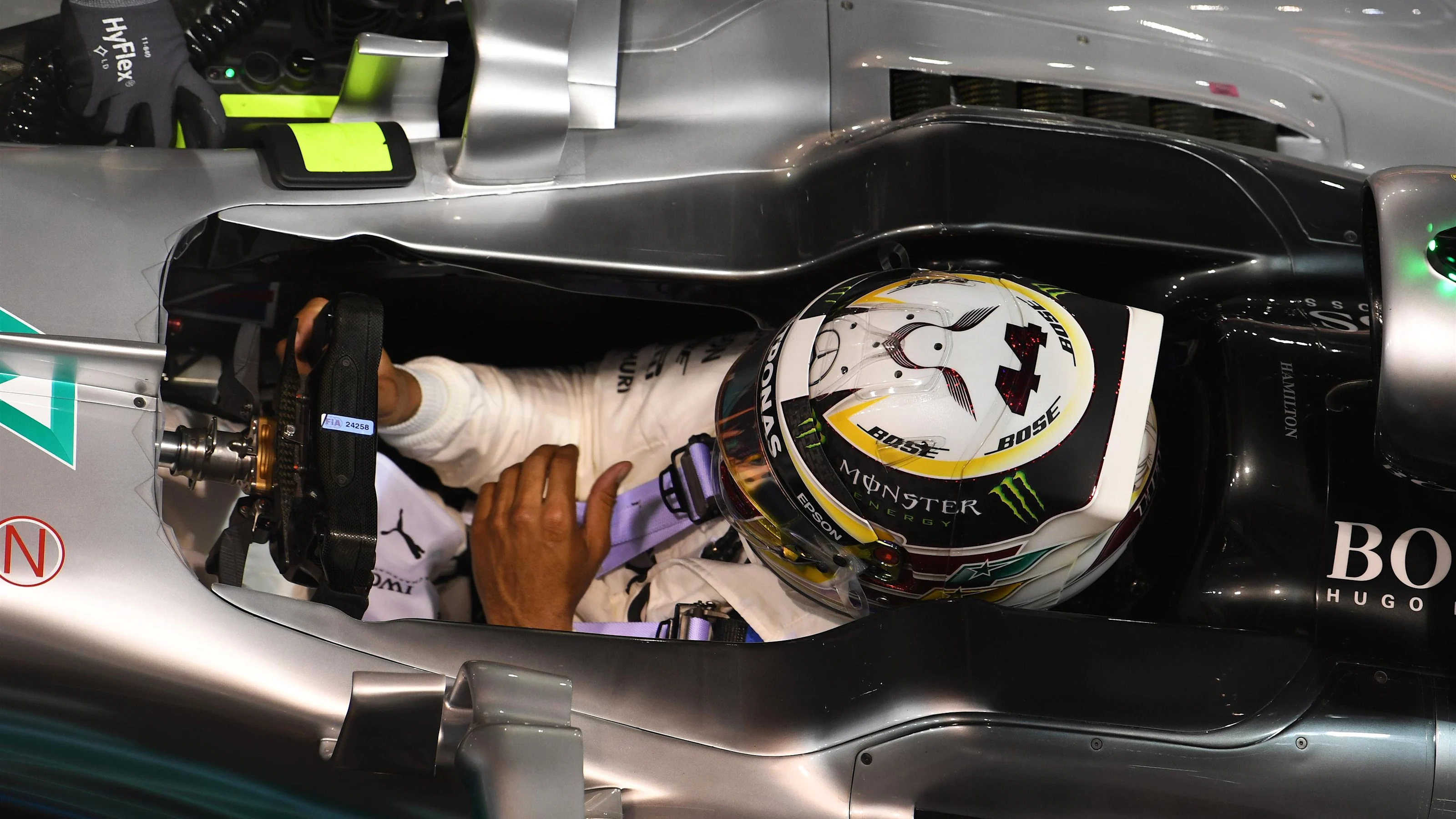
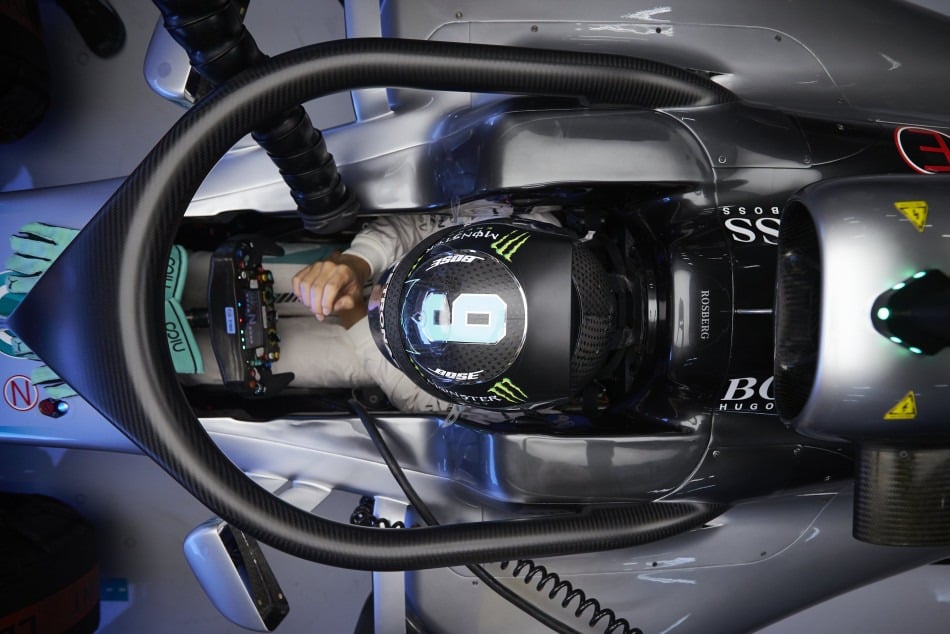
A Formula 1 race can run for up to two hours. The Singapore Grand Prix, held on a twisty street circuit where overtaking is miserable and the average speed is low, routinely flirts with that two-hour ceiling. Sixty-two laps, nineteen corners, and barely a straight long enough to exhale. Now imagine doing all of it strapped into a seat shaped exactly like your body, with a six-point harness cinched so tight you can barely breathe, while braking forces slam you forward at several times your own body weight.
There is no coasting to the shoulder. There is no ducking into a restroom at the next corner. A driver who unbuckles mid-race is a driver who has retired, and nobody is giving up championship points for a bathroom break. So the choice, when the urge arrives, is brutally simple. Hold it, or let it go.
And here is the part that makes it worse than your worst road trip. Former world champion Damon Hill explained on the Motor Sport podcast, in comments reported by VMax.si, that race interruptions are the cruelest twist of all. During a red flag or a long safety car period, concentration dips, adrenaline eases, and the sweating slows down. All the mechanisms quietly suppressing the urge suddenly stand down. Hill once arrived at Spa badly needing to go, raced the whole Grand Prix, and crossed the line having, as he put it, driven his car dry. He insisted he had never once urinated in a race car, calling the idea disgusting, and said that if motorsport taught him anything, it was how to control his bladder.
Why the safety car is the enemy
Lewis Hamilton, a seven-time world champion, pinpointed the exact moment his own defenses collapsed. Speaking to host Sean Evans on the YouTube interview series Hot Ones in May 2024, Hamilton confessed that he had urinated in his race car exactly once. It happened, of course, in Singapore, the most punishing race on the calendar. A safety car had bunched up the field, the pace dropped, and Hamilton found himself crawling behind it in agony. "It was maybe two or three years ago," he said. "And basically the safety car came out, and I was behind the safety car like, 'I'm dying.'"
Hamilton's larger point was about the G-forces. "Honestly when your bladder's full with the G-force that you're pulling it's really really uncomfortable. And so, you're pulling the G-force, you just can't focus on your job," he explained. Every braking zone becomes a negotiation. When Evans pressed him, Hamilton admitted the truth plainly: "I have once. It was in Singapore." Just the once, and he has never repeated it. His pre-race routine is militant avoidance. He told Evans he drinks a lot of water before races but tries to visit the bathroom as many times as possible right up until he climbs in. "I just can't bring myself to pee myself," he said.
That last line is the quiet thesis of the entire sport. Most drivers would rather suffer than surrender. They just do not always get to choose. Hamilton also offered the paddock's closest thing to an official census, telling Evans that, as far as he is aware, quite a lot of drivers do pee in the car. It is an anecdote, not a survey, but it comes from the most experienced driver on the grid.
There is a fun footnote to all of this, and it comes from the FIA's own scales. After every race, drivers are weighed as part of the official post-race procedure. When a driver steps on those scales several kilos lighter than at the start, that is the receipt for two hours of work in a sauna that does 200 miles per hour. It also means the evidence of any mid-race decisions has, by the checkered flag, mostly evaporated into the night air.
The Singapore Factor: Where Bodies Lose Liters
The sweatiest two hours in sports
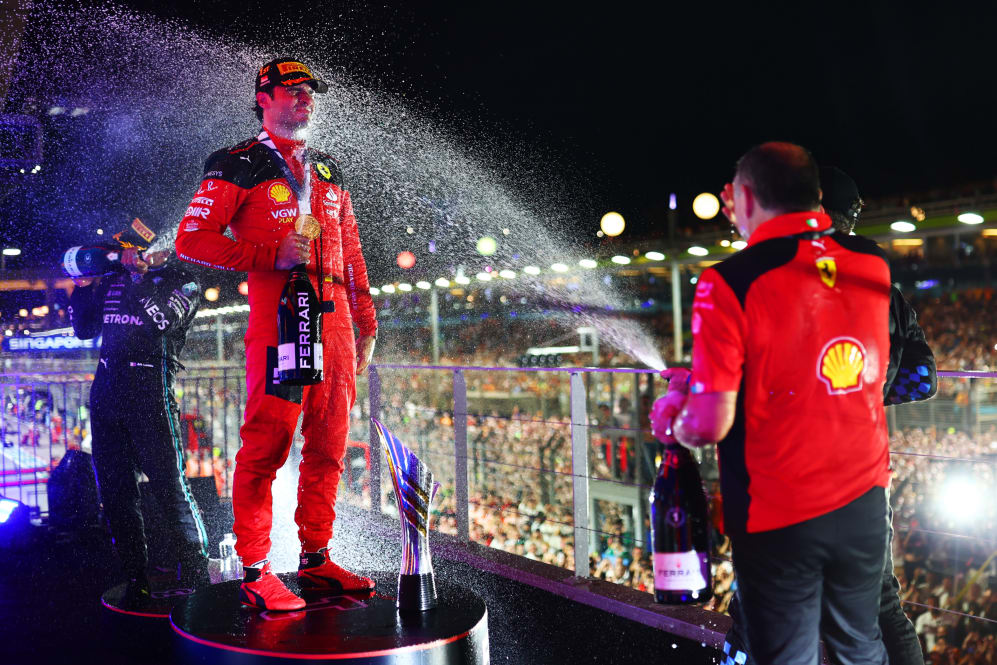
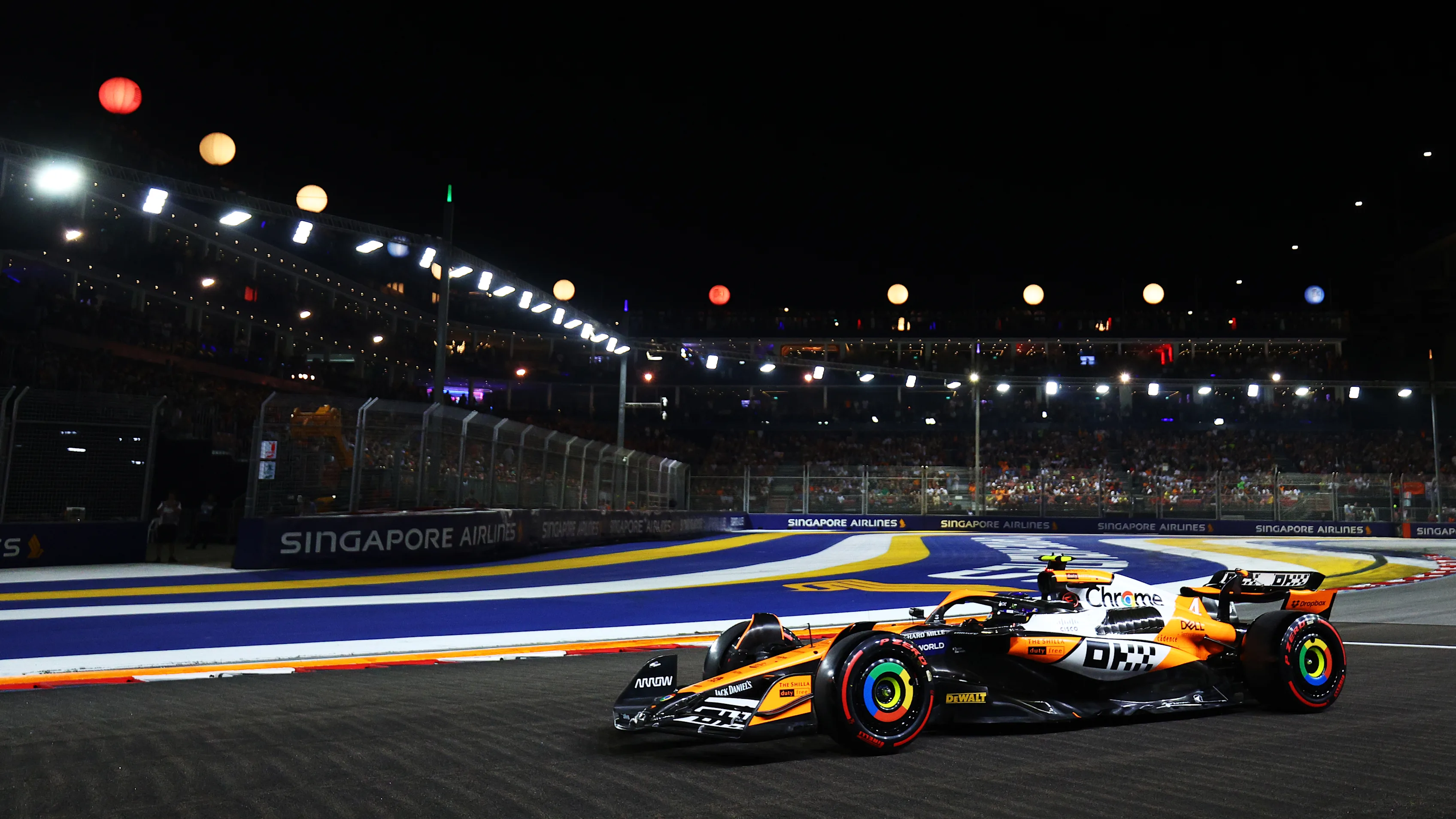
If there is a capital city for this particular problem, it is Singapore. The Marina Bay street circuit combines everything a bladder hates: extreme heat, brutal humidity, and a race that runs nearly the full two hours. ESPN's Laurence Edmondson has reported that a driver typically loses as much as three kilograms of body weight through sweat during the two-hour Singapore race, the equivalent of about three liters of fluid. Depending on the driver's starting weight, that is somewhere between four and five percent of total body weight, gone in a single evening. ESPN's Niamh Lewis reported in 2024 that during a typical grand prix drivers lose two to three kilograms in sweat, and as much as four kilograms in Singapore for taller drivers, roughly three to four percent of bodyweight.
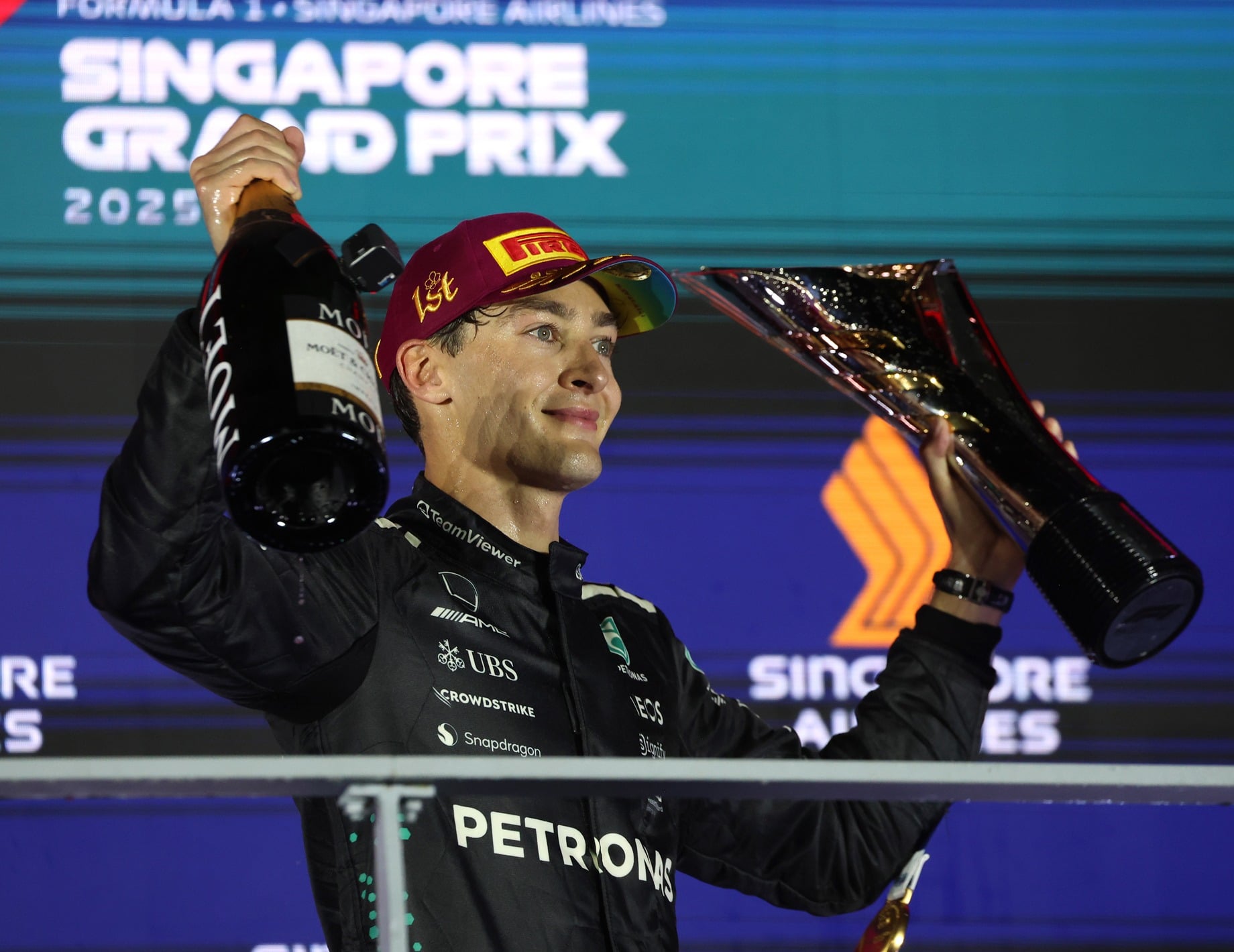
George Russell, one of the tallest drivers on the grid at 1.85 meters, has described the cockpit as getting on for 50 degrees Celsius in Singapore, in comments to Yahoo News ahead of the 2024 race. "With the humidity, you're dripping in sweat as soon as you go outside, let alone when you're locked in a race car for two hours," he said. "We lose almost 4kg of fluids in an hour-and-a-half race so it's a pretty good weight-loss programme, if that's what you're chasing." Daniel Ricciardo, appearing on The Ellen Show in 2021, said drivers can lose up to eight to ten pounds in a race, which is three and a half to four and a half kilograms. Every estimate points the same direction: this is one of the most dehydrating assignments in professional sport.
It got genuinely scary for Russell at the 2024 Singapore Grand Prix. His body temperature reached a reported 42 degrees Celsius, he lost four kilograms, and he was found hyperventilating in an ice bath afterward, in what Mercedes described as borderline heatstroke. The Times reported the details ahead of the 2026 season's Sepang race.
Here is the paradox that makes the bathroom question so delicious. If drivers are sweating out three to four liters of fluid, how is there anything left to pee? The answer is hydration strategy. Drivers arrive deliberately over-hydrated, having spent days drinking water and electrolytes to build a buffer, and they keep drinking through the weekend. The body's plumbing does not pause for the formation lap. All that fluid has to go somewhere, and the sweat glands cannot always keep pace with the intake, especially early in the race before the heat has fully ramped up. That is the window when the urge strikes hardest.
The drink tube nobody uses
Every F1 car carries a drinks bottle, plumbed to a tube near the driver's mouth. The regulations allow up to 1.5 liters, but as ESPN has reported, teams routinely fit far less, because in Formula 1, performance always outranks comfort and water is heavy. The bottle is often just 500 milliliters or a liter to save weight. And the water does not stay refreshing. Drivers describe the drink starting cold and degrading, lap by lap, into something ESPN likened to drinking warm tea, heated by the cockpit around it.
Hamilton, characteristically, wants no part of it. "We do have a drink tube in the car but I never drink," he told Hot Ones. "I just forget most of the time. So, I usually have that weight taken out, it's only like 500 millilitres." A driver would rather run the most physically demanding race of the year slightly dehydrated than carry an extra half kilo of water. Lando Norris told Yahoo News ahead of the 2024 Singapore race that he usually skips drinking because it makes him feel sick, though even he admitted he might relent in Singapore.
The heat has real consequences beyond discomfort. After the 2023 Qatar Grand Prix, run in savage heat and humidity, Logan Sargeant retired with heat exhaustion, Esteban Ocon vomited in his helmet, and Lance Stroll later admitted he had been close to blacking out in high-speed corners, collapsing beside his car after the finish. ESPN reported the details at the time. The FIA responded by introducing a formal heat hazard rule. It was first applied at the 2025 Singapore Grand Prix by race director Rui Marques, under Article 26.19 of the sporting regulations, when the forecast heat index exceeded 31 degrees Celsius. The declaration lets drivers wear liquid-cooled vets, with the car's minimum weight raised by five kilograms to accommodate the hardware. Use of the vest is optional, but drivers who skip it must carry ballast so nobody gains a weight advantage.
What the Drivers Actually Say
The confession: Hamilton, Singapore, and one bad safety car
Hamilton's Hot Ones confession remains the gold standard of this genre, partly because he is the most successful driver of his generation admitting something deeply human, and partly because of the details. He did not just admit it happened. He explained the physics of why it is so miserable, described the exact race and the exact safety car, and then drew his line: once, never again, and he cannot bring himself to do it on purpose.
The holdouts: suffering as a point of pride
Not everyone surrenders. Daniel Ricciardo, appearing on The Ellen Show in 2021, said he has never done it and simply endures it. "Everyone can relate to peeing, you need to relax. And it's hard to relax driving at those speeds," he said. "I've never done it. If you have to go, you just painfully hold on until the end, but every bump, every little kerb you hit hurts." Damon Hill, as noted, treated bladder control as a professional discipline, honed over a championship career. And Sebastian Vettel, when Formula 1's own Grill the Grid series put the question to him in 2018, said he could not do it out of respect for the mechanics who strip and service the car afterward. The people who clean the cockpit deserve consideration, which is a very Vettel thing to say, and honestly a fair point.
Vettel did, however, admit to a related offense in that same Grill the Grid episode, as reported by TheSportsRush: he has urinated in a wetsuit, because in that case he could take care of the cleanup himself. There is an entire moral philosophy in that distinction. The suit is yours. The car belongs to the team. In a separate exchange reported by TheSportsRush in 2021, Vettel said he was one of the few drivers who did not pee in the car, and reckoned that about half the grid did. That is a paddock anecdote rather than a census, but it is a telling one.
The unbothered: Kimi, Eddie, and the pragmatists
Then there is Kimi Raikkonen, who treats this subject the way he treats everything: with total indifference to your discomfort. On that same 2018 Grill the Grid episode, while Vettel was agonizing over the mechanics, Raikkonen stated flatly, as reported by TheSportsRush, that he had taken a piss in the cockpit. No elaboration. No apology. The Iceman does not do shame.
He is not alone in his candor. Years earlier, Eddie Irvine declared in his video series A Drink with Eddie Irvine that relieving yourself mid-race was completely normal, and even offered technical guidance: it is a little harder under braking, he said, and much easier under acceleration, as reported by VMax.si. Somewhere, a race engineer read that and updated a driver briefing.
Oscar Piastri, representing the younger generation, gave the most balanced answer when Sky Sports F1 put fan questions to him in October 2024, as reported by SPORTbible. "If you need the toilet in the race you don't have many options to you," he said. "It's not unheard of for drivers to go in their suit. Personally, I've never had to." Then he corrected himself: "Well, I have had to but I've never followed through with it." His conclusion was pure pragmatism: "There's not much you can do. Some drivers are able to go in their race suit which is a bit gross, but if you gotta go, you gotta go."
The Suit Situation: Nomex, Layers, and Laundry Day
What they are actually wearing down there
Let us talk about the suit, because it is central to the whole affair. A modern F1 race suit is a marvel of fireproof engineering: multiple layers of Nomex, the flame-resistant fiber, plus fireproof long underwear, a balaclava, gloves, and socks. The suits are tailor-made for each driver and, as Autosport has reported, now weigh around 750 grams, a stark difference from the two-kilogram suits of earlier eras. They are designed to protect against direct flame for precious seconds in a crash. They are also, by necessity, an extra layer of insulation in a 50-degree cockpit, which is why the sport keeps investing in breathable panels and moisture-wicking linings.
Now, the diaper question. It is the internet's favorite answer to this topic, and it surfaces every few years, usually attached to vague, unsourced claims. But there is no credible record of diapers being standard practice on the modern F1 grid. No driver or team has ever documented their use. RacingNews365, in its explainer on the subject, explicitly reports that Formula 1 drivers do not use relief devices during a race, noting that such devices are used in some other motorsport classes but not in F1. When nature calls in Formula 1, drivers wear FIA-regulated fireproof underwear, and those who cannot hold on simply go in the suit. It is not elegant. It is, however, effective, because the cockpit is so hot and the airflow so constant that moisture evaporates fast.
The number two question: asked and answered, sort of
We should address the question everyone is really asking, the one that makes the pee discussion look tame. Has any F1 driver ever, mid-race, in the car, done a number two? On the record: no. No driver has ever admitted to it in any published interview, and given how freely they discuss urination, the silence is telling.
What sports physiologists describe helps explain why. Under extreme stress, the body runs its fight-or-flight response, diverting blood flow and energy away from digestion and toward the muscles, heart, and lungs. It is a general, expert-backed concept in exercise physiology, and it is exactly the state a driver lives in for two hours.
What drivers do instead is prevention, pursued with the same obsessive professionalism they bring to tire strategy. Meals are timed with military precision in the days before a race, and the pre-race bathroom visit is treated with the seriousness of a pit stop. Drivers will visit the facilities as late as humanly possible, sometimes minutes before climbing into the car, because once the belts are tightened, the next opportunity is two hours away.
And the most famous bathroom story in F1 history is not about a race at all, but about the grid before one. At the 2006 Brazilian Grand Prix, football legend Pele was on the starting grid presenting Michael Schumacher with a lifetime achievement award, and Kimi Raikkonen was nowhere to be seen on the broadcast. When ITV's Martin Brundle caught up with him live on television and asked where he had been, Raikkonen answered, with total calm: "I was having a shit." Brundle shot back: "Obviously, you have a nice, light car on the grid then."
It remains the most Raikkonen sentence ever uttered, and it contains the whole philosophy. Handle it before the lights go out.

The Verdict: Glamour Is a Part-Time Job
So here is the unglamorous truth, verified by the drivers themselves. Yes, some F1 drivers urinate during races, usually in the suit, usually in the heat of Singapore, usually when a safety car slows the pace and the body's suppression systems stand down. Lewis Hamilton did it once and found it so miserable he swore it off. Kimi Raikkonen did it and shrugged. Eddie Irvine treated it as routine maintenance. Daniel Ricciardo, Damon Hill, and Sebastian Vettel chose suffering, discipline, and courtesy to the mechanics instead. Oscar Piastri has needed to and held on. They all agree on one thing: there are no other options.
There is something wonderful about this. Formula 1 is the most polished, most expensive, most image-conscious sport on earth, and at its core are twenty-two people dealing with the exact same problem as a kid on a long car ride, except the car is doing 200 miles per hour and the whole world is watching. The next time you see a driver climb from the cockpit looking impossibly composed, remember what the last two hours asked of them. The glamour is real. It is just a part-time job, and biology works full time. So the next time someone asks what makes these drivers superhuman, you will know the truth: they are not. They are just extremely well hydrated and extremely determined.
FAQ
Do F1 drivers pee during races? Some do. Lewis Hamilton admitted on Hot Ones in May 2024 that he urinated in his car once, during the Singapore Grand Prix behind a safety car. Kimi Raikkonen has also admitted to it on Formula 1's Grill the Grid, and Oscar Piastri told Sky Sports F1 in 2024 that "it's not unheard of for drivers to go in their suit." Many others, including Daniel Ricciardo, Sebastian Vettel, and Damon Hill, say they have never done it and simply hold on.
Why can't drivers just stop for a bathroom break? A Grand Prix runs for up to two hours with no scheduled stops for the driver, and unbuckling or leaving the car mid-race effectively ends the driver's race. There are no timeouts in Formula 1, so the only options are to hold it or go in the suit.
How much fluid do drivers lose in hot races? In Singapore, drivers typically lose up to three kilograms of body weight through sweat during the two-hour race, the equivalent of about three liters of fluid, or four to five percent of body weight, according to ESPN's Laurence Edmondson. George Russell has said drivers can lose almost four kilograms of fluids in a single race, with cockpit temperatures approaching 50 degrees Celsius.
Do F1 drivers wear diapers? There is no credible record of that. The rumor circulates widely online, but no driver or team has ever documented diaper use. RacingNews365 explicitly reports that Formula 1 drivers do not use relief devices during races. Drivers wear FIA-regulated fireproof underwear beneath multi-layer Nomex race suits, and those who cannot hold on simply go in the suit.
Methodology Note
Every driver quote and anecdote in this article comes from a real, published interview or broadcast. Lewis Hamilton's confession and his comments on G-forces, the drink tube, and pre-race routine come from his May 2024 appearance on First We Feast's Hot Ones, as reported by OutKick, TheSportsRush, thejudge13.com, and Jalopnik. Oscar Piastri's remarks come from his October 2024 fan Q&A with Sky Sports F1, as reported by SPORTbible. Daniel Ricciardo's comments come from his 2021 appearance on The Ellen Show, as reported by EssentiallySports and TheSportsRush. Damon Hill's account comes from the Motor Sport podcast, as reported by VMax.si. Eddie Irvine's remarks come from his A Drink with Eddie Irvine video series, as reported by VMax.si. Kimi Raikkonen's Grill the Grid admission and Sebastian Vettel's comments on the mechanics, the wetsuit, and his "half the grid" estimate come from Formula 1's own Grill the Grid series (August 2018), as reported by TheSportsRush. Raikkonen's 2006 Brazilian Grand Prix grid comment to Martin Brundle is a matter of broadcast record, reported by Jalopnik and EssentiallySports. Physical data on fluid loss and cockpit temperatures comes from ESPN (Laurence Edmondson and Niamh Lewis), Yahoo News (George Russell interview), The Times (Russell's 2024 Singapore heatstroke), and the Associated Press (heat hazard rule). Qatar 2023 heat details come from ESPN and fastestlap.com. Race suit specifications come from Autosport and RacingNews365. Claims about diapers are framed as widely repeated but unverified online rumor, because no named source documents their use. Gastrointestinal physiology is described as a general expert-backed concept from exercise physiology rather than attributed to any single interview. Two anecdotes from the earlier draft were removed because they could not be verified to a named source: a laboratory sweat-rate simulation attributed to The Race, and a cockpit flatulence quote attributed to Hamilton. No quotes were invented; where exact wording could not be confirmed, claims are paraphrased and attributed to the reporting outlet.